Gas up by several dozen percent. The new chapter of the war in the Middle East is again hitting raw material prices


publication
2026-03-19 08:50
Global markets faced new challenges due to the war in the Middle East. Wednesday's attacks on key gas infrastructure in Iran and Qatar mark a critical transition from supply chain disruption to a direct threat to the physical availability of raw materials. The attacks have pushed gas prices up by about 30 percent, and investors are abandoning hopes for a quick solution to the problems in the energy market, pricing in the risk of a permanent loss of production capacity. Financial markets suffered losses as a result of the recent attacks.
On Wednesday, there was a sharp escalation of military operations when Israel launched an attack on Iran's South Pars, which is the largest gas field in the world. In retaliation, Tehran directed missile attacks on Qatar's Ras Laffan liquefied natural gas (LNG) terminal. This situation changes the paradigm of the current crisis. As Dan Pickering, founder of Pickering Energy Partners, noted:
“We're going from a supply chain problem to a potential supply problem. That's a big difference. Supply chain problems can be solved quickly.”
The largest gas deposits and the most important export hub
The attack on the South Pars field hits the very foundation of the Iranian economy and is also the first attack on Iran's energy infrastructure in this conflict. The South Pars facility accounts for approximately 70% of Iran's total natural gas production. Although the scale of the damage is not yet fully known, experts warn against paralysis of exports to Turkey, Iraq and Armenia. Türkiye itself, which imports 8 billion m³ of gas from Iran annually, may be forced to increase its already high dependence on supplies from Russia.
Iran's response hit Ras Laffan Industrial City in Qatar – the world's most important LNG export hub. The importance of this place for global energy security is critical because Qatar is the second largest exporter of LNG after the USA, securing almost 20% of global supplies. Orlen uses Qatari gas supplies. In 2025, LNG imports from Qatar accounted for approximately 10% of the Polish company's demand.
In total with 105 billion m³ of gas is sent annually to Ras Laffanand the entire complex covers 295 km², housing not only LNG terminals, but also refineries, petrochemical plants, power plants and desalination plants. It is true that Qatar suspended LNG production on March 2 after earlier drone attacks, but the current “serious damage” caused by the missiles may mean the need for long-term repair workswhich goes beyond the time frame of normal transportation delays.
Gas prices at the Dutch TTF hub have skyrocketed
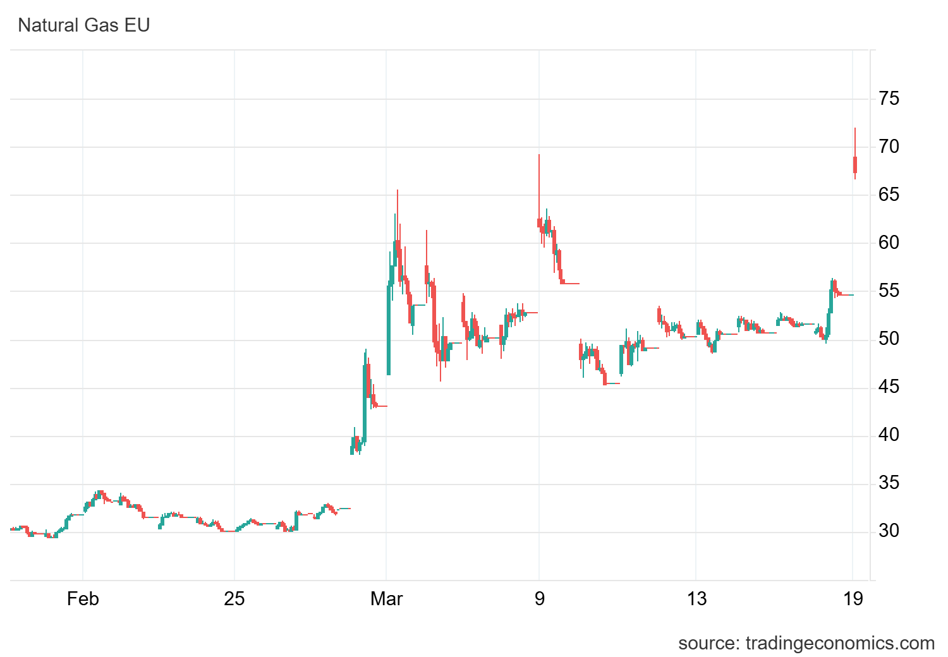
The market reaction was immediate. Brent crude oil prices rose by over 6.5%, exceeding USD 114 per barrel. Gas contracts at TTF's European hub jumped by around 30% on Thursdayfrom approximately EUR 55 per MWh to over EUR 71 per MWh.
US President Donald Trump issued a “strong warning” threatening Iran to “mass blow up the entire South Pars Field”if attacks on Qatari infrastructure continue, but importantly, he noted in his entry on the Truth Social platform that it was Israel that carried out attacks on the southern South Pars gas field on its own, without the knowledge of the US.
“ISRAEL WILL NOT PERFORM ANY MORE ATTACKS related to this extremely important and valuable field,” the US president added.
Recent events again had a strong impact on financial markets. During the Asian session, the Japanese Nikkei 225 fell by 3.57 percent, the Koden KOSI fell by 2.73 percent. The Chinese China A50 from mainland stock exchanges fell by 0.92%, but Hang Seng from Hong Kong lost over 2%. The Indian Nifty 50 lost 2.3%. Futures on European indices lost over 1.5%.. Contract quotations for American indices remained at neutral levels.
Escalation comes at the moment of key monetary decisions. The European Central Bank, the Bank of England and the central banks of Sweden and Switzerland are scheduled to announce their interest rate decisions on Thursday. On Wednesday, the US Fed announced no change in rates. The Bank of Japan kept rates at 0.75 percent on Thursday, although this one, unlike the other large central banks in the world (apart from the Reserve Bank of Australia), is in a cycle of increases. In any case, policymakers took a wait-and-see approach, analyzing how the war and soaring energy prices would affect inflation and economic growth.