Szymon Majewski, Business Insider Polska: President Karol Nawrocki yesterday officially supported the liquidation of the ETS system. Meanwhile, according to the presidential bill from last autumn, the revenues from this system were to finance the reduction of electricity bills. One doesn't conflict with the other?
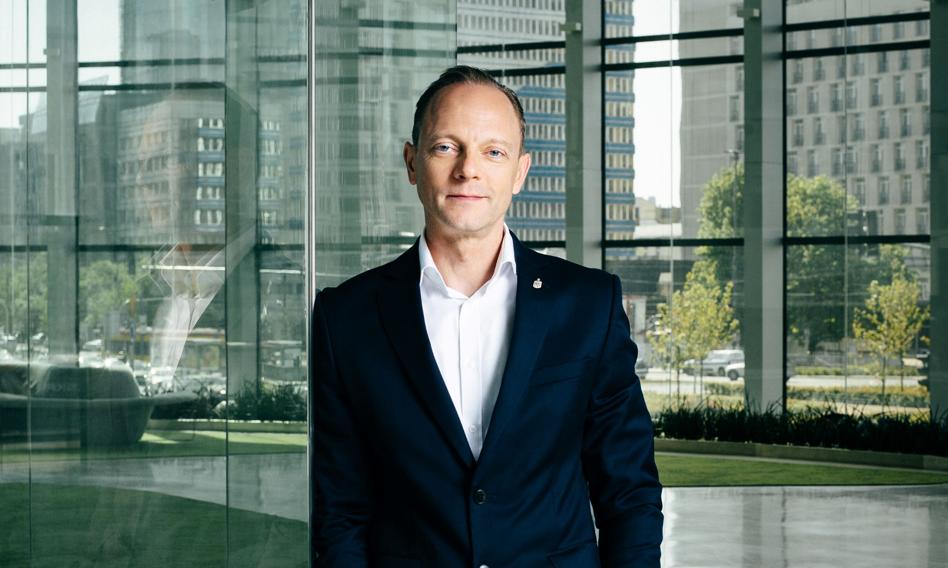
Wanda Buk, social advisor to President Karol Nawrocki on energy, partner at the Business Law House law firm and energy expert at the Sobieski Institute:
It's very simple – if the ETS can be abolished, energy prices will fall and the target will be to reduce bills by approximately 30%. de facto will be achieved. There are several ways to achieve lower prices. In the fall, the president proposed a solution that takes into account the functioning of the ECJ. Its liquidation also means lower electricity bills.
The rest of the article is below the video:
Read also: Letter from Karol Nawrocki to the Prime Minister regarding the ECJ. We have the full content
The ETS affects energy prices themselves, but how would its liquidation reduce system and network fees, which were to be suspended according to the president's proposal?
First of all, there would be a significant and noticeable reduction in the price of active energy. Today, people pay both for additional fees and for the ETS, which – if it is to work – should finance these fees. If the ETS disappears, our bills will no longer be double charged. Of course, the remaining demands of the draft act remain valid, namely limiting excess margins of distribution network operators. What distribution tariffs look like today sounds like a scandal, and operators take advantage of their position as natural monopolists. Recently, a report by the European Council of Energy Regulators (CEER), an agency of the EU energy market regulators, was published, in which it was written that distribution companies in Poland record the highest growth of invested capital in the entire EU. Regardless of the ETS, this must be stopped because it is simply milking customers.
Is the proposal to eliminate the ECJ realistic at all? More and more EU member states agree that it needs to be reformed, but the president's idea goes much further. Wouldn't Poland be alone with such a proposal?
I am afraid that in the EU there is not yet such widespread awareness of how harmful the ETS system is today – despite the known facts. Yesterday, at a conference at the Presidential Palace, I cited data from Draghi's report. I didn't set them myself – the document, which caused a shock throughout the EU, states like a bull that high energy prices hurt our competitiveness. The first step to change is realizing there is a problem, and when Draghi published his report, I was sure that this was where we were headed. However, the EU elites have not yet come to their senses, and there is a deep belief in Brussels that the existing policies may not have yet brought the expected results, but in principle they are good. I think this is self-deception.
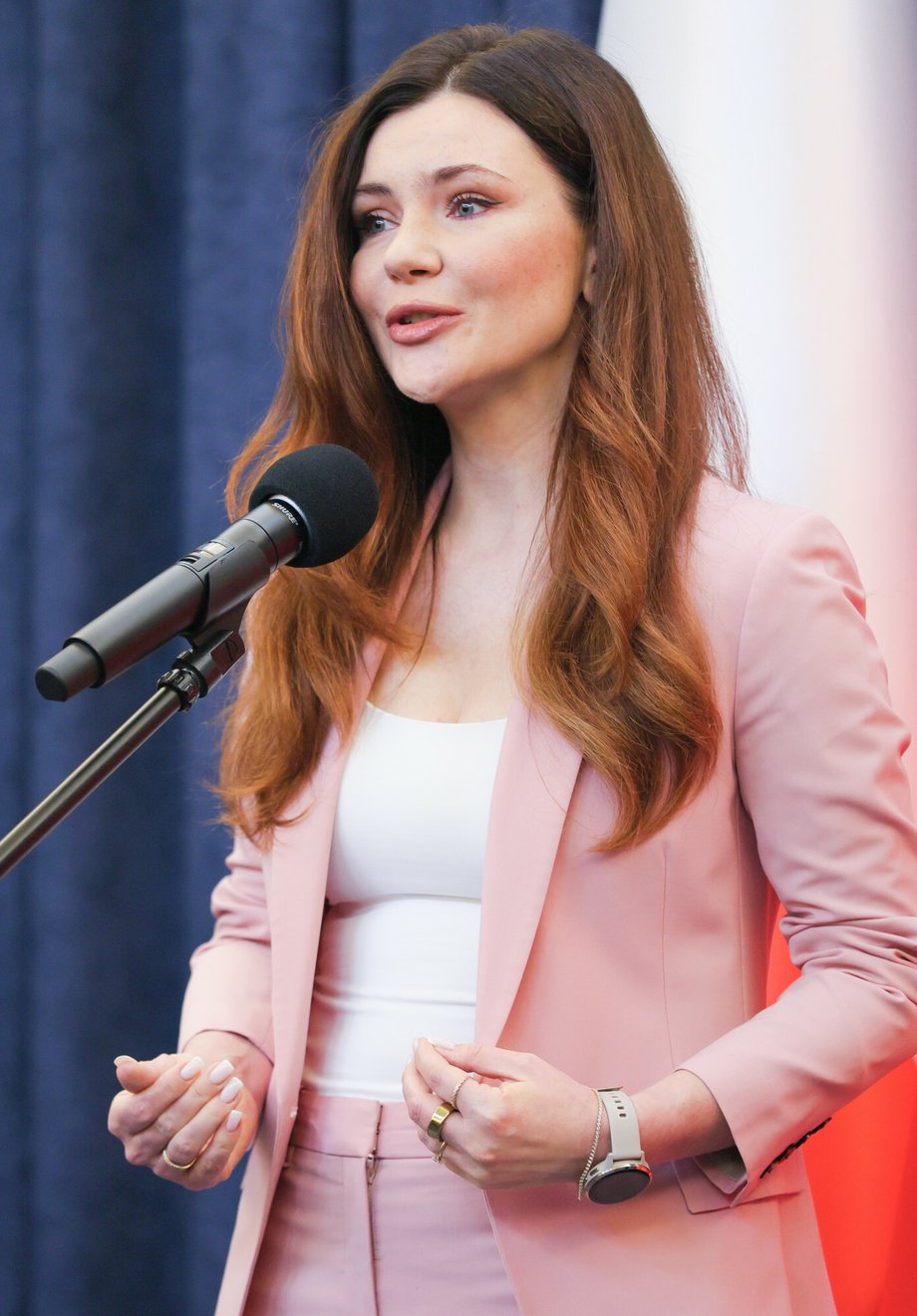
Wanda Buk at the press conference of the Chancellery of the President of the Republic of Poland regarding the ETS system, March 17
|
Dawid Wolski/East News / East News
Do you think Poland would be able to look for allies who would support such a radical demand?
It would be very difficult and the Presidential Palace is also aware of this. Therefore, the president proposed alternative solutions that would improve the situation of the Polish and other EU economies even without meeting the main goal. A deep reform of the ETS really needs to happen, although I am afraid that after today's European Council it may end up only as a correction in the area of maintaining free allowances for industry. The effect will be that we will not throw our European production into the abyss tomorrow, but we will allow it to descend to it a little slower. However, international discussions around the ECJ give hope for more serious changes.
What is the substitute fee proposed by the president, which entities covered by the ETS would pay instead of acquiring rights?
This is a proposal that addresses several problems. Not much is said about it, but Polish entrepreneurs are net payers in the ETS system. The funds they spend on entitlements exceed subsequent budget revenues by approximately 20-25 percent. This is money that flows into the budgets of other countries because – to put it simply – there are no longer enough allowances from the pool allocated to Poland and business has to buy them in other parts of the market.
Paying the substitute fee into the budget would ensure that the funds of Polish entrepreneurs actually go to the Polish budget and not to other countries. The second, perhaps even more important, issue is that the fee would affect the exchange prices of allowances. When a business could choose between the market price and the substitute fee, the market would naturally follow the substitute fee. It would be obvious that no one will buy a more expensive allowance if they have an alternative solution. A similar mechanism already works today in the case of the so-called white certificates, i.e. energy efficiency certificates. Energy producers and sellers are obliged to purchase them, but they can also charge a substitute fee. When developing today's proposals, we were inspired by this solution.
Read also: The discussion about the ETS had an impact on the stock exchange. “The reaction was quite surprising”
The president also calls for maintaining the prices of allowances at the level of EUR 10 per tonne. Will the system still make sense then? Its essence is to maintain cost incentives at a level that will encourage business to reduce its emissions. There have been no such prices in the ETS for approximately eight years.
Let us better consider to what extent the original logic of the ECJ is justified at all. The system is designed to punish those who emit, rather than reward those who make some transformative effort. The European Union has made huge investments over the last two decades in the name of reducing emissions, and the ETS has been a tool to implement this agenda. However, the effect was not to build a low-emission and strong European economy but to limit the production of European industry. In the world, production is increasing, but in our country it is decreasing. Over the last 20 years, global carbon dioxide emissions have also increased 4-5 times more than the EU has managed to reduce them. So you have to ask yourself what sense there is in maintaining this system. We are returning here to the president's original demand – it must be abolished.
You ask about the level of EUR 10 – the average price of allowances in the Chinese equivalent of the ETS is EUR 8-10. On most days, costs there are up to 10 times lower than in the EU. In the California system they are lower by half. So why should Europe condemn itself to greater burdens when its emissions amount to approximately 4 billion tons of CO2 per year, and China's – 12 billion tons?
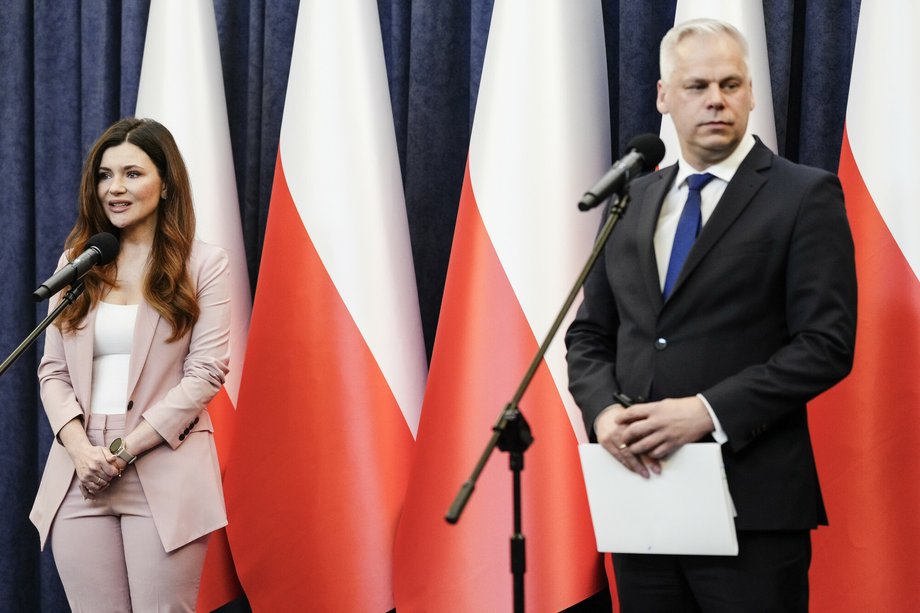
Wanda Buk and Undersecretary of State in the Chancellery of the President of the Republic of Poland Karol Rabenda at a press conference on the ETS system, March 17
|
Marysia Zawada/REPORTER / East News
What could be more rewarding instruments to support green technologies and reduce fossil fuels, which – apart from climate protection – are risky due to their dependence on unstable supplies and geopolitical shocks? The current war in the Middle East shows this.
Renewable energy sources in the EU already enjoy extremely high regulatory and systemic support. I don't think we need this support any more. The renewable energy industry has really favorable development conditions.
The government also supports changes to the ECJ. Minister of Climate and Environment Paulina Hennig-Kloska supports, among others, increasing the number of free allowances for industry and greater support for heating. So maybe the political consensus on the ECJ between the two centers of power – the government and the president – is greater than it seems at first glance?
I am not convinced that, for example, the Ministry of Climate shares our belief that the ETS is harmful. I hear from Deputy Minister Urszula Zielińska that it is a very good system. The president's message is clear – the ECJ is best abolished, or at least thoroughly changed.
If the ECJ fails to be abolished, do you think an acceptable option is for Poland to try to suspend it unilaterally? How to do it without Polexit at the same time?
From a formal legal perspective, the suspension of the system would mean repealing the Emissions Trading Act, which implemented the ETS directive. The European Commission would then launch infringement proceedings. Such proceedings for non-implementation or incorrect implementation of EU regulations are carried out every year against virtually all Member States. As the case is very political, it would probably be dealt with very quickly by the Court of Justice of the European Union. I assume that a decision would be made very quickly on the fines that Poland would have to pay, as in the case of the Turów mine dispute. In my opinion, this is the most possible scenario of events after the theoretical unilateral suspension of the ECJ.
The EU needs a leader who will dare to put the ECJ case on a knife's edge. We are talking about a hypothetical situation at the moment; we do not know whether the Polish Parliament would decide to repeal this law. I believe that if this actually happened, and then the entire proceedings took place before the Court, it is very possible that other countries that also have problems with the ECJ would follow Poland. Why has this topic become so loud in the EU only recently? For a very simple reason. In recent years, the ETS has been a problem primarily for member states with emission-intensive energy, primarily Poland, but also, for example, the Czech Republic. Now, however, we are entering the stage of withdrawing free allowances for industry, which is starting to hurt Germany and France much more, which has not been hurt by the ETS so far because it was based on zero-emission nuclear energy.
It is clear today that if something is a problem only for Poland, the EU does not have to worry about it, but it is a different matter when it becomes a problem for Germany.