Time is on Iran's side. Expert: They may intensify cyberattacks

Blick: Donald Trump declared that he would “completely destroy the regime.” Is it real?
Iran has specialized in strategic niches. An example is the network of regional groups proxythe so-called axis of resistance, which includes, among others, Hamas, Hezbollah, Shiite militias in Iraq and the Houthis. This also includes programs to develop missile and drone technology and uranium enrichment.
What is the situation with missiles and drones?
It is difficult to clearly assess this. Various sources estimate that at the beginning of the war, Iran had approximately 2,000 medium- and long-range missiles capable of reaching Israel and approximately 4,000-8,000 short-range missiles that could hit the Persian Gulf countries. Israel and the US also bombed missile launchers, which likely resulted in a decline in the number of rocket attacks.
What about economic pressures?
Attacks on Iran's oil and gas infrastructure could put economic pressure on the regime, but could also hit the population hard. The same applies to attacks on seawater desalination plants. Disruptions to water and energy supplies can be expected, which could lead to serious damage in the long term and threaten the stability of the new government if the US and Israel overthrow the current regime.
“Time is on Iran's side”
The regime threatens to launch attacks on “new fronts.” What fronts are we talking about?
On Thursday, Italian and French troops in Iraq were attacked by Shiite militias. Iran may expand its target list to include new countries and additional civilian or strategic facilities, such as water desalination plants – one has already been hit in Bahrain. Mining the Strait of Hormuz or blocking the Strait of Bab al-Mandab by the Houthis would also be an escalation. In addition, the Iranians may intensify cyber attacks and activate the so-called sleeper cells to carry out terrorist attacks in the region and beyond.
How long can this conflict last?
This is impossible to predict, but the longer it continues, the more Iran will be perceived as the winner and the greater the pressure will be on the US to end the war. It could be said that time is currently on Iran's side. Although Iran no longer has the capacity to launch massive attacks on Israel, its potential is still sufficient to destabilize the region in the long term. Preventing this without the use of ground troops currently seems impossible.
“The Accumulation of Crises”
Can the conflict spread to the entire region?
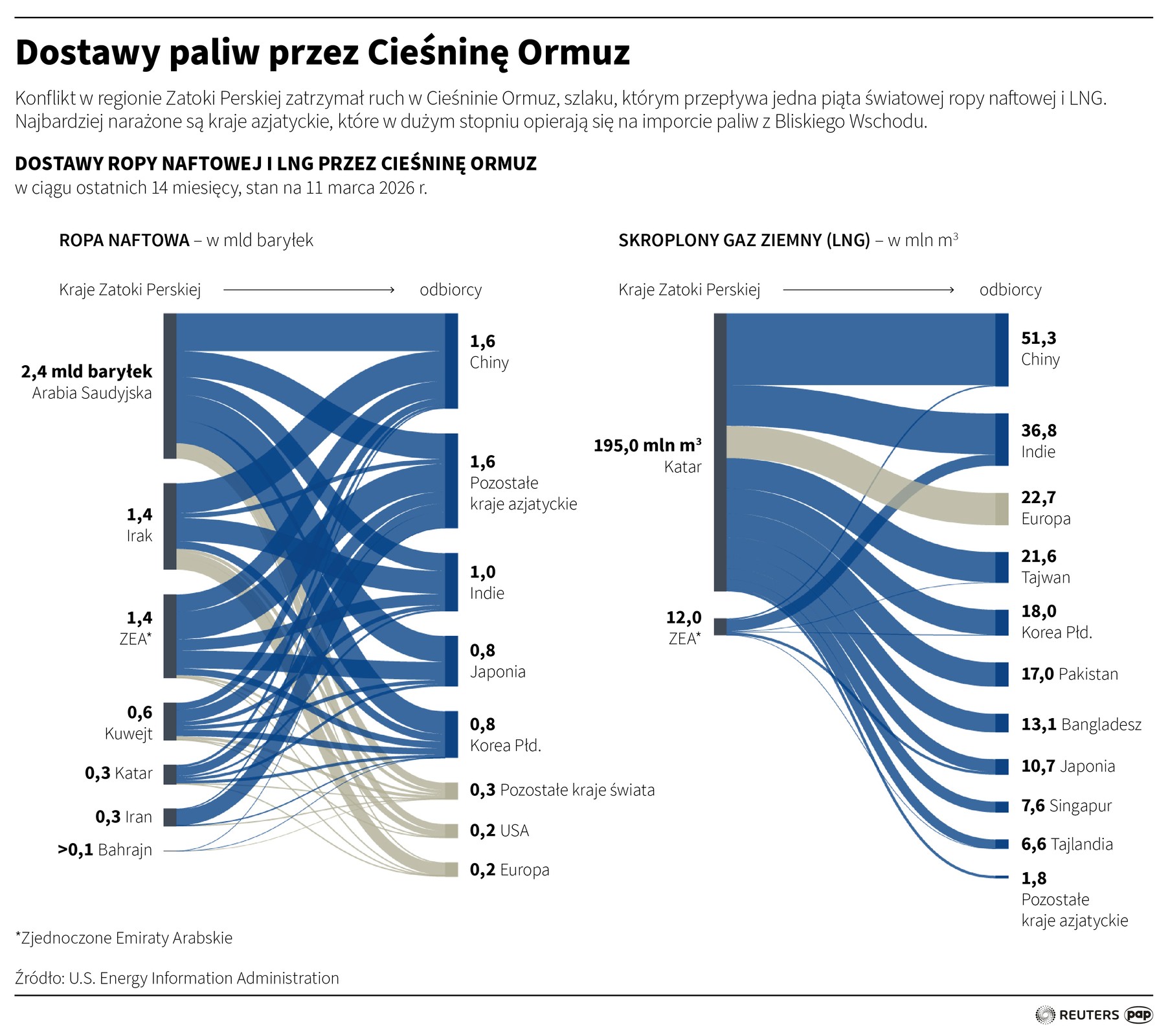
Fuel supplies through the Strait of HormuzPAP
How do you, as an expert, assess the global development of the situation?