A plant with beneficial effects has been growing around Dacian fortresses since ancient times. In the spring, the forests of Sarmizegetusa Regia are covered with carpets of leurde, the most distinctive sign of the season.
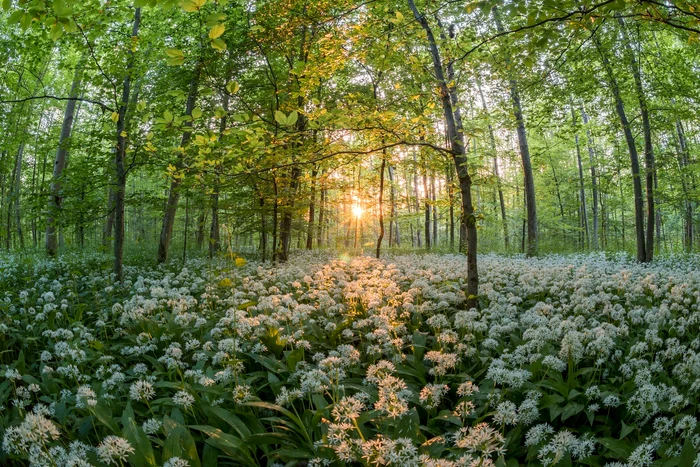
Wild garlic, leurde. Photo: Jonathan Sautter. Pixabay
One of the oldest medicinal plants known in Europe grows undisturbed in the forests that cover the Dacian fortresses of the Șureanu Mountains and is surrounded by mysteries.
Leurda (Allium ursinum) has been used for centuries in Romanian folk medicine, and some scientists have attributed its name to Dacian origins. Others have noted the use of a similar name in the Albanian language as well.
Why was it called bear's garlic?
In local tradition, leurda is also called “bear's garlic”, “wild garlic” or “garlic”. Legend has it that its name comes from the habit of bears to eat wild garlic to remove toxins from the body and regain strength after a long period of hibernation. The ancient Greeks would have called it “bears' onion” because of this, a name that has stood the test of time.
The ancient Romans would have called it herba salutaris, “healing plant,” and the medicinal uses of wild garlic were recorded by the physician Pedanios Dioscorides (ca. AD 40–90), who considered it a detoxifier. Some locals believe that this plant has been growing in the land of Dacian fortresses in the Șureanu Mountains since the time of the Dacians.
“Usturoița, or leurda, prefers shady deciduous forests, rich in humus and moisture, where they often form compact carpets. It is found in lowland forests around the Capital (Pustnicul, Ciolpani, Snagov, etc.), in Dobrogea (Niculițel, Mănăstirea Cocoș), in the hilly wooded area around Târgoviște, Câmpina, in Gurghiu, Roșia Montană, Abrud, in the surroundings of Iași — in the Hermeu forest — reaching the mountain area up to 1,200 meters high. It is also common in the surroundings of Sinaia, in the Anina and Maramureș mountains, as well as in many other places in the country.” informs Dr. Ovidiu Bojor (1924–2023), honorary member of the Academy of Medical Sciences.
According to the phytotherapist, both the bulbs and the leaves can be eaten by hikers in salads, for their spicy taste and for the intake of vitamin C needed by the body in the spring. In addition, garlic contains antibiotic substances, destroying pathogenic flora in the digestive tract. The plant has diuretic and slightly hypotensive action.
The healing plants of the Dacians
Along with leurde, the healing power of many medicinal plants has been known since ancient times in Romania, scientists show.
One of the most precious works from Antiquity about plants with therapeutic properties is the treatise “De Materia Medica”, left to posterity in the 1st century AD. by the Romanian military doctor Pedanios Dioscorides. He inventoried nearly 200 medicinal plants, along with the names by which they were known, their properties and how they were used.
According to the Romanian historian Ion Horațiu Crișan, known for his research on the Dacian civilization, among the plants recorded by the ancient physician Pedanios Dioscorides, linguists considered 21 names to be of Dacian origin.
These are: aniarsexe (sorrel), boudathla (ox tongue), cinouboila (motter), coadama or coalama (water plantain), coicolid or coicodila (duckweed), dielleina (butterfly), diesema (candlestick), doctila or dochela (field frankincense), duodela or diodela (mousetail), dyn (nettle), guoleta (beads), mendruta (lily), mizela (thyme), priadila (curpen), propodila or procedila (five-fingers), riborasta (burdock), salia (plague), sciare (scaly), stirsozila (earthworm), tendila or teidila (mint) and usazila (dog's tongue).
Some of these plants also grow in the Carpathian Mountains and have been used since ancient times for therapeutic purposes. Among the most famous is the nettle, which the doctor called Acalyphe.
“Dioscorides says that the leaves of this plant, in the form of poultices, cure dog bites and gangrenous or carcinomatous ulcerations. The weed is good for dislocations, swellings, parotiditis, axillary tumors, abscesses. It is applied with wax to those suffering from the spleen.” wrote archaeologist Ion Horațiu Crișan, author of the volume Medicine in Dacia.
Another common plant, with beneficial properties known since the time of the Dacians, is isma. The doctor mentioned it by the name Tendila or Teidila (Mentha piperita L., Izmă, Izmă buone, Gingiurnă, Mintă).
“Dioscorides believes that the plant, drunk and applied as a poultice, is useful to those bitten by snakes”informs the historian Ion Horațiu Crișan.
Dandelion, the unmistakable yellow flower, was called the “queen of herbs” in Romanian tradition, being a completely usable healing plant – leaves, flowers, stems and roots.
In the old traditions of the Romanians, the dandelion was also used in charms, for love, luck and health.