
How Iran managed to strike where the Americans seemed invincible. The inconvenient truth for Trump: “This shows misjudgment”

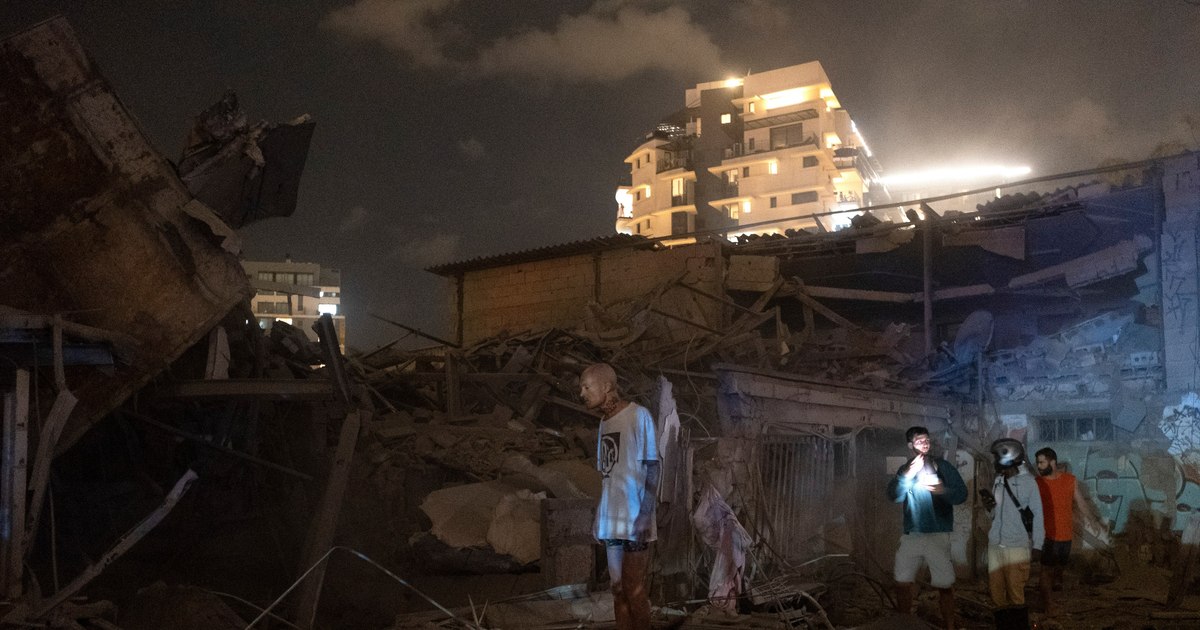
The US-Israeli military operation in Iran is facing a tough response, far beyond expectations, and the Iranians have managed to surprisingly strike US bases and targets in several countries. Experts interviewed by “The Truth” explain these uncomfortable realities.
Iranian missiles also hit Tel Aviv. PHOTO: Profimedia
The conflict in the Middle East that led to the special military operation by the US and Israel against Iran degenerated, as Iran retaliated and hit targets in 14 countries. The missiles and drones of the totalitarian regime in Tehran have penetrated the defensive systems of these countries, most of them even of American and European origin. They caused damage and casualties among Americans and more.
According to The New York Times, the inconvenient truth for the Trump administration, visible to careful and unregimented observers, is that Iran's operational capacity, but also the actual costs, have been greatly underestimated. Basically, the Americans made the same mistake the Russians made in February 2022, when they expected to march on Kiev in no more than a week, but reality proved them wrong.
“Truth” tried to find out how it was possible for the Pentagon experts to be wrong to such an extent, thus endangering the lives of the American military, but also the allies of the United States in the Middle East. A well-known intelligence general and a well-known international political analyst have their own answers to this complicated problem.
Allied defensive wall, passed by Iranian missiles
General (r) Adriean Pârlog, former deputy of the Military Intelligence Directorate in Romania, tries to come up with answers from the perspective of the military analyst. From the start, the general admits that the success rate of Iranian strikes is far beyond expectations, which can only come as an unpleasant surprise for the Americans and Israelis. However, there were signs of this as far back as the previous attack in 2025.
“The fact that Iran has continued to demonstrate its effectiveness in the area of this nuclear technology, I believe, was the main reason why Israel, in the first instance, and the US, in the second instance, decided on this approach to forcefully cutting off the Iranian nuclear file. It remains to be seen what Iran's real potential is from here on out. So far they have demonstrated something that I hardly believed. first, the 2025 operation, from the perspective of the effectiveness of the Iranian air strikes, was a relatively successful one in that they managed to penetrate at least four layers of Israeli air defenses. The Arrow 2-3 system was never so obviously penetrated until 2025. Whether success or failure, please, remains to be seen insufficiency of air defense in the event of a missile attack is relatively acceptable in military theory, but a coefficient in the range of 30% to 40% presents us with a rather unexpectedly high level. These 30-40% defense ineffectiveness rates can very easily, by reverse logic, be considered success rates for Iran“, says the general.
Iran followed a well-laid plan
Precisely starting from this reality, which has been kept silent for a long time, Iran has now hit even harder the states allied to the US in the Middle East, but also the American bases hosted by them.
“If that happened last year, now the fact that Iran has been able to afford to specifically hit US military bases located on the territory of states in the Middle East and by extension going to one of the main supporters of the hard policy of the United States, and I mean Great Britain, with their military bases in Cyprus, is clear evidence that, at least in this space, their medium-range missiles, since the previous local war-type event, the 12-day war, until February 28, 2026, Iran continued to accumulate equipment that they kept in their offensive stockpile for situations like these, where the retaliation was going to be imperious.“, says the general.
General (r) Adriean Pârlog's conclusion is that Iran had a tough response, beyond any expectations. And Iranian attacks on countries like the United Arab Emirates, Saudi Arabia and Kuwait have shown that some of these states are much more vulnerable than expected. Incidentally, the AA defense of the United States (Anti-Air/Anti-Air and Anti-Missile) is known to be undergoing restructuring according to the new defense strategy of 2025-2026. This puts a massive emphasis on Homeland Defense and deterring China, while support for allies, especially European ones, becomes more limited and critical.
“It appears that Iran has had enough strike capabilities beyond many expectations. And it also appears that the American and Israeli anti-missile munitions stockpile is not as inexhaustible as everyone says. Donald Trump has made comments on his personal social media accounts about the US's AA defense potential. But there have been enough strikes that have affected American military bases. This is a far from optimal assessment of what has been done in terms of strategic decisions bringing more strategic comfort to the US and Israel. So, these are obvious things to everyone. If not what, in an obvious propagandistic way, Tehran keeps throwing in the information space, only from here on will their responses show their true potential“, adds the general.
A bad political decision
Starting from the analysis of the American press, which clearly showed that the American administration was warned about the risks of an attack on Iran, Ștefan Popescu looks at the data of the problem from the perspective of the political analyst. He believes that Trump made a mistake when he ordered the attack, ignoring the warnings he received.
“It is certainly a bad political decision. And it is bad against the advice of the military, despite the advice of the CIA. There is an irrational component to the foreign policy decision that has led to an unfortunate outcome for the United States of America. And the consequences will be seen in the weakening of the authority of the United States in the region. America has not looked good. It has looked like a great power that has shown serious limits in protecting its own bases, infrastructures that have been largely destroyed. A great power that has failed to secure the protection of their partners in the region. The United Arab Emirates, Saudi Arabia, countries that are already announcing that they are reviewing their investment policy towards the United States. These limits are undoubtedly being observed by the United States' allies in the Indo-Pacific.”says Stefan Popescu.
The European allies of the United States were also not happy that the Americans attacked without warning. Ukraine, for example, is a collateral victim, in a way, explains Ștefan Popescu.
“Not to mention the fact that this intervention caused a crisis, accentuated the economic crisis, we could say, of Europe. It degraded its competitiveness, its ability to intervene, to support Ukraine in a file that was a priority for European security. And this is covered by the American intervention and the obligation of the European states with a systemic role in supporting Ukraine – France in particular, Germany less, Great Britain, please, it is not in the European Union, but it plays an important role in supporting Ukraine – forcing them to offset the limits of the American device in the Middle East”explains Popescu.
Russia and China are the big winners
The bad news is that Russia and China are, at least for now, the big winners.
“The big winners are precisely Russia and China, in the present case. There is no doubt that it is so, because the effect in the region will not be the strengthening of the Abraham Accords, which were an extraordinary result of the first term of Donald Trump. Unfortunately, there will be a relaxation, because these countries, noticing the vulnerability of their industrial assets (no – assets), will seek to diversify their partnerships, and, first of all, this diversification will be achieved with China and with Russia, with those countries that can mediate in the relationship with an Iran that will stiffen“, says the expert.
The analyst also claims that in Iran power belongs to the military, more precisely the Revolutionary Guards, and less to the clergy.
“Another result is the election of Khamenei's son by the Pasdaran, the real holders of power in Iran – by the way, and the myth that persists in our circles that we are dealing with the 'Republic of the Ayatollahs.' Power is in reality held by the Pasdaran, i.e. the Revolutionary Guards, who also own most of the Iranian economy. This is a signal of the rigidity of the regime, of intransigence“, he says.
Trump recalled that he needs European allies
The European allies of the United States are now forced to make efforts to compensate for American weaknesses and to support their allies in the Middle East. France, for example, mobilized huge resources. The ammunition that will be consumed by the Europeans in these actions in support of their allies could have reached to a large extent in Ukraine, a country that will be widowed in the next period of more consistent support.
“The Europeans had to mobilize important devices in the area. France is taking out eight frigates, two helicopter carriers, a naval aircraft group. It is a very important commitment, because France has partnerships in the region, it has military bases to defend, it also has an infrastructure on the ground, it has 400 thousand citizens, it has 52 ships blocked in the Persian Gulf. France has an important presence, plus the interests it has, the defense agreements with the Arab Emirates United, with Qatar, with Kuwait. Qatar is one of the important customers of the French arms industry, operator of Rafale aircraft. So France has very high stakes in the region”, says Ștefan Popescu.


