Last year a record was recorded at the airports in Romania, but the map remains strongly unbalanced. Where do Romanians fly the most?

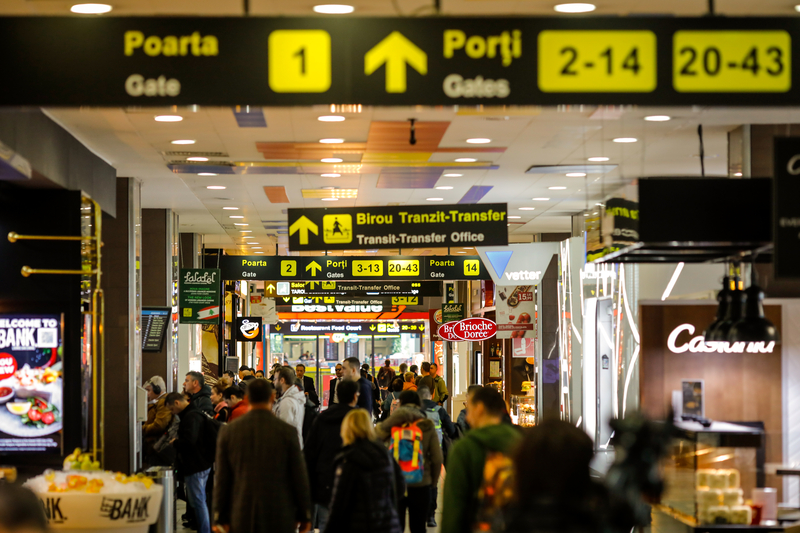
Almost 28.5 million passengers transited Romanian airports in 2025 – an increase of almost 10% compared to the previous year, according to data from the National Institute of Statistics.
The country's 17 airports are all classified as international, but the market remains strikingly concentrated. Henri Coandă from Bucharest handled more than 17 million passengers alone – approximately 60% of the national total.
Avram Iancu Airport in Cluj-Napoca ranked a distant second with 3.5 million, followed by Iasi International Airport with 2.2 million. Beyond any political discourse about regional development, Romania's air network remains anchored in the Capital and a few secondary cities.
International traffic accounts for most of the passenger volume. In 2025, 93% of all boarded passengers flew on cross-border flights, and 7% on domestic flights.
Where do Romanians fly?
Italy dominated the rankings at both origin and destination, with around 2.57 million passengers arriving from Italian airports and an almost identical number departing to them. The UK came in second with 1.82 million, Germany third with 1.62 million and Spain fourth with 1.19 million. These four countries alone accounted for more than half of all international passenger movements.
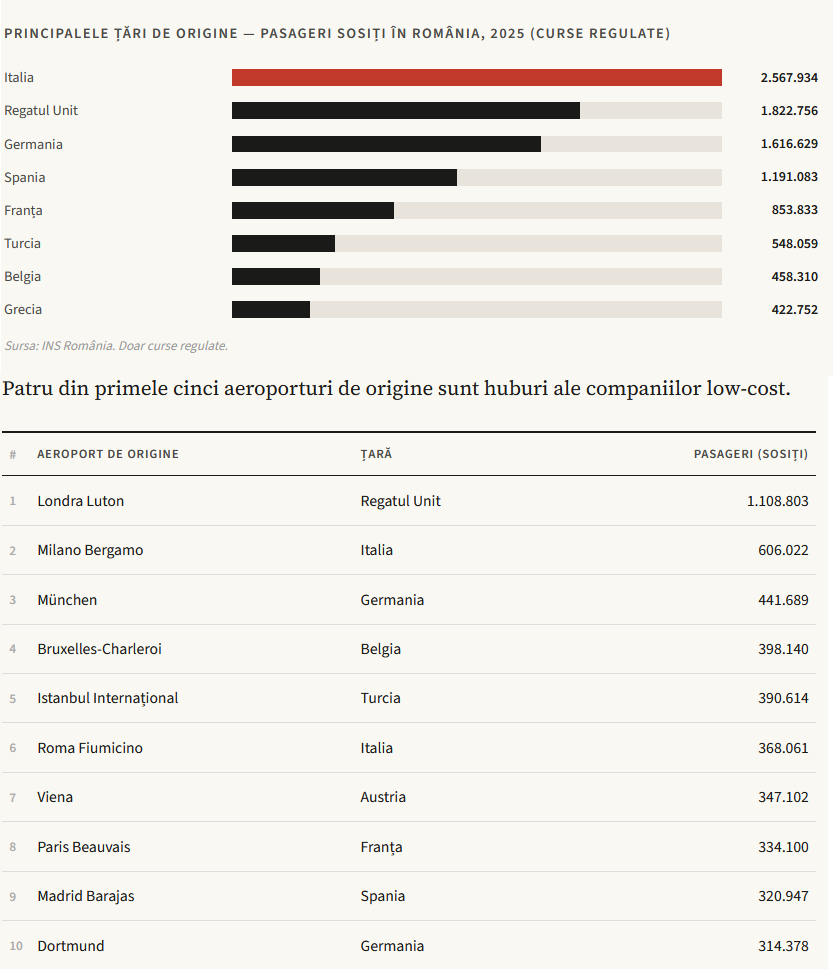
At airport level, London Luton took first place with 1,108,803 passengers arriving and 1,098,656 departing. Milan Bergamo ranked second with 606,022 passenger arrivals, followed by Munich, Brussels-Charleroi and Istanbul International. Three of the top four airports are hubs of low-cost companies.
Merchandise: the less noisy boom
While passengers grab the headlines, air cargo traffic posted an even stronger performance. Total volumes, including mail, reached 57,280 tonnes in 2025, up 10.5% from 51,853 tonnes in 2024. Discharged cargo increased by 18.9% to 36,471 tonnes, while loaded volumes fell slightly to 20,809 tonnes.
Henri Coandă-București Airport also dominated cargo, as it does with passengers, handling 43,915 tons – 76.7% of the national total. Cluj-Napoca and Timișoara shared most of the rest. In domestic cargo, the hierarchy suddenly changes: Cluj-Napoca leads with 47.7% of the total domestic cargo loading, ahead of Timișoara with 32.6% and Bucharest with 19.7%, which shows that Romania's internal logistics network works more on the ground than in the air.
A solid end to the year
The fourth quarter of 2025 saw 7.03 million passengers, up 13.6% from the same period in 2024, the fastest quarterly growth rate of the year. Henri Coandă alone processed 4.1 million passengers in those three months.
Commercial aircraft movements reached 217,517 for the full year, up 10.5% from 196,800 in 2024. Non-commercial movements fell 14.4% to 29,450.
The problem of concentration
The story of Romanian aviation is essentially one of marked geographical concentration. Bucharest, Cluj-Napoca and Iasi bring together the vast majority of passengers. Smaller airports – Sibiu, Suceava, Timișoara, Craiova – have significantly lower volumes. The domestic network remains modest: only 2 million passengers, i.e. 7% of the total traffic, flew between Romanian cities in 2025.
Source: National Institute of Statistics (INS Romania), Airport transport of passengers and goods in 2025, February 2026 edition. All figures refer to commercial services at airports in Romania. The number of passengers includes both boardings and disembarkations; direct transit passengers are excluded. Freight figures are in metric tons including postage.