Hundreds of teenagers report for duty in Croatia. The former Yugoslav republic reinstates compulsory military service

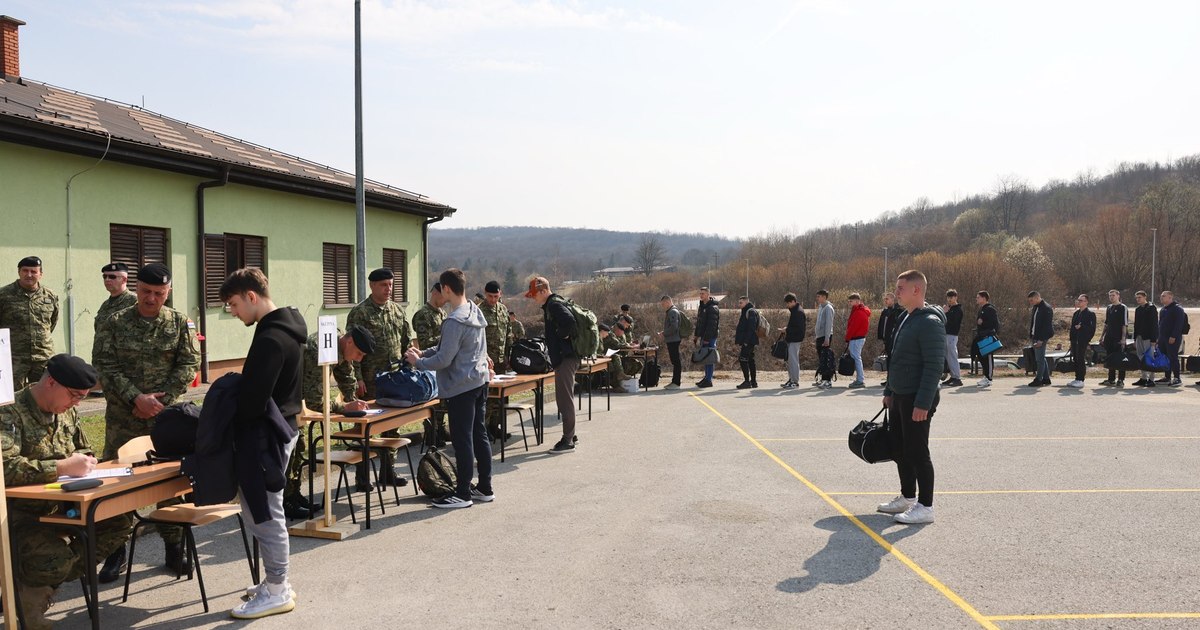
Croatia has taken the first concrete step towards reintroducing compulsory military service after almost two decades of hiatus. Hundreds of young men have been inducted these days, marking the first batch of conscripts called up to arms since the requirement was suspended in 2008.
Young Croatians presented themselves at the incorporation/PHOTO:X
Approximately 800 young people have presented themselves at military training centers in three locations in Croatia, where they will undergo an intensive training program for two months. Recruits were assigned to barracks near their home towns, where they received military equipment and were accommodated in unit dormitories.
For young people, the experience marks a sudden change of pace. “They were practically removed from the civilian environment,” said Chief of Staff of the Croatian Armed Forces, General Tihomir Kundid.
However, the military official tried to allay the parents' fears, stressing that the recruits' adaptation to military discipline will be done gradually.
“We'll get them used to it step by step so they don't experience too much stress”the general explained.
For many of the recruits there is also good news: the use of mobile phones is not completely prohibited. The only restriction concerns their use during the training program.
Croatian authorities said that more than half of the 800 recruits in the first batch did not wait for the official order to enlist, choosing instead to volunteer for military service. About 10% of those enlisted are women, who are not legally required to do military service.
Croatian officials were keen to point out that so far only 10 people have registered as conscientious objectors. They will have to perform four months of civilian service, receiving less than half of the 1,100 euro (£953; $1,273) monthly allowance given to military conscripts.
The training program will be “dynamic and interesting”
According to General Kundid, the training program will be “dynamic and exciting”. Recruits will learn both classic military skills and modern skills such as basic drone operation, methods of protection against drones and elements of cyber warfare.
Croatia's decision to reintroduce compulsory military service was largely influenced by the war in Ukraine and the deteriorating security environment in Europe.
Croatian Defense Minister Ivan Anušić explained that the situation in the region has changed radically in recent years.
“For a long time, the security environment in Croatia and its neighborhood was stable. Today, the reality is completely different“, said the official.
According to him, not only Russia's aggression against Ukraine is a cause for concern, but also the activity of networks and actors influenced by Moscow in several European states.
Croatia's initiative could be followed by other states in the region
In Slovenia, the largest opposition party proposed, in the context of the parliamentary elections, the return to compulsory military service.
At the same time, Serbian President Aleksandar Vučić announced that the army would reintroduce conscription over the next 12 months, alongside a significant increase in the defense budget.
These developments, however, have raised concerns in Kosovo and Bosnia and Herzegovina. For its part, Serbia criticized the new military cooperation between Croatia, Kosovo and Albania.
Analyst James Ker-Lindsay, who specializes in Balkan issues, warns that such moves risk fueling regional tensions.
“Any military development in the Balkans makes the region less secure, because each state interprets it as being directed against itself”he explained.
For now, however, Croatia's plan is moving forward. Authorities in Zagreb plan to hold three more recruitment rounds by the end of this year, with the aim of training around 4,000 recruits annually.
Croatia thus joins a group of ten NATO member states that have returned to compulsory military service, including Greece, Turkey, the Nordic countries and the Baltic states.