Airbnb-type apartments have surpassed agritourism guesthouses in Romania. Other trends in tourism

Figures from the National Institute of Statistics show that rental flats hold 14% of the country's accommodation capacity, but capture less than their size would suggest. Meanwhile, foreign tourists discover Romania and prefer hotels.
In 2025, Romania registered a total accommodation capacity of 99.7 million place-days.
Hotels dominate overwhelmingly, with 51.1 million (51.2%), but the surprise comes right after: apartments and rooms for rent, the domestic equivalent of Airbnb-type platforms, come in second place with 14.4 million place-days (14.4%), surpassing agro-tourism guesthouses (13.7%) and tourist guesthouses (8.4%).
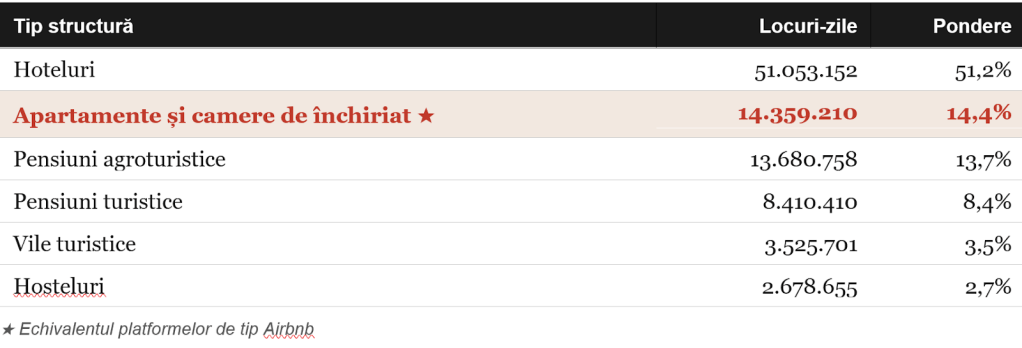
This substantial share tells a story about the profound transformation of the Romanian accommodation offer in the last decade. Individual owners renting out their apartments through digital platforms now represent a market force of 14 million potential nights per year.
What is a «place-day» and why it matters
Before reading any tourism statistics, it is worth understanding the unit in which accommodation capacity is measured: the place-day.
If a hotel has 100 rooms available for 365 days a year, its annual capacity is 36,500 place-days. Think of it as an accommodation potential: the theoretical maximum number of nights an operator could sell if all beds were permanently occupied.
This unit solves an important statistical problem: how do you compare a hotel open only in the summer with a business hotel active all year round? Through place-days, each structure is weighted not only by the number of beds, but also by the duration during which they are available. A 50-site campsite, open only 90 days a summer, has a capacity of 4,500 site-days, which is less than a modest year-round guesthouse.
Geographic concentration: the coast, the mountains and the capital
The geographical distribution of apartments for rent is revealing. Constanța County dominates with 2.25 million place-days. It is the area where the owners of Mamaia and Eforie have turned their holiday homes into accommodation units. In second place is Brașov (1.95 million), followed by Bucharest (1.13 million) and Cluj (1.06 million).
This geography follows the logic of demand: summer seaside, mountain resorts, and university/corporate centers.
What is missing is a significant presence in the Danube Delta — a paradox, given the ecotourism potential of the area — and in Moldova, where agritourism guesthouses dominate instead of apartments.
Tourists who choose apartments: a portrait
The 14.4 million available place-days generated 1.59 million arrivals and 3.39 million overnight stays, implying an average length of stay of about 2.1 nights — shorter than the overall average, but consistent with the specific use: city breaks, weekend vacations, informal business trips.
The structure of customers is overwhelmingly dominated by Romanian tourists (85.3%), a higher proportion than in the case of hotels, where the international presence is more balanced. Foreign tourists visiting Romania still seem to prefer traditional hotels, perhaps for reasons of predictability and clear standards.
The problem of use: high capacity, low efficiency
The most important figure in the report is perhaps the most discreet: the net utilization index of accommodation capacity in operation was, in 2025, 29.8% for all structures. Translated in terms of place-days: out of every 100 nights theoretically available, only 30 were actually sold.
Hotels perform significantly better, with an index of 39.6%, while hostels barely reach 18.8%. There is no disaggregated data for Airbnb-type apartments, but the implicit estimates, relating nights to capacity, suggest a similar or even lower level than the average, precisely because of the seasonal concentration on the coast and the mountains.
This low rate is not necessarily a problem for sole proprietors, whose fixed costs are lower than a hotel. But for a national tourism economy, it indicates a structural overcapacity, too many beds for too few tourists, unevenly distributed in time and space.
2025 versus 2024: a year of contrasts
Compared to 2024, the picture is one of contrasts: the total capacity increased by 2.1%, a sign that investments in accommodation continue, regardless of the dynamics of demand.
But it was precisely the latter that disappointed: the total number of arrivals decreased by 2.4%, with an even more pronounced decline in Romanian tourists (−4.6%).
The only good news comes from outside: foreign tourists increased by +8.5%, a signal that Romania is gradually gaining international visibility.