Higher prices at gas stations are clearly visible, and analysts predict that it will be even more expensive. The reason is the war in Iran, blocking the Strait of Hormuz and sudden increases in oil prices on world stock exchanges. On Friday, the price of a barrel of oil (WTI and Brent) increased by 10 percent, and on Monday it increases by another dozen or so percent. (was close to $120). Therefore, there are demands for the government to intervene in connection with the increases.
Przemysław Czarnek, announced as a candidate for prime minister by PiS over the weekend, proposes a temporary reduction in VAT on fuels (from March 15 to June 30 this year) – from 23 percent. up to 8 percent and a reduction in excise duty by 9-10 percent. We checked whether such government actions make sense and how much they may cost.
Andrzej Domański, Minister of Finance and Economy, did not rule out changes. Experts point out that the increase in fuel prices affects the entire economy. — If fuel prices increase, this also translates into, for example, food prices in stores, because transport costs increase. Temporary tax reductions may therefore limit the negative effects of high fuel prices on the economy – comments Dr. Mateusz Lewandowski from the Warsaw University of Technology and an expert in taxes and excise duty at the KDCP law firm.
Read also: Over 8 million people file their taxes jointly with their spouse. We know what the tax office checks
How much VAT and excise duty constitute the prices of petrol and oil
Taxes and fees in the fuel price structure constitute approximately 50 percent, including excise duty and VAT. According to data from the Polish Organization of Petroleum Industry and Trade (POPIHN – see the box below) at an average price:
— EU95 gasoline, excise duty was 24% and VAT was 19%,
— diesel excise tax was 18%. prices, and VAT 19%.
The organization's data refer to 2024 (there are no newer ones). Currently, according to data from Reflex, the situation is almost identical.
Theoretically, there is room for tax reductions. Especially since it would not be a precedent, because in 2022 the government of Mateusz Morawiecki introduced the so-called anti-inflation shield, and therefore reduced VAT, among others for fuels – from 23 percent up to 8 percent
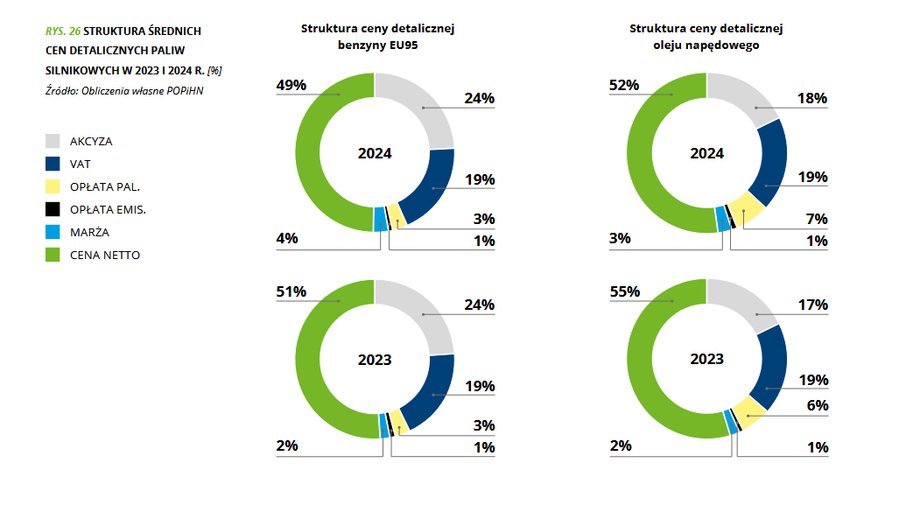
What taxes are included in the price of fuel
Is it possible to reduce excise duty and VAT on fuel?
Currently, excise tax rates from January 1, 2026 are:
— PLN 1,529 for 1,000 liters of EU95 i gasoline
— PLN 1,160 per 1,000 liters of fuel.
— Currently, we have room to reduce fuel excise duty, especially if it will only be for a certain period of time. This is not the only levy on fuels. We also have, for example, fuel fees and VAT. Reducing taxes may, of course, influence the stabilization of prices at gas stations – says Mateusz Lewandowski. The expert also points out that Ministry of Finance from many years shapes prices of excise goods. For example, it increases excise tax rates on cigarettes and alcohol to make their prices higher and less accessible to consumers. — You can do the same with fuels, only in the opposite direction. The reduction in excise duty and VAT should therefore contribute to the stabilization or reduction of prices, explains Mateusz Lewandowski.
— However, excise duty on fuel can be reduced minimally – emphasizes Szymon Parulski, tax advisor and partner at Parulski i Wspólnicy. The expert explains that the small possibility of movement results from the fact that the minimum excise duty rates are imposed on us by the Energy Directive.
Whereas when it comes to VAT, you can always lower the rate. — However, this means costs for all of us, as it results in a decline in revenues state budget – says Szymon Parulski. Of course, rising fuel prices provide a buffer here. The budget receives more VAT at a price of PLN 7 per liter than at a price of PLN 6 per liter of fuel. If the government decides to reduce the rate from 23%. up to 8 percent Due to higher prices, the change is slightly less noticeable for the state budget.
What may be the effects of reducing fuel taxes?
Reducing VAT and excise duty on fuel would mean a decline in state budget revenues.
— Excise tax revenues currently amount to approximately PLN 90 billion, most of which comes from taxation of the so-called energy products, including: fuels – points out Mateusz Lewandowski. Reducing the excise tax itself would mean lower revenues of the order of billions of zlotys.
This was also the case with the anti-inflation shield, which operated from February to the end of 2022. The shield was a costly expense for the state budget. — Each month of its operation meant PLN 2.5 billion less in budget revenues, i.e. in total in 2022 – PLN 30 billion less – said Artur Soboń, then deputy minister of finance. Let us emphasize, however, that the shield included not only a reduction in the VAT rate on fuels (it dropped from 23% to 8%), but also on food (it dropped to 0%), electricity (8% instead of 23%), heat (5% instead of 23%) and natural gas (0% instead of 23%).
According to calculations by the Ministry of Finance, the average profit for each family from the VAT reduction on fuel alone was PLN 485 in 2022.
What about margins on fuel sales?
Price reductions at gas stations overnight surprised many drivers. In practice, stations are currently still selling “old” fuel, i.e. the fuel they ordered and bought before the start of hostilities in Iran, i.e. at lower prices.
As explained by people familiar with the fuel market who wish to remain anonymous, even old crude oil will be used for fuel production for several months, although prices at gas stations have already increased. In practice, this means that station margins have increased. This is how the fuel market works. The problem is that on the other hand, it doesn't work like that anymore. When oil prices plummet, margins shrink much more slowly.
Author: Łukasz Zalewski, journalist of the Law section, Business Insider Polska