In 2025, the GDP of European Union countries increased by 1.5% in real terms. Eurostat reported on Friday. This is a higher growth than Japan (+0.7% yoy), but lower than the USA (+2.2% yoy), China (+5% yoy) and India (+6.6% yoy). End of the year with a dynamics of 1.4%. y/y meant that the EU economy was not accelerating, but was actually slowing down slightly.
Read also: The minimum wage in the EU is rising. Is Poland chasing Germany?
But the job market continued to expand, and so did and salaries increased. The total number of employees increased by 1.2 million (+0.6% y/y) to 221 million. Poland did not lag behind here, and we are actually at the forefront in terms of the growing number of workers.
Poland is at the forefront of employment growth
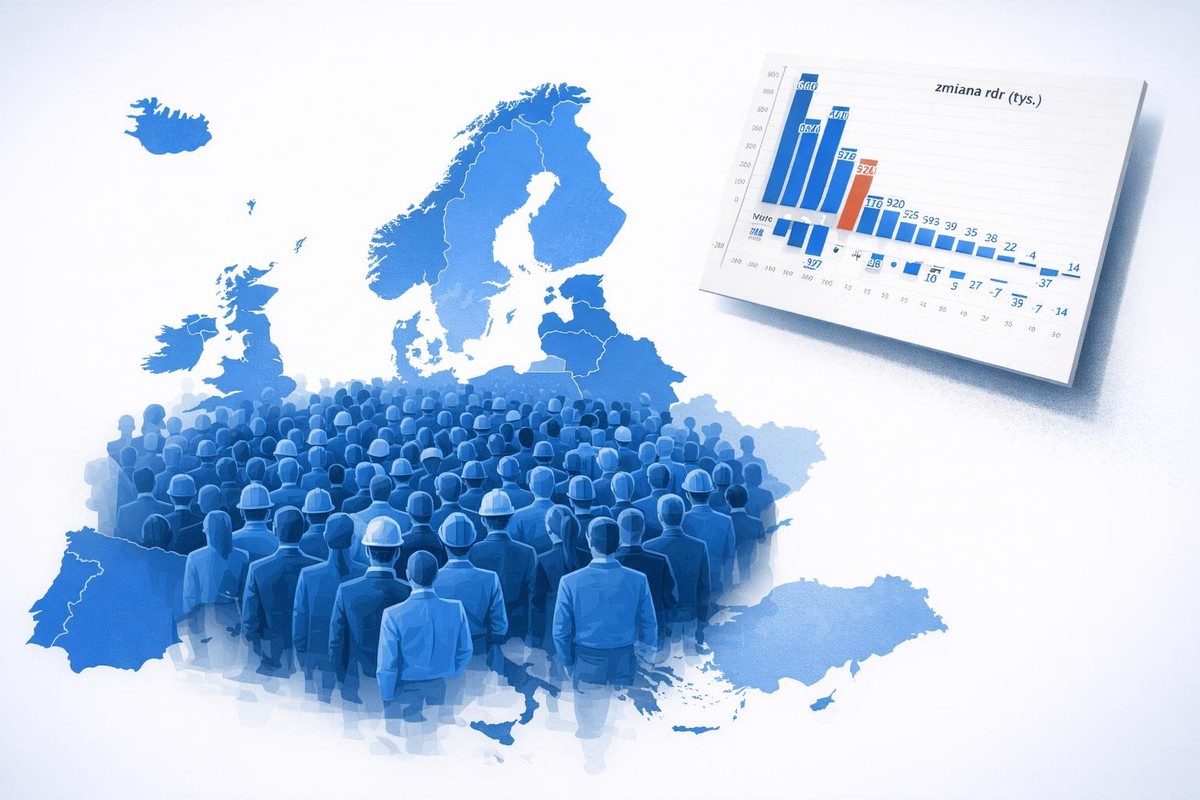
The number of employees increased by 120.3 thousand. and at the end of the year 17.5 million people worked. Growth dynamics by 0.7%. is higher than the EU average (0.6%). When it comes to increasing the number of people working (+120,000), then We were only behind three countries: Spain (+599 thousand, +2.7% yoy), Italy (+312 thousand, +1.2% yoy) and Portugal (+143 thousand, +2.7% yoy).
Among our neighbors, only the Czech Republic had better statistics than Poland, with an increase of 1%. y/y (+57 thousand to 5.5 million). However, employment decreased in Lithuania (-2.5% y/y, -37,000 to 1.5 million), in Germany (-0.1%, -57,000 to 45.9 million) and in Slovakia (-0.1% y/y, -1.8 thousand to 2.4 million). In our neighbor across the Baltic Sea, Sweden, there was an increase of 0.3%, or 13.7 thousand. up to 5.5 million.
Read also: This is how much the richest Poles from the top 10 percent earn, and so many receive the minimum wage. Whose pay increases the most?
The highest percentage increase in employment was recorded in Malta (+4.2% yoy), and the largest decline in Romania (-3.4% yoy).
Industry is withdrawing from the EU, but not from Poland
While total employment in the EU increased by 1.2 million, there were declines in the processing industry. High energy prices and rising employment costs are effectively driving factories out of the Old Continent, and the number of employees has dropped by 160,000. up to 30 million (-0.5% y/y). There was a smaller decline in the information and communication industry (-26,000, -0.3% y/y to PLN 7.6 million).
In the EU, these losses were made up for by trade (+362,000, +0.7% yoy to PLN 53 million), public administration and military (+551,000, +1% to PLN 54 million) and professional, scientific and technical services (+381,000, +1.3% yoy to PLN 29 million).
In Poland it was the opposite, because employment in production increased by 0.8%. rdr (+26 thousand to 3.4 million), and decreased in trade by 0.1 percent. (-5,000 to 3.8 million) and decreased in professional services by 0.1%. y/y (-3 thousand from 3.8 million). The largest increase in the number of people working in Poland was in agriculture, forestry and fishingwhere 3 percent increased. employees (+34 thousand to 1.2 million).
Read also: Nurses will earn more. Here are the rates
The largest declines in employment were observed in agriculture in Romania, where as many as 21.4 percent no longer work. working a year earlier (-361,000 to 1.3 million), but also in production in Germany, where 2.4 percent lost their jobs. people (-176 thousand to 7.2 million).
In percentage terms, apart from the above case of Romania, the largest loss was in the financial sector in Estonia (-29% y/y, -6.6 thousand to 16 thousand) and in the entertainment sector also in Romania (-15%, -6.1 thousand to 34 thousand).
Wage growth in Poland compared to the EU
Okay, but if more of us were hired, how were we paid? Statistics show that we have one of the largest increases in the EU.
Employers' spending on wages in Poland increased by 12.4%. y/y to EUR 386.7 billion – according to the conversion of Eurostat data. Only in Croatia the growth was higher, by 12.7 percent, and behind Poland was Bulgaria with a growth rate of 12 percent. Outlays on wages grew the slowest in Finland (+1.8% yoy) and France (+2% yoy). In Germany they increased by 5.1%. y/y with a decline in employment.
Data on employee wages do not cover the full population of entities, but we have compared them with data on the number of employees to estimate how much individual wages have changed.
And this is what we noticed in the case of Poland an increase in the average salary by approximately EUR 202 per month, or 12.2 percent. rdr. The strengthening of the zloty helped in these statistics.
When it comes to the value of the raises, only those working in seven countries on the continent received more, including: the most in Luxembourg (+EUR 298 per month, +4.3% yoy), in Lithuania (+EUR 221 per month, +10.1% yoy) and Germany (+EUR 216 per month, +5.1% yoy). Italians received the smallest increases (+74 euros per month, +2.7% yoy).