publication
2026-03-06 22:05
Friday's session brought significant declines on the New York stock exchanges. Amid the continuing blockade of the Strait of Hormuz and poor data from the US labor market, the S&P500 index dropped to its lowest level since December.
The Dow Jones industrial average, after losing 0.95%, ended the week at 47,501.55 points. That is the lowest since the beginning of December. The S&P500 also set a nearly three-month minimum, dropping by 1.33% and stopping at 6,7400 points. The Nasdaq fell by 1.59% and finished with a score of 22,387.68 points.
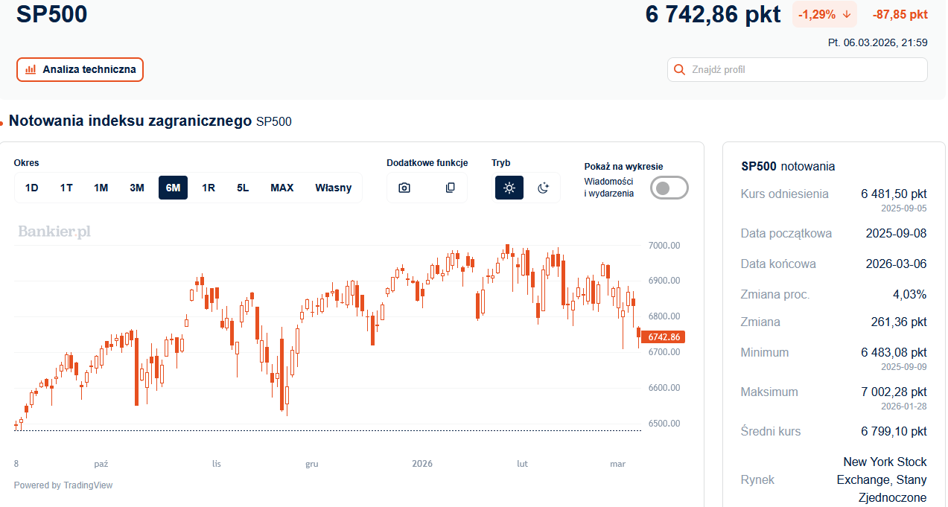
The reasons for Friday's sell-off on Wall Street can be traced to two sources. The first was the unfolding oil crisis. Only on Friday, the price of Brent crude oil increased by 8% and its price exceeded USD 90 per barrel. This is already half as much as two months ago and the highest since September 2023. This is already a price level that raises concerns about the economic situation and the results of listed companies.
Advertisement
Due to Iran blocking the Strait of Hormuz, Kuwait has limited oil production. There is simply no place to store the raw material that cannot flow out of the Persian Gulf. A similar situation may soon affect the UAE and Saudi Arabia. Another problem will be the resumption of gas supplies from Qatar, where Iran bombed the installations in Ras Laffan.
Donald Trump's statements did not improve the situation. The US president announced that he would not accept any deal with Iran other than unconditional surrender. And this may be difficult, since the American leader has ruled out the use of land forces. Therefore, the war with Iran may last weeks or even months – and this is the scenario that investors fear the most. Investors also did not buy subsequent declarations by the White House that the US Navy would begin escorting ships through the Strait of Hormuz.
The second catalyst for the deterioration of sentiment on Wall Street was the February report from the US labor market. The data was just terrible. Instead of a modest increase in employment (the market consensus assumed +60,000 jobs), the BLS report indicated a decline in employment in non-agricultural sectors by 92,000. full-time positions. The unemployment rate also unexpectedly increased. This doesn't look like a strong job market providing income for consumers whose spending accounts for 70% of U.S. GDP.
The scale of concern on Wall Street was also reflected in the 23% increase in the VIX volatility index. This indicator measures the implied volatility of options and thus indicates the demand for hedging positions against declines in stock prices. However, the current VIX values (approx. 29.3 points) are still relatively low considering the scale of global perturbations. For comparison, in April last year during the outbreak of President Trump's tariff wars, the VIX reached 45 points.
Generally financial markets received a double – and strictly stagflationary – blow on Friday. The deteriorating labor market raises fears of a recession, while skyrocketing fuel prices basically guarantee an increase in price inflation. In such a situation, central bankers from the Federal Reserve are powerless and do not have tools that can support the economic situation without the risk of causing galloping inflation. The oil shock means not only higher operating costs for companies, but also the risk of a decline in discretionary consumer spending. Americans and Europeans will simply have to leave more money at gas stations and limit less necessary expenses.
These concerns were visible in Friday's market structure. Virtually all sectors of the S&P500 index were in red, except for shares of companies providing basic consumer goods and public utility companies. Despite the expensive oil, even the shares of the largest oil companies did not gain.
The publication contains affiliate links.