Migrant beekeepers Burek with his wife and Galovichev. St.Tikhonkaya. 1929
Photo: Heritage JAO
March 7, 1929
D. Weisserman’s book “Birobidzhan: Dreams and Tragedy” (12+) contains information that the most active assistance to IKOR began precisely when the Council of People’s Commissars of the USSR, on March 7, 1929, concluded an agreement with it on providing assistance to Jewish workers settling in the USSR. According to this agreement, ICOR for all, without exception, operations was exempt from all state and local taxes and fees, including stamp, notary and rent taxation.

“Having received certain tax benefits, ICOR begins to actively and, most importantly, provide assistance to Biro-Bidzhan free of charge. Equipment, machinery, cars, tools, various agricultural implements, parts for the construction of wooden two-story standard houses, compressors, electric laundries, medicines and medical instruments are sent to the future region.”
March 7, 1955
On this day, a three-day seminar of secretaries of party organizations of collective farms, MTS and state farms of the region ended. The first secretary of the regional party committee, A.P. Shitikov, made a report “On the results of the January (1955) Plenum of the CPSU Central Committee and the tasks of the regional party organization for the further development of agriculture.”
An exchange of experience took place on issues of organizational-party and party-political work.
March 7, 1959
The reference and information publication “Streets of the City of Birobidzhan” (0+) contains information that by decision of the Birobidzhan City Executive Committee of March 7, 1959 No. 63, the village of military warehouse 721 was given the name Amursky, and by the same decision in the village of Shveiny behind Ikura, parallel to Baikalskaya Street, the name Ulyanovskaya was given.
March 7, 1958
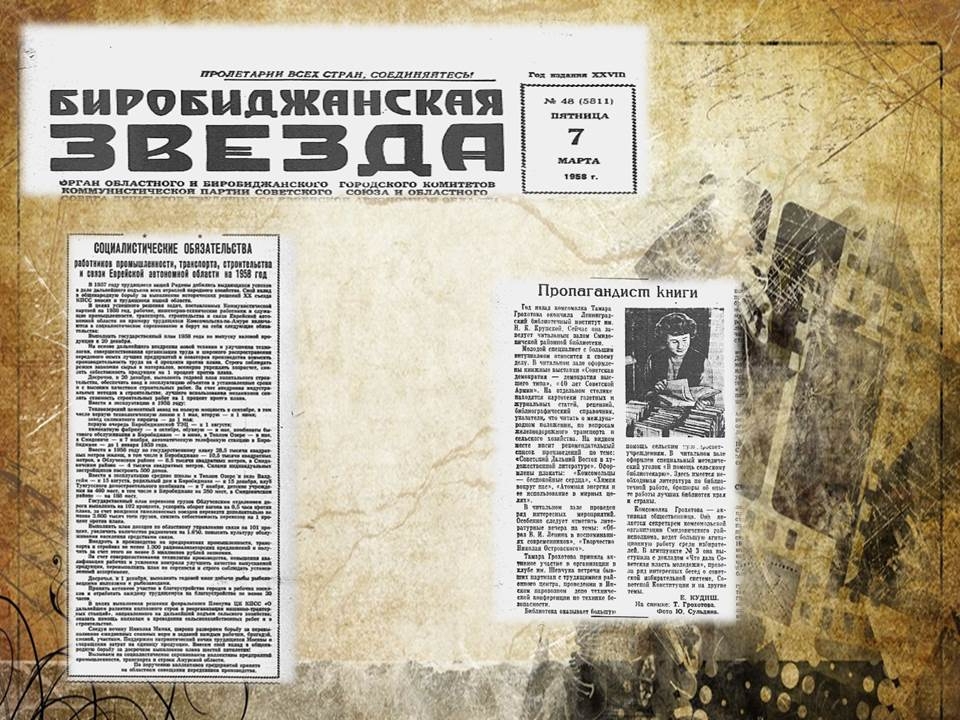
Clippings from the newspaper “Birobidzhan Star”. Photo: Photo: Regional Library
The newspaper “Birobidzhan Star” (12+) published the socialist obligations of workers in industry, transport, construction and communications of the Jewish Autonomous Region for 1958.
The workers of the region undertake to put into operation: the Teploozersky cement plant at full capacity in September, including the first production line by May 1, the second by June 1; sand-lime brick plant until May 1; the first stage of the Birobidzhan CHPP by August 1; a rolling factory in October, a shoe factory in May.
“To put into operation secondary schools in Teply Ozero and the village of Valdgeim – by August 15, a maternity hospital in Birobidzhan – by December 15, a club of the Tunguska house-building plant – by November 7, children's institutions for 460 places…”
Efim Kudish in the article “Book Promoter” (12+) talks about the work of the head of the reading room of the Smidovichi regional library T. Grokhotova, who graduated from the Leningrad Library Institute. N.K. Krupskaya. Tamara is very enthusiastic about her work: the reading room constantly displays exhibitions on current topics, recommends lists of literature, and hosts interesting events and literary evenings.
“Komsomol member Grokhotova is an active social activist. She is the secretary of the Komsomol organization of the Smidovichi district executive committee, and does a lot of campaigning work among voters. At propaganda point No. 3, she made a report “What the Soviet government gave to youth”, held a number of interesting conversations about the Soviet electoral system, the Soviet Constitution and other topics.”
March 7, 1960
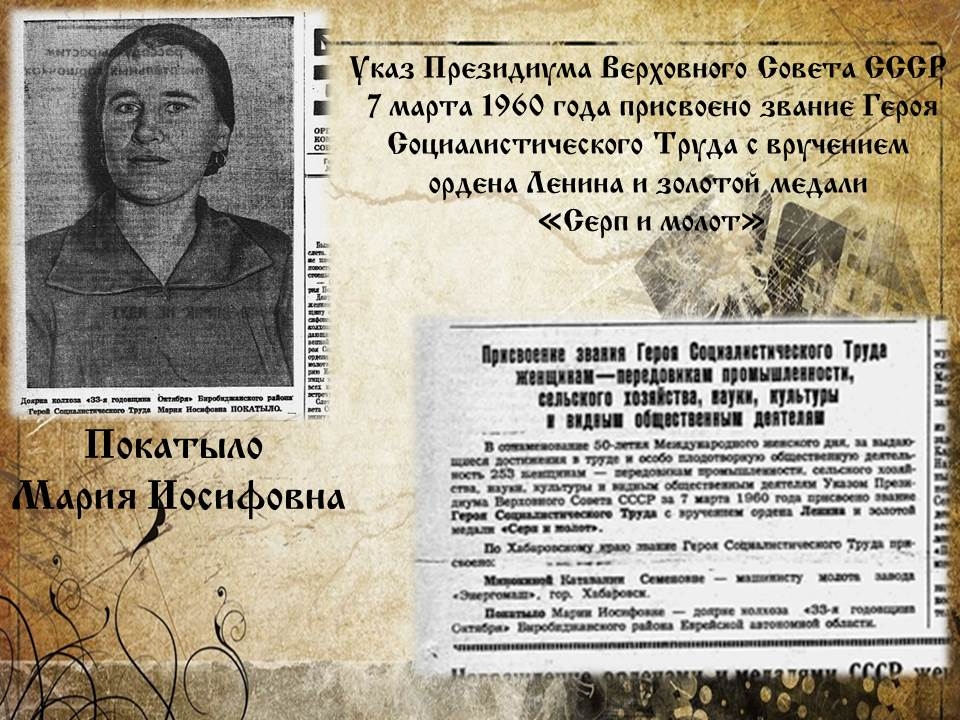
Clippings from the newspaper “Birobidzhan Star”. Photo: Photo: Regional Library
By decree of the Presidium of the Supreme Soviet of the USSR, Maria Iosifovna, a milkmaid from the collective farm “33rd Anniversary of October”, was awarded the title of Hero of Socialist Labor with the Order of Lenin and the gold medal “Hammer and Sickle” by Decree of the Presidium of the Supreme Soviet of the USSR.
Maria Iosifovna Pokatylo was born on August 26, 1921 in Vinnitsa. Maria Iosifovna came to the Far East in 1950 under the resettlement program. And she started working as a milkmaid in the village of Ptichnik, Birobidzhan district of the Jewish Autonomous Okrug. Soon she became an advanced milkmaid. She was the first among the region's agricultural workers to be awarded the title Hero of Socialist Labor.
In March 1960, several collective farms merged and Maria Pokatylo headed a lagging dairy farm in the village. Pronkino. A year later, the Pronkin brigade, led by M. Pokatylo, reached the forefront and firmly held this place for two five-year plans. Many of its milkmaids have been awarded orders and medals.
Maria Iosifovna Pokatylo passed away on March 31, 2005.
March 7, 1963
The Bureau of the Regional Committee of the CPSU approved the initiative of a group of advanced drivers of the Birobidzhan auto office, who appealed to all drivers in the region to launch socialist competition under the motto “A car plus a car.” Each of these drivers exceeded the vehicle mileage between repairs two to three times and saved hundreds of kilograms of fuel. Since the beginning of the seven-year plan, each of them has 7-8 thousand rubles of saved government funds in their personal account.
March 7, 1964

Clippings from the newspaper “Birobidzhan Star”. Photo: Photo: Regional Library
The newspaper “Birobidzhan Star” published the article “My Fighting Friends” by Olga Timofeevna Teres, a teacher at school No. 9 in Birobidzhan, who fought during the Great Patriotic War in the famous 46th Guards Flight Regiment, where she was a navigator of night bombers. Olga Timofeevna has eight government awards. In the article, she talks about the courage, heroism and courage of the female pilots, with whom she had to go through the entire war from Krasnodar to Berlin. Olga Timofeevna spoke about the famous pilot M. Raskova, about the girls who did not live to see the victory over Nazi Germany, including Yulia Pashkova, Ira Kashirina, Zhenya Rudneva, Vera Belik and many others. Olga Teres spoke about Klava Serebryakova when her plane was shot down over East Prussia, as a result of which she was found to have 18 fractures. She spent 2.5 years in the hospital, and in peacetime she began working as a teacher in the city of Oktyabrsky.