The whole world is arming Poland. We buy this in individual countries [MAPA]

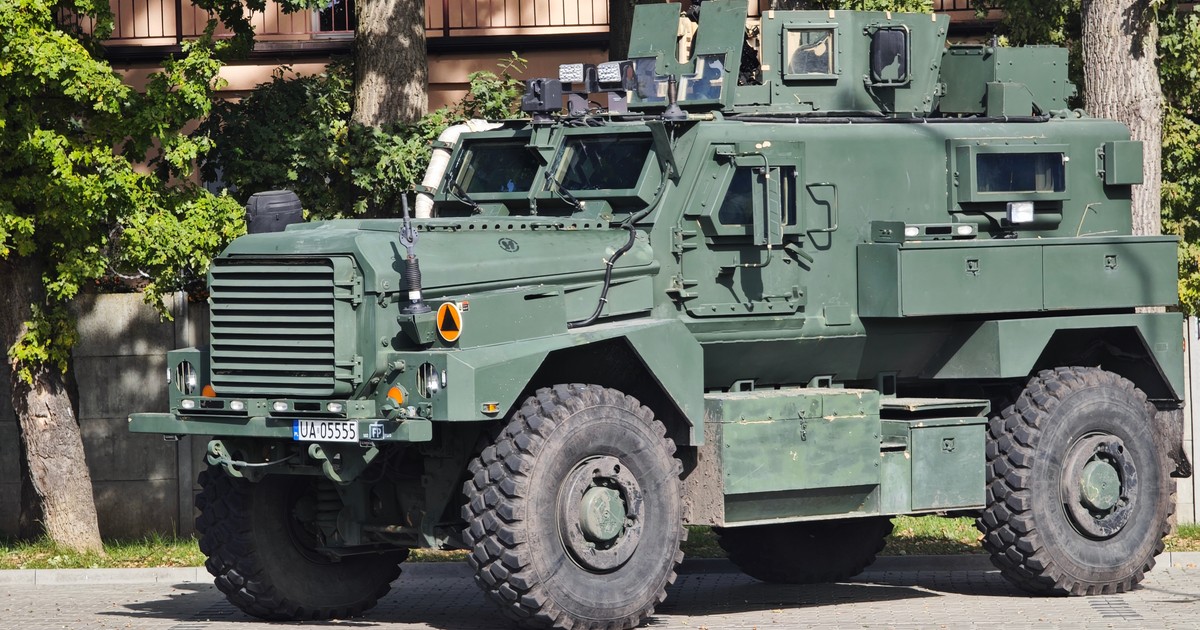
After the outbreak of a full-scale war in Ukraine, Poland embarked on gigantic arms purchases. As a result, we have, for example, three types of modern main battle tanks and even more types of armored vehicles.
Why are our weapons so “international”? We explain.
Read also in BUSINESS INSIDER
If we look at the map of arms orders in recent years, we will see that we obtain equipment from countries scattered around the world. After 2022, orders from the USA and South Korea dominated. — but this trend is slowing down a bit. Recently, the Ministry of National Defense has chosen Sweden – Saab is to provide us with three submarines.
What's more, we often order one type of equipment from different suppliers from different countries. Let's take tanks. The Polish army has had German Leopards for a long time, but recently it also decided to order American Abrams and South Korean K2 Black Panther.
We have Polish Krab howitzers and new ones are still being produced. We are also ordering their South Korean competition, the K9A1 Thunder.
When it comes to wheeled armored vehicles, we have Rosomaks produced in Poland under a Finnish license, but we are also thinking about taking over the American Strykers. I could go on and on for a long time…
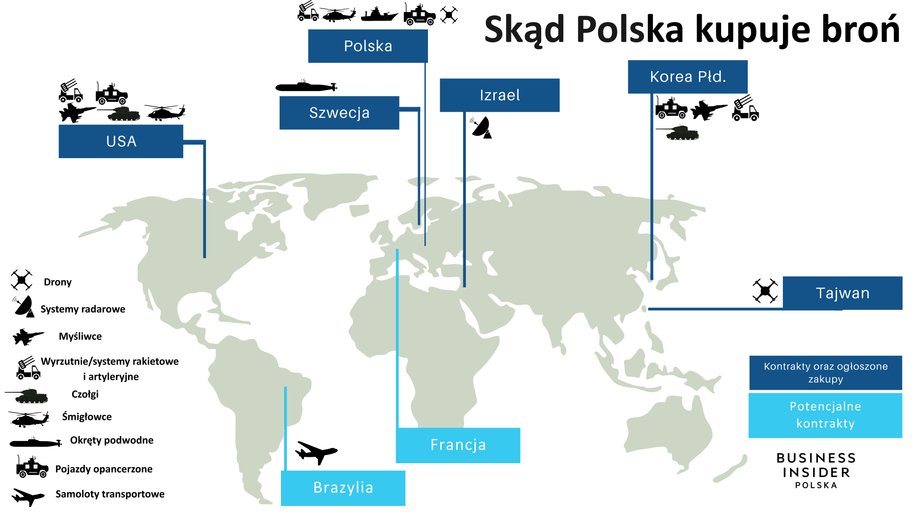
Where does Poland buy weapons?
|
Mateusz Madejski / Business Insider Polska
The list of key arms suppliers includes countries such as the USA, Sweden and South Korea, but not only them. We are quietly buying drones from Taiwan, for example. There is information that we purchase up to half of this type of machines produced there. Israel remains an important partner for us, from which we recently purchased, for example, coastal radars for several hundred million zlotys.
Moreover, the military procurement map is unlikely to end there. There is a lot of talk about potential purchases in France, which has recently become one of our key partners when it comes to security. It is also possible that we will buy transport planes from distant Brazil.
What does Poland buy in Poland?
It's not like we buy everything abroad. The above-mentioned Crabs are still produced and sent to our land forces. Borsuk combat vehicles produced on the Vistula River are also entering service, and the construction of frigates from the “Miecznik” program is underway in Gdynia. In turn, AW149 helicopters of the Italian concern Leonardo are manufactured in Świdnik.
We usually sign large contracts with foreign companies, but Polish companies also provide important equipment, for example drones. WB Group especially stands out here.
Contracts with Polish companies are one thing, “Polonization” of contracts with large foreign concerns is another. Poland has not had the best experience, for example with the famous offset with F-16 aircraft.
Unofficially, we often hear that Americans are very resistant when it comes to technology transfer or “Polonization” of production. The Koreans were said to be more willing to do so. You can understand it – South Korea. it has a powerful arms industry, but in this respect it is not an export power. Poland is to be, as it were, a “window to the world” for this country. Hence, for example, K2 tanks, which are to be produced at the Bumar-Łabędy plant in Gliwice, are to be “Polonized”.
Also in the case of the Swedes, it is said that there may be no end to submarines, and the agreement is to assume quite advanced technology transfer.
Armament of the Polish army. Is it healthy?
For a long time, Poland limited its defense spending. “After 1989, we largely benefited from the so-called peace dividend, which resulted from the decline in international tension and allowed us to limit defense spending and redirect these funds to other purposes,” point out the authors of the Deloitte report on our country's defense investments. However, history accelerated and – according to company analysts – in years In 2025-2035 we will spend an astronomical amount of PLN 1.9 trillion on defense.
But why are our purchases so scattered all over the world? There are several answers here. First of all, in 2022, we suddenly decided to make gigantic purchases. On the one hand, because we felt threatened, but on the other, because we simply handed over a lot of equipment to Ukraine. So the holes had to be patched very quickly. So the winners were those companies that could deliver weapons to us relatively quickly.
There were no express deliveries. Contracts for new tanks or planes are a matter of many years. Here, the Polish authorities were criticized – if we had ordered everything from a similar source, we could have negotiated better contract terms. It would also be much easier and cheaper to maintain and service such equipment.
The “shooting” can therefore be explained primarily by politics. From a purely technical point of view, it would make sense to order weapons from Germany – something we have not had a problem with in recent decades. Our neighbor produces modern equipment that our soldiers often know well (e.g. Leopard tanks). Additionally, supplying weapons is not a problem for geographical reasons.
The situation with weapons from Korea is different. Here, we may have to wait a long time for deliveries, and the distance between countries may be an even greater problem during a possible crisis.
It is no secret that German companies tried very hard to obtain contracts, for example the one regarding submarines. “But the political climate is such that it is currently difficult to imagine a large contract for military equipment from Germany,” explains one of our interlocutors from the arms industry.
See also: The NATO corps commander says what the wars of the future should look like. “Drones will finally stop dominating”
Some experts point out that although buying equipment around the world is not economically viable, it has its advantages. The advantage is that Poland is not dependent on one country.
In times of recent tensions between the US and Europe, for example, many countries have begun to wonder whether Americans can “disable” their own weapons or rather make their use more difficult.
Mariusz Cielma from “Nowa Technika Wojskowa” told us that such actions are potentially possible. “Diversification” of arms supplies is therefore an idea in a world where no one really knows which ally he can trust.
A much better solution would, of course, be to rely as much as possible on your own production and technological ideas. This is not just reserved for the largest countries. 50 million people in South Korea. Sweden's 10 million people too. However, in Poland's population of 38 million, this is still extremely difficult to imagine.
Author: Mateusz Madejski, journalist of Business Insider Polska