The information demanded by the far-right opposition party Alternative for Germany (AfD) would be very useful to the Kremlin. The concerns are even greater because AfD is famous for its sympathy for Russia. Alternative for Germany took particular interest in last year's Hedgehog 2025 exercise, a large NATO exercise in Estonia in which Ukrainian drone specialists used tactics learned on the battlefield to destroy NATO units in a war game.
This is not the first time the AfD has raised concerns about inquiries that could spark Russia's interest. The threat appears in particular to NATO's eastern flank, including Poland.
In a letter obtained by POLITICO, Ruediger Lucassen, AfD defense spokesman, asked the government in Berlin on February 19 to inform the defense committee in the country's parliament about the conclusions drawn from the Hedgehog 2025 exercises.
“What capability gaps have been identified – particularly in the areas of counter-drone defense, electronic warfare, command capabilities and mobile force protection?” Lucassen asked in the letter. He also asked for clarification on “what capability gaps still exist and when they are expected to be filled.”
The article continues below the video
— In the case of some of the AfD's proposals and questions, the question increasingly arises as to what purpose they actually serve and whose interests are being pursued in them, says Florian Dorn, a member of the defense committee from Germany's ruling coalition, in an interview with POLITICO, referring to the AfD's inquiry about the Hedgehog 2025 exercises. “If such information falls into the wrong hands, it will threaten our security and defense capabilities.”
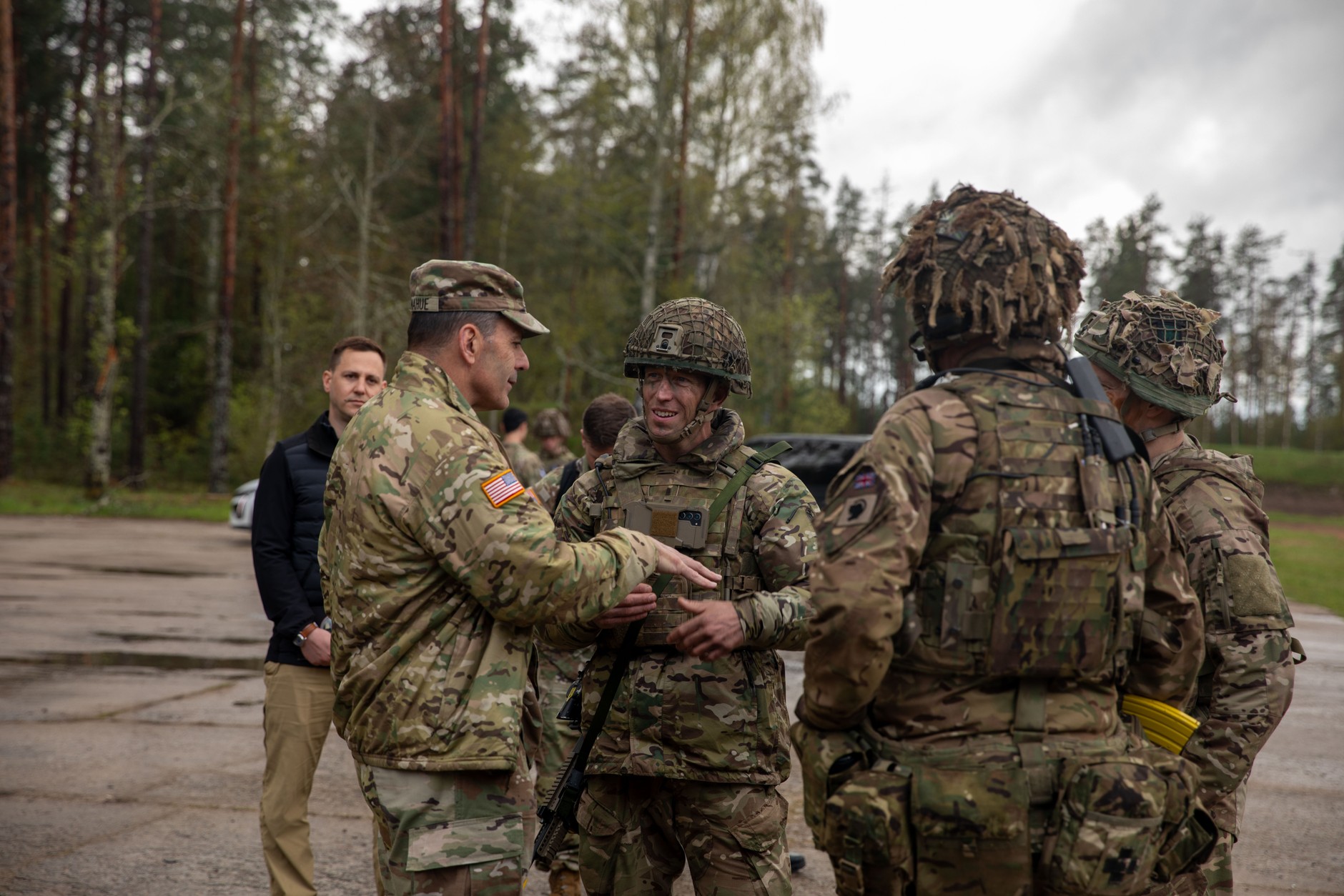
U.S. Army Gen. Christopher Donahue, commander of U.S. Army Europe and Africa, talks to British soldiers during exercise Hedgehog 2025, May 15, 2025 (illustrative photo)Jaidyn Moore / DVIDS
In the German political system, opposition parties have significant power to demand answers from the government. Ministries can withhold classified material, but generally must respond to formal inquiries.
Evaluations of military exercises are not limited to describing what went wrong. These can reveal how vulnerable certain units were, how quickly they were neutralized and how long it might take to correct identified problems.
“Information may fall into the wrong hands”
European security officials assume that Russia and other adversaries are using publicly available materials to recreate operational patterns. Particularly in drone warfare—where tactics change rapidly and adaptation cycles are short—knowing how long forces can hold specific points can provide a strategic advantage.
Thomas Erndl, the Christian Democratic Union's (CDU) spokesman for defense policy, also warned of the risks involved, including “the danger that security information could end up in the wrong hands.” He added that ministries have become accustomed to considering such risks when developing responses to parliamentary questions.
A senior NATO military official told POLITICO that the AfD inquiry had not caused “serious concern” within the alliance, but added that NATO members “always want to be cautious about the information that reaches the public.”
The controversy over the Hedgehog 2025 maneuvers follows earlier disputes in which AfD MPs raised detailed questions about military transport routes, infrastructure protection and security systems.
Last year, the interior minister of the eastern German state of Thuringia, Georg Maier, accused the AfD of using parliamentary questions to “systematically identify critical infrastructure,” claiming in an interview with the Handelsblatt newspaper that the far-right party was effectively implementing what he described as the Kremlin's “to-do list.”
According to reports from the German newspaper “Die Welt”, the Thuringian interior ministry has prepared a list of several dozen inquiries from Alternative for Germany from October 2024. They were to concern sensitive infrastructure, including police IT systems, drone defense capabilities, military transport routes, energy networks, water supply and civil protection.
Lucassen rejected the suggestion that the AfD had ulterior motives, calling his motion a routine instrument of parliamentary oversight.
In an email to POLITICO, he wrote that lawmakers must rely on official military assessments, not media reports, to support the armed forces through legislative and budget decisions.
I’m Ashley Davis as an editor, I’m committed to upholding the highest standards of integrity and accuracy in every piece we publish. My work is driven by curiosity, a passion for truth, and a belief that journalism plays a crucial role in shaping public discourse. I strive to tell stories that not only inform but also inspire action and conversation.