After Russia's GPS jamming in Europe, the US accelerates the development of quantum navigation

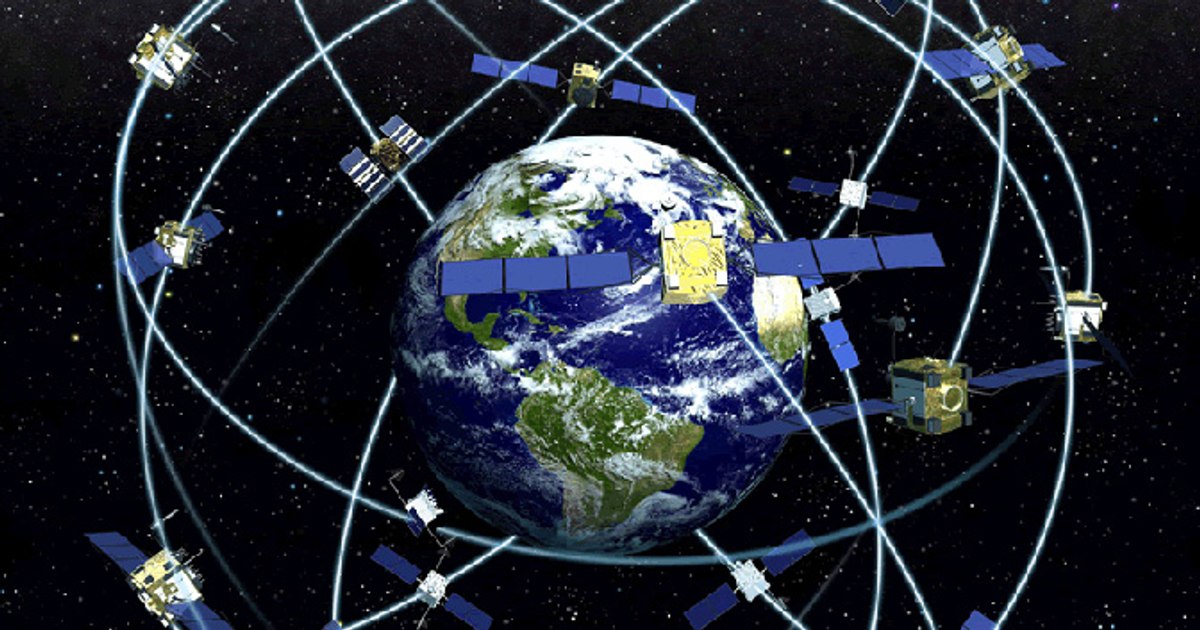
Amid increasing jamming of GPS signals – essential for guiding military equipment, but also vehicles, commercial aircraft and ships – quantum technology is starting to offer a viable alternative.
Constellation of GPS satellites/PHOTO:archive
US government contractor Q-CTRL told Newsweek that its quantum sensors, along with the software that enables their practical use, will be commercially available by the end of this year. Although quantum technologies have not always lived up to the ambitious expectations that surrounded them, they have become a strategic priority for the White House and the Pentagon.
“The Trump administration is helping to ensure that adversaries will never be able to catch up to the United States' leadership in this area, and Q-CTRL is working to make that vision a reality in partnership with the U.S. government,” said Michael Biercuk, the company's founder and chief executive officer.
According to him, the most pressing challenge identified is interference with GPS signals.
NATO member countries have accused Russia of jamming global positioning systems, including those used by civilian aircraft and ships, in an alleged hybrid war. Moscow has denied involvement in the jamming of civilian uses, but disturbance maps show massive interference over Ukraine during the Russian invasion. GPS was originally developed for the US military, but is now ubiquitous in civilian uses.
Biercuk described the situation as an “electromagnetic iron curtain” stretching from Sweden and Norway to the Black Sea in Turkey. If at the end of 2023 several dozen incidents were registered daily, currently their number exceeds 1,000 per day. The phenomenon is not limited to Europe or the actions of governments: last year, the port of Doha, Qatar, was temporarily closed following a GPS “spoofing” attack – a technique by which false signals are sent to mislead navigation systems.
How quantum technology works
Quantum sensors can use the Earth's magnetic field and gravitational variations to determine position, thus providing an alternative to GPS. Quantum physics describes the behavior of matter and energy at the atomic and subatomic scale. However, technological applications – such as quantum computing or quantum cryptography – have often been plagued by technical difficulties, exaggerated expectations and longer-than-anticipated implementation timelines.
“The central problem with this technology is its fragility”explained Biercuk.
Quantum sensors rely on “trapped” atoms and detect extremely small variations in magnetic or gravitational fields, measured with lasers. According to the company, the key innovations relate mainly to software, but also to hardware integration, which allows optimization and elimination of unnecessary components.
Unlike GPS, the signals generated by quantum sensors cannot be jammed or spoofed and do not depend on satellites that could be knocked out of service in the event of a conflict. Thus, they can function as a backup system for satellite and visual navigation, being less vulnerable to noise and interference than sound or light-based systems.
The company is currently developing for the US government sensors adapted to more difficult platforms, such as helicopters – where intense vibrations complicate measurements. In parallel, Q-CTRL is collaborating with Lockheed Martin and the Defense Innovation Unit on a new quantum navigation system. Other partnerships include DARPA, Airbus and the Royal Australian Navy.
According to Biercuk, additional applications of quantum technology are emerging in managing information on the battlefield and optimizing military logistics.
And China is investing in quantum technologies. If there were cross-border collaborations with Chinese researchers in the past, they have since ceased. According to Biercuk, Beijing particularly excels in quantum communications – the use of quantum physics to secure information transmissions – but there is no public evidence of similar expertise in quantum sensors and navigation.