The trial for the “retirement” of the judge who sued the Constitutional Tribunal. After his election, he never ruled

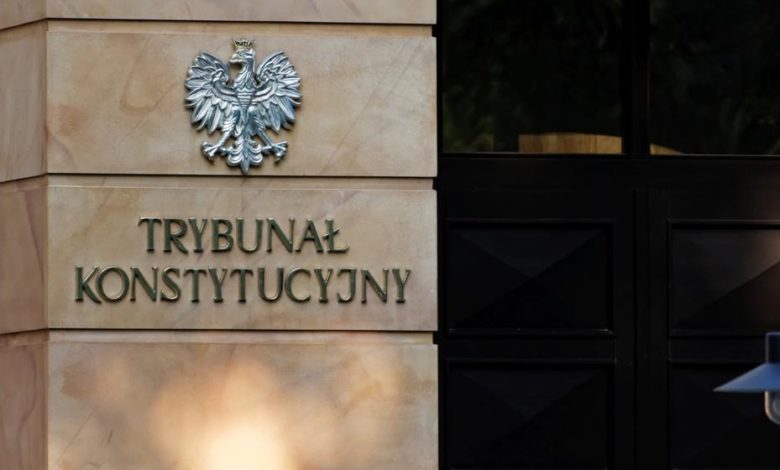
On Tuesday, the trial brought to the Constitutional Tribunal by Prof., elected to the Constitutional Tribunal in 2015, started before the capital court. Krzysztof Ślebzak for payment of the salary of a retired judge. This is the only instrument that allows me to demand that my status be determined after 10 years, said Ślebzak.
– After 10 years I didn't get anything and I can no longer be considered as a candidate for the Constitutional Tribunal – Ślebzak said in court. He recalled that – in accordance with the constitution – re-election to the Tribunal is inadmissible.
Therefore, he added, this case would “symbolically close a certain stage of life.” Ślebzak noted that his lawsuit formally concerns retirement in one month – November 2024. But, he noted, “the whole matter has an important rule of law nature, because it will affect each subsequent candidate for the Constitutional Tribunal.”
A decade in legal obscurity
On Tuesday, the Constitutional Tribunal's attorney, Bartosz Kałduński, filed a motion to dismiss the lawsuit. – The case is not actually about payment, but about the district court assessing the plaintiff's status – he said. As he emphasized, “it is indisputable that the plaintiff did not take office” in the Constitutional Tribunal. He pointed out that although formally the lawsuit concerns retirement for one month, “in principle, it is a lifetime benefit.”
The origin of the lawsuit, which was brought to the District Court for Warsaw-Śródmieście, dates back to events from a decade ago and the beginning of the dispute over the Constitutional Tribunal.
The beginning of the crisis can be dated to October 8, 2015, when the Sejm of the 7th term elected – primarily with the votes of the then PO-PSL coalition – five new judges of the Constitutional Tribunal: Roman Hauser, Andrzej Jakubecki, Bronisław Sitek, Andrzej Sokala and Krzysztof Ślebzak. They were to be the successors of three judges whose terms ended on November 6 and two judges whose terms ended in December of that year, i.e. during the next parliamentary term.
On November 25, 2015, the Sejm of the new, 8th term, in which PiS already had a majority, adopted resolutions stating that the election of Constitutional Tribunal judges of October 8 had no legal force. On December 2, the Sejm elected Julia Przyłębska, Piotr Pszczółkowski, Henryk Cioch, Lech Morawski and Mariusz Muszyński, nominated by PiS, as judges of the Constitutional Tribunal. The last three were successors of judges whose terms expired in November. These five judges were sworn in by then-President Andrzej Duda.
On December 3, 2015, the Constitutional Tribunal – at that time the president was Andrzej Rzepliński – found that the previous Sejm of the 7th term had elected two judges of the Constitutional Tribunal in a manner inconsistent with the constitution (instead of those whose terms ended in December); the election of the remaining three (replacing those whose terms ended in November) was consistent with it. Ślebzak was in the latter group. The Constitutional Tribunal also found that the president was obliged to “immediately” take the oath of office from each newly elected judge.
This opened the main axis of the dispute over the appointment of three judicial positions in the Constitutional Tribunal and the occupation of these positions by people described by the then opposition and the current ruling coalition, as well as some lawyers, as three “double judges” who were to occupy positions in the Constitutional Tribunal that were previously properly filled.
From Xero Flor to “double judges”
This problem also took on a cross-national dimension when, in May 2021, the European Court of Human Rights found that in the Xero Flor case, Poland had violated the provisions of the European Convention on Human Rights – the right to a fair trial and the right to a court established by law. The company sued the State Treasury. After unfavorable court judgments, the case was referred to the Constitutional Tribunal, which discontinued it, and this decision was signed by Judge Muszyński. The company brought an accusation before the ECtHR regarding the panel of judges that heard its case in the Constitutional Tribunal. The Strasbourg tribunal found, among other things, that the Constitutional Tribunal was ruled by a judge who did not have the right to do so and ruled that Poland should pay the company PLN 3,000. 418 euros in compensation.
Ślebzak's lawsuit against the Constitutional Tribunal for payment of a retired judge's salary was registered in the labor department of the downtown district court last year. Ślebzak's nine-year term of office – as he himself indicated in court on Tuesday – expired in early November 2024.
Dispute over the moment when a judge's mandate arises
Last year, the Ombudsman for Human Rights, Marcin Wiącek, joined the case. “From the point of view of the creation of the judicial mandate and the beginning of the term of office, the lack of the oath was irrelevant,” the Ombudsman noted in his written position. He added that “the lack of taking the oath resulted in the factual impossibility of taking up office by the plaintiff, establishing an employment relationship and performing judicial activities.” “However, it did not deprive him of his constitutional judicial mandate, because the legal basis for this mandate was the resolution of the Sejm of October 8, 2015.” – Wiącek emphasized.
On Tuesday, a representative of the prosecutor's office also reported her involvement in the case. However, after the court's question, she informed that she would present her position at the end of the trial.
Since the defendant still has to refer to the pleadings that have recently been submitted to the court, Judge Adam Pruszyński adjourned the hearing until May 26 this year. Then it is possible that the process will end.
Six vacancies and publication paralysis
Over the last decade, the multi-faceted conflict surrounding the Tribunal has involved numerous legal, political and administrative issues. Ultimately, it led to many lawyers and politicians questioning the judgments passed before the Constitutional Tribunal.
In the resolution adopted in March 2024, the Sejm emphasized that “taking into account in the activities of a public authority the decisions of the Constitutional Tribunal issued in violation of the law may be considered a violation of the principle of legalism by these bodiesThe Sejm also found, among other things, that the two judges currently adjudicating in the Constitutional Tribunal – Jarosław Wyrembak and Justyn Piskorski – are not judges of the Constitutional Tribunal.
Since the Sejm adopted that resolution, the Constitutional Tribunal's judgments have not been published in the Journal of Laws. In the resolution adopted in December 2024, the government indicated that publishing the Constitutional Tribunal's decisions in official journals could lead to the perpetuation of the rule of law crisis. As added, “it is not permissible to publish documents that were issued by an unauthorized body.”
As of the second half of December 2025, there are six vacancies for 15 judicial positions in the Constitutional Tribunal. After at the end of January this year The Sejm once again did not choose the candidates for Constitutional Tribunal judges proposed by the PiS club, the Speaker of the Sejm, Włodzimierz Czarzasty, announced that the procedure for electing judges of the Tribunal would be carried out again. This time, the government coalition clubs are to present candidates.
Meanwhile, on March 10 this year The Constitutional Tribunal has set a date for a hearing on the application of MPs represented by Marcin Warchoł and Michał Wójcik from PiS, which challenges the provisions relating to the procedure for electing Constitutional Tribunal judges by the Sejm.
Ślebzak said in court on Tuesday that his case is important because the problem of electing judges to the Tribunal still exists, there is a hearing in the Constitutional Tribunal in March and it cannot be ruled out that “history will come full circle.”
Marcin Jabłoński (PAP)
my/par/