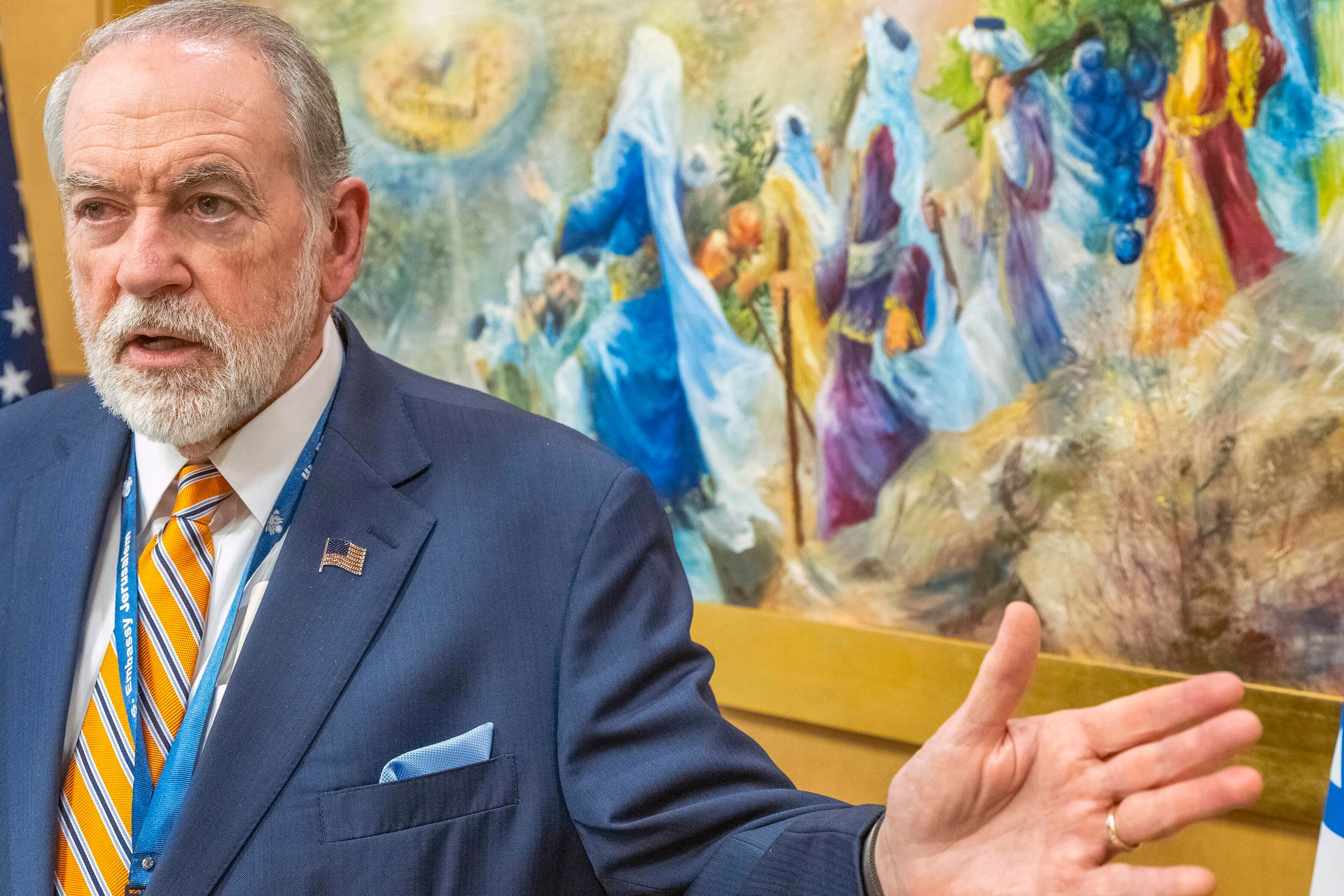
Mike Huckabee claimed on Friday in an interview with Tucker Carlson that Israel's geographical boundaries have their source in the Bible. A columnist and former Fox News journalist asked the US ambassador whether the country therefore has the right to the land that, according to the Book of Genesis, God promises to Abraham's descendants: from the Nile to the Euphrates. In practice, this would include, among others: present-day Jordan, Syria, Lebanon and parts of Egypt, Saudi Arabia and Iraq.
“I'm not sure we'd go that far,” Mike Huckabee replied. “There would be nothing wrong with it if Israel took over all this,” he added.
According to the biblical interpretation, what territories could Israel include?
How did the Saudi Arabian Ministry of Foreign Affairs react to the US ambassador's statements?
What are the internationally recognized borders for Israel?
What did Mike Huckabee say about Israel's desire to take over the Middle East?
The US ambassador talked about Israel's borders. There is a reaction from Saudi Arabia
The US ambassador's statements were strongly condemned by the Saudi Arabian Ministry of Foreign Affairs. Authorities in Riyadh warned that the rhetoric “threatens the stability of the region.” They also re-endorsed a two-state solution based on the 1967 borders, with East Jerusalem as the capital of a future Palestinian state.
Israel's borders are not written in local law
Israeli law does not clearly define the borders of the state. The country's internationally recognized borders are based on the 1949 armistice lines (the so-called Green Line) and subsequent Israeli peace agreements – including: with Egypt in 1979 and with Jordan in 1994.
The status of the West Bank, East Jerusalem, the Gaza Strip and the Golan Heights – which came under Israeli control as a result of the 1967 Six-Day War – is the subject of international disputes. The International Court of Justice (ICJ) ruled in 2024 that the Israeli occupation of the Palestinian territories was incompatible with international law.
Some Israeli politicians publicly refer to the idea of ”Greater Israel” present in religious-nationalist circles, which assumes the expansion of the state's borders even beyond the territories acquired in 1967.