The most resounding scandals in which Brâncusi was involved. Why the sculptor sued the US Government


Constantin Brâncusi was a man ahead of his time, an artist who revolutionized the idea of modern art. That is precisely why his works caused, especially in the interwar period, numerous controversies testing the accepted limits of artistic expression. He was sued including the US Government.

Constantin Brancusi
Constantin Brâncusi is considered one of the most influential sculptors of the 20th century, a true pioneer of modern art. Through his works, Brâncusi redefined sculpture and challenged the art world to accept the abstract, essentialization and spirituality in pure form. Brâncusi moved from traditional realism to an abstract art form, focused on the essence of the object or being represented.
Sculptures such as “Bird in Space”, “Infinity Column” or “The Kiss” do not faithfully copy objects, nature or people, but go on the deep, abstract side, on essences, transmitting energy, movement, freedom and idea. This approach paved the way for modern and contemporary sculptors, proving that abstract form can be deeply expressive, not just decorative.
Constantin Brâncusi was a revolutionary of forms and concepts. Through abstraction, essentialization and symbolism, he changed the way the world perceives sculpture, proving that modern art can be deeply expressive, spiritual and universal. In short, he was a pioneer of modernism, a source of inspiration for many artists. Being a man ahead of his time, a visionary, the artistic world and society were not always ready to digest Brâncusi's symbolism and artistic expression. That is precisely why his career was marked by scandals and lawsuits. The loudest were those from France, but also from the United States. Basically, Brâncusi's relatives sued the United States Government, after the customs officials did not want to recognize the artistic value of his works considering them kitchen utensils.
Brâncusi kicked out, with the police, from the exhibition in Paris
One of the biggest scandals in which Brâncuși got into, the peak, because of his visionaryism, not understood by his contemporaries at all, was the one related to “Princess X”, an exponential work of the great Romanian sculptor. “Princess X” was a sculpture inspired by Princess Marie Bonaparte, a wealthy aristocrat and important figure in Parisian society at the time. Her relationship with Brâncusi was rather platonic, and the respective sculpture symbolized her image in Parisian society.
Brâncuși simplified the form to its essence. That is, the sculpture has curved lines, a smooth and symmetrical appearance, which does not resemble a traditional bust of a woman. The artist said that he tried to capture the essence of the feminine, not just physical features. In short, without further ado, for a non-initiate in modern art, for an amateur or art ignoramus, it resembled an erect penis. Well, that's precisely why society, including the symandic and open one like Paris, was not ready for such an artistic expression. It was something so new that they could not perceive it at its value and essence. Whether Brâncusi achieved this or not, it is certain that he exhibited it at the Salon of the Independents, in Paris, in January 1920, one of the most prestigious exhibitions in the French capital. Upon seeing the work, the famous French artist Henri Matisse exclaimed “Voilà le phallus!” (Look at the phallus!).
Most of the participants in the exhibition had the same reaction. They thought it was an erect phallus and that Brâncusi jumped the horse, offering the public a pornographic work. The initial amusement, the giggles quickly turned to indignation and revolt. The organizers actually called the police, demanding that the work be removed and its author kicked out of the exhibition for indecency and pornography. The organizers were desperate, especially since the president of France was supposed to visit the exhibition. “As Brâncusi told me, he took the Princess by the petticoat and descended the steps to the cheers and boos of the angry crowd, like a Caesar in triumph in Rome. He had not thought of doing anything obscene or phallic. He spoke with indignation about the unjust accusation. Princess X (it seems from the Bonaparte family) had a long neck, prominent breasts, she was vain and always looked at herself in mirrors. Brâncusi's play was a satire”stated Petre Pandrea in “Brâncusi. Memories and exegesis”.

Princess X
Brâncusi was shocked by this reaction and wondered how the people present at the exhibition, most of them artists, people of culture, failed to penetrate its essence and think only of something gross. “They threw insinuations of obscenity at this polished copper bust! I personally heard no such insinuations. My sculpture is the Woman, the very essence of the Eternal Woman”stated Constantin Brâncuși.
In fact, the sculpture had started from another more realistic work called “Woman Looking in a Mirror” (nr “Femeie care se uita en oglinda”), inspired by Princess Maria herself, but Brâncusi worked for years on the effective simplification of the form until reaching what we see in “Princess X” today. “My sculpture is about woman, all women in one, Goethe's Eternal Feminine reduced to its essence… For five years I worked, I simplified, I made the material speak and express what cannot be said”Brâncuși added.
When Brâncusi legitimized modern art in court
The scandal in Paris was nothing compared to what would follow six years later on the American continent. Brâncuși, despite the controversies and those who were not culturally prepared to understand his art, had numerous fans and followers.
Among them is Marcel Duchamp, who will become a famous French painter. Well, this Duchamp organizes a personal exhibition in New York, Constantin Brâncusi, with 71 works. Duchamp leaves for New York with the exhibits. At US customs, stupor. The customs officers saw the works in the boxes, analyzed them and briefly decreed: they are not art objects. The reason was hilarious. Under the law at the time, imported works of art could enter the US duty-free, but only if they complied with conservative art canons. Such as sculptures that directly imitate natural forms or classical works.
Brâncusi's abstractionist sculpture did not fit this definition. Especially after they saw the work “Bird in Space”. This work was nothing like a bird in its natural sense. It was an elongated bronze form, elegant and curved, without wings, head or eyes. She only suggested the flight and grace of a bird. Brâncusi's idea was the essence of flight, not the physical details. The work caught the light and created the impression of movement and lightness, as if it were flying. But these abstractions were totally foreign to the customs officials who sought to see a bird, as anyone can see them in nature, with feathers, beak, wings. So they decided to relegate it to the kitchenware category and charge about $200. Only after increased interventions by the authorities, from Brâncuși's friends, and especially from American artists passionate about the works of the Romanian from Hobita, were the works accepted in the country and taken to the Brummer Gallery. The exhibition was a smashing success, being later taken over by the Art Club of Chicago.
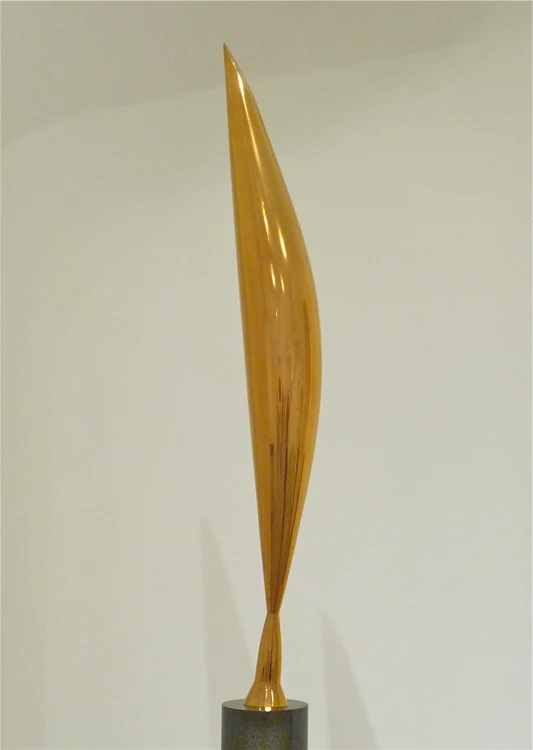
The bird in space PHOTO wikipedia
However, one issue remained unsolved: Brâncusi's art could not remain in the category of kitchen utensils. A legal battle ensued that profoundly changed the view of art and was the ruling that legally gave legitimacy to modern art. All the trouble started after the customs appraiser specified that all the works sold in the United States, by Brâncusi, will be taxed, because they are not art objects.
“Several highly respected people in the art world were asked to express their opinions and thus help the Government in this regard. One of these people told us that “if this is art, then I am a bricklayer”. And another told us that “dots and dashes are as artistic as any work by Brâncusi””stated the evaluator for “The New York Evening Post”.
Aided by his friends, Brâncusi sued the US government in October 1927. Opinions were divided. On one side were those with a conservative vision who did not consider modern art, art in the true sense of the word.
On the other side, those who appreciated Brâncusi's works and saw them as something new and extraordinary. “It suggests flight, grace, aspiration, strength and beauty, just as a bird does. But the name or title of the work alone doesn't really mean much”said an American artist.
In any case, in 1928, the court won Brâncusi's case. The “bird in space” was recognized as an art object in the United States. “Whether or not we agree with these new ideas and the schools that represent them, we believe that their existence and their influence on the world of art, as recognized by the courts, must be taken into account”reasoned the court.
It was not just a victory for Brâncusi, but for modern art in general. Brâncusi's sculptures convey a state, an emotion, an ideal, not just physical forms. This process led to the legal and cultural recognition of modern art and practically introduced abstract sculpture to international galleries, changing the way the public came to perceive art.