

In a broader perspective, when we include a chain reaction across the entire West Antarctic sector, we are talking about a potential increase of several meters – a scenario that would threaten hundreds of millions of people in coastal zones.
In January and February 2026, the research vessel Araon arrived in the area, and dozens of tons of equipment were then transported to the ice by helicopter in more than 40 flights. The team of scientists camped directly on the glacier's surface, in a place where the ice moves up to 9 meters a day.
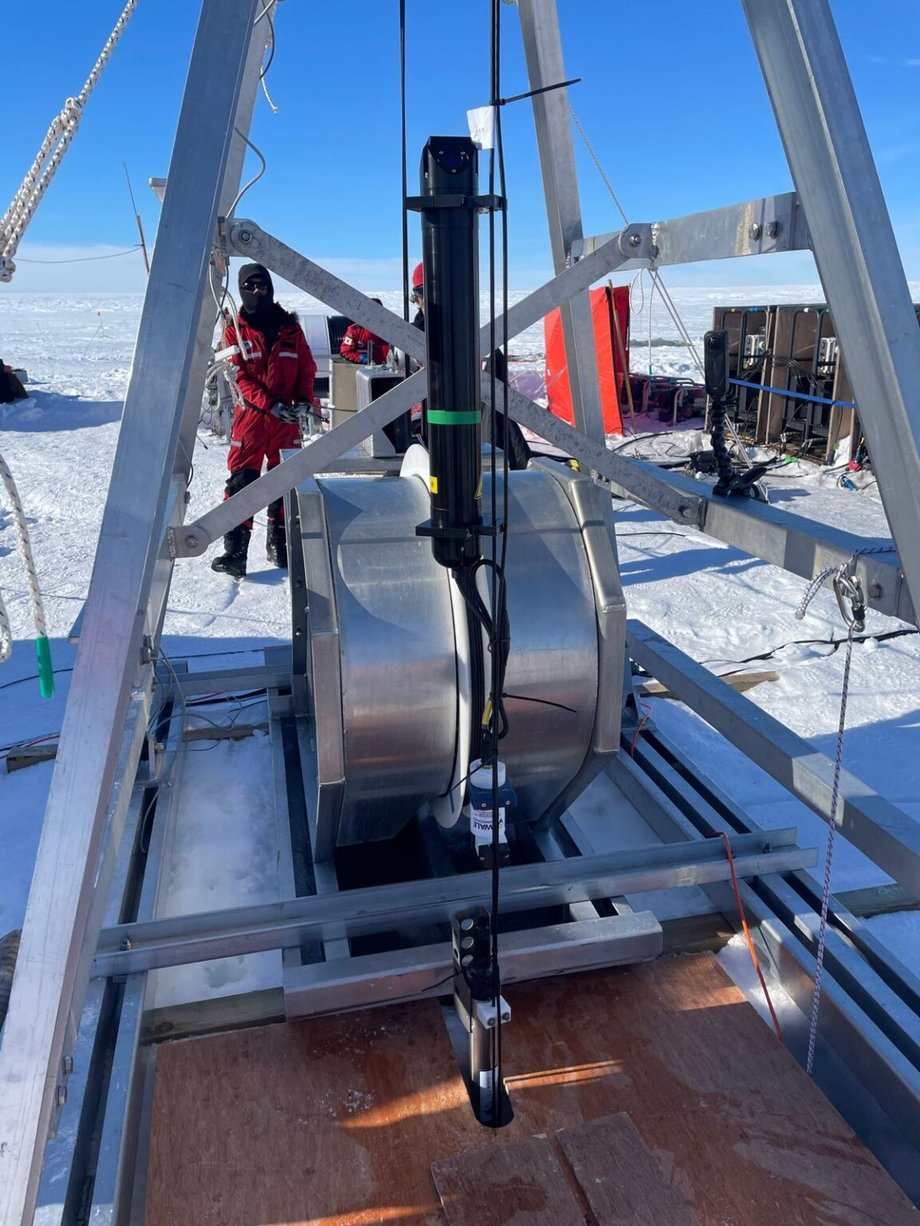
A drill used in the Arctic
For many days, researchers drilled and maintained a hole with a diameter of about 30 cm, using hot water under pressure – a temperature of 80 degrees Celsius allowed the ice to melt to a depth of over a kilometer. Every 48 hours the shaft had to be “refreshed”, otherwise it would freeze or deform under the pressure of the flowing giant.
- Read also: We visited the only fully operational mine in Greenland. It makes no money and there are no roads leading to it
Eventually they managed to break through to the ocean under the glacier. Scientists lowered the first probes and collected unprecedented data: the water is surprisingly warm, it is moving and actively eroding the ice from below. This confirms the worst predictions – the main mechanism of the accelerated melting of Thwaites does not lie in the warmer air, but in the ocean current that presses under the glacier and “washes” it from the inside.
You can see the video from inside the glacier below:
Escape without equipment
But then everything stopped. In the last phase of the mission, the team tried to install a heavy monitoring set – a system with batteries and a satellite transmitter that was supposed to operate autonomously for at least two years and transmit data continuously. As the instruments descended, they became stuck – most likely due to rapid freezing or deformation of the hole caused by glacier movement.
Time was running out: a bad weather front was approaching, hot water for drilling was running out, and the Araon had to leave. It was no longer possible to drill a new hole. Scientists made the most difficult decision – abandoning the equipment. Key equipment was buried in ice.
“The window for success is minimal”
Dr. Keith Makinson of BAS summed it up succinctly: “field testing always carries risk, and in such extreme conditions the window for success is minimal.”
Despite the disappointment, the team does not lose hope.
- Read also: The iceberg is melting at a dizzying pace. Scientists point to its shade
Professor Won Sang Lee emphasizes that even these fragmentary measurements are invaluable – they show that they have found exactly where the answer is needed. The warm and turbulent water beneath the glacier's main body is evidence that the melting process is proceeding faster than some earlier models suggested.
How much time is left?
Thwaites has been retreating at an accelerated rate for years – the line of contact with the ocean floor has moved kilometers away and ice flow has increased significantly since the 1970s. The latest mission unfortunately didn't provide long-term monitoring, but it did give scientists a new, direct look at what's going on underneath. It also showed how thin the line is between breakthrough and failure in such a hostile environment.


