The Industrial Revolution of the 19th century decisively changed the urban landscape in many developed areas of the West. Despite technological and economic advances, the industrial revolution gave rise to working-class slums that became dangerous places.
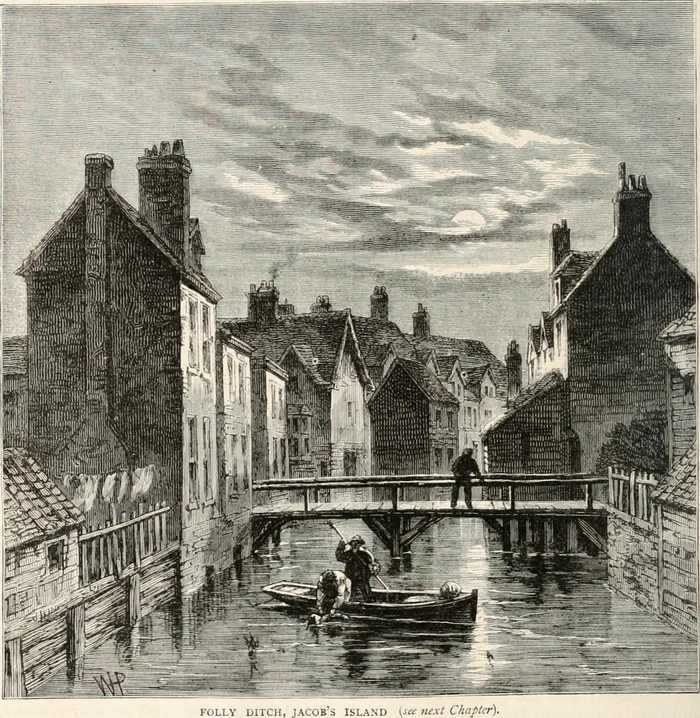
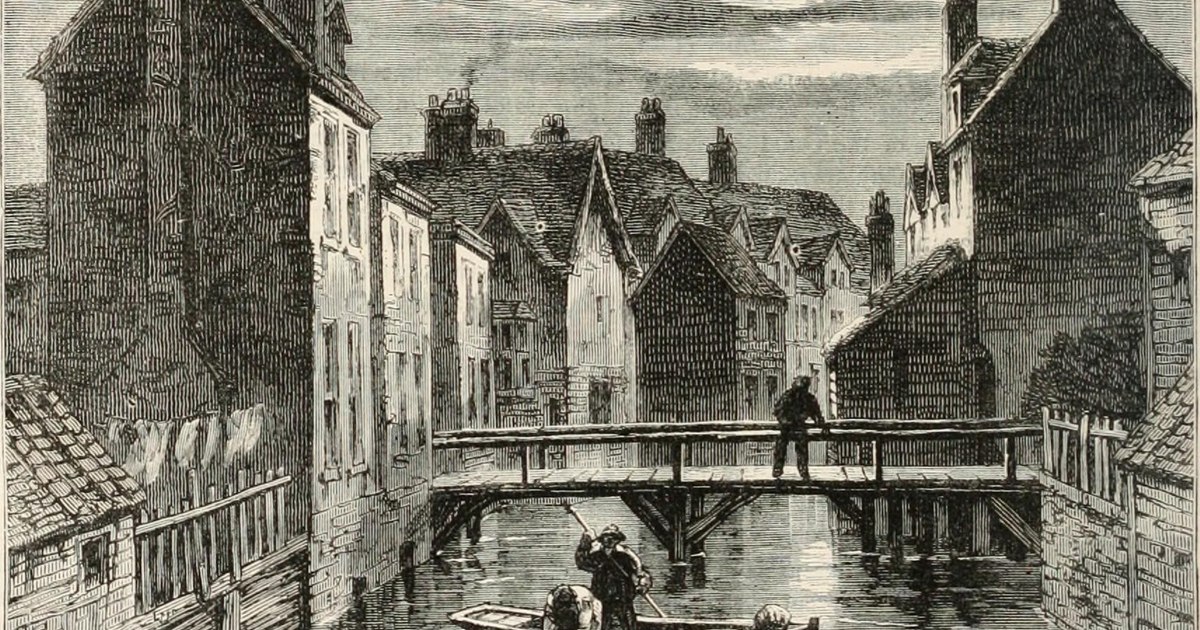
Jacobs Island PHOTO wikipedia
The industrial revolution, which began in England towards the end of the 18th century, represented a turning point in human history. In the 19th century, the industrial revolution, which will enter its second phase after 1870, spreads throughout Western Europe, the United States, and then gradually to Central and Eastern Europe. Inventions gave birth to machines, and machines created a new environment of production with revolutionary social and economic implications. The factory and the worker became a new urban reality. Cities grew rapidly but chaotically, trying to cope with the great exodus of population that came to settle near the production areas. As a direct consequence of rapid and unregulated urbanization, which also had to respond to a need for employers to bring in as many employees as possible, slums arose. There were those neighborhoods inhabited by immigrants, poor peasants who came to the city in search of a future, disinherited, criminals and all those who could not adapt or could not afford rent in a better place. These slums became areas of extreme poverty, overcrowded, disease-ridden, with high mortality and crime to match. Three of these have earned the reputation of 'Hell on Earth', being the worst places to ever live.
“Hell on Earth”, the place where the air was impossible to breathe
One of the most appalling neighborhoods of the 19th century was undoubtedly Jacob's Island, a slum in Bermondsey, London. It was situated on the south bank of the River Thames, bounded by the present Mill Street, Bermondsey Wall West, George Row and Wolseley Street. Jacob's Island had the reputation of a “Hell on Earth”, becoming popular also thanks to the novel “Oliver Twist” by the famous Charles Dickens. Jacob's Island was so infamous and unsanitary that the slum was effectively razed to the ground after 1860.
“On entering the precincts of Plague Island, the air smelled literally of a graveyard, and a feeling of nausea and heaviness came over anyone unaccustomed to absorbing the damp atmosphere. Not only the nose, but the stomach, told how much the air was loaded with sulphuretted hydrogen; and as soon as you crossed one of the dangerous and putrid bridges over the fetid moat, you knew, as sure as if you had chemically tested it, by the black color of what what had once been white lead paint on the door-posts and window-sills, that the air was thickly charged with this deadly gas. The heavy bubbles rising from time to time in the water showed you where at least some of the mephitic compound came from, while the open and doorless latrines hanging over the water, and the dark streaks of filth on the walls, where the drains of every house poured into the ditch, were proofs indisputable of the way in which the pollution of the ditch was produced”, it appeared in the London publication “Morning Chronicle” in 1848.
“The water was foamed almost like a spider's web and prismatic with grease. In it floated great masses of putrid algae, and on the bridge-posts were the bloated carcasses of dead animals, ready to explode from the gases of putrefaction. Along its shores were piles of indescribable filth, whose phosphorescent smell told you of the rotting fish there, while which oyster-shells were like pieces of slate because of their coating of filth and mud. In some parts the fluid was as red as blood from the coloring matter which poured into it from the stinking leather-closets.”it is mentioned in the same publication.
Even Charles Dickens described this slum in Oliver Twist:
“Crazy wooden galleries, common at the back of six houses, with holes through which you can see the mud below; broken and ragged windows, with posts pushed out, on which to dry linen that is never there; rooms so small, so dirty, so narrow, that the air seems too polluted even for the filth and filth they harbor; wooden rooms that creep above the mud and threaten to fall into it; mud-smeared walls and dilapidated foundations, every repulsive feature of poverty, every disgusting hint of filth, rot, and rubbish: all these adorn the shores of Jacob's Island”.
Unemployed workers, ballast workers, coal warehouse handlers, prostitutes or dangerous criminals lived in this place. It was unconscionable for anyone to venture into this place especially after dusk. He would most likely have been robbed and killed. If he hadn't contacted at least one disease. It was an area of extreme poverty but also of gregarious living.
A narrow dead end from which few came out to tell the story
Another slum of particular notoriety was “Bandit's Roost”, located across the Atlantic Ocean in New York City. Like Jacob's Island, it had such a frightening notoriety that the authorities decided to destroy it in the late 19th century. “Bandit's Roost” was a stuffy and extremely unsanitary alley located at Mulberry Street. 59½ from Lower Manhattan. Beyond the squalid poverty and squalor, the alley was also considered the most dangerous slum in mid-nineteenth-century New York. Located in the notorious Five Points neighborhood, an area of immigrants and illegal businesses, the alley served as a haven for criminals, gangs and poor immigrants.
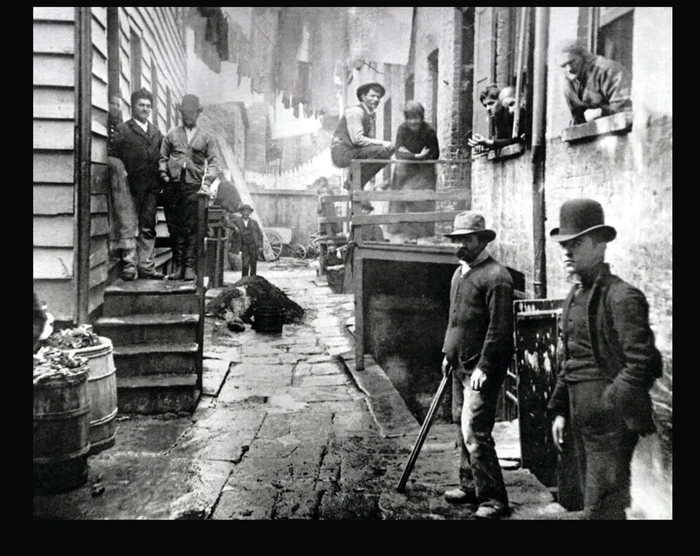
Bandit's Roost PHOTO getty images
She is best known for her 1888 documentary photograph by Jacob Riis, which she used to promote social reform and the building of new housing for immigrants. As the vintage photos show, torn or patched clothes hung to dry on the “Bandit's Roost”, garbage piled up, rats scuttled and droppings were thrown around the corners. The air was probably a bit more breathable than Jacob's Island. But in general, police don't recommend anyone venture into the area. Crime was huge. As a tourist, you risked, at best, walking out of that lane naked.
Places of Perdition in the City of Lights
Paris is a city with a long and very interesting history. In the 19th century, along with the social and economic transformations produced by the industrial revolution, the Parisian urban landscape also changed. The workers appeared and implicitly the slums. Paris had among the most infamous 19th-century working-class slums. At the top was “Île de la Cité”, an overcrowded, dangerous and dirty neighborhood. It was composed of a network of narrow and dark streets where a lot of crime took place. People driven by hunger were capable of robbing, stealing and killing. On the streets of the “Île de la Cité” slum, rats, criminals, homeless people, the unemployed and poor workers roamed. Diseases spread rapidly.
This is how the cholera epidemics of 1832 and 1849 appeared. The famous Les Halles slum was just as brutal and dangerous. Also called the “Belly of Paris”, it was actually a trading center for the lower population. It was full of stalls and street vendors. At the same time, the maze of streets that formed the neighborhood was full of criminals, robbers, pickpockets and traffickers. “It was a loud, boisterous and… smelly shopping mall,” wrote Emil Zola. Belleville and La Villette also had a reputation as violent neighborhoods. So is Montmarte (before redevelopment). There were places no one would want to enter. In some streets it was a miracle if any stray adventurer survived. Precisely because of the unsanitary conditions, the criminality, all these neighborhoods were effectively transformed by the effort of Baron Haussmann, under Napoleon III.