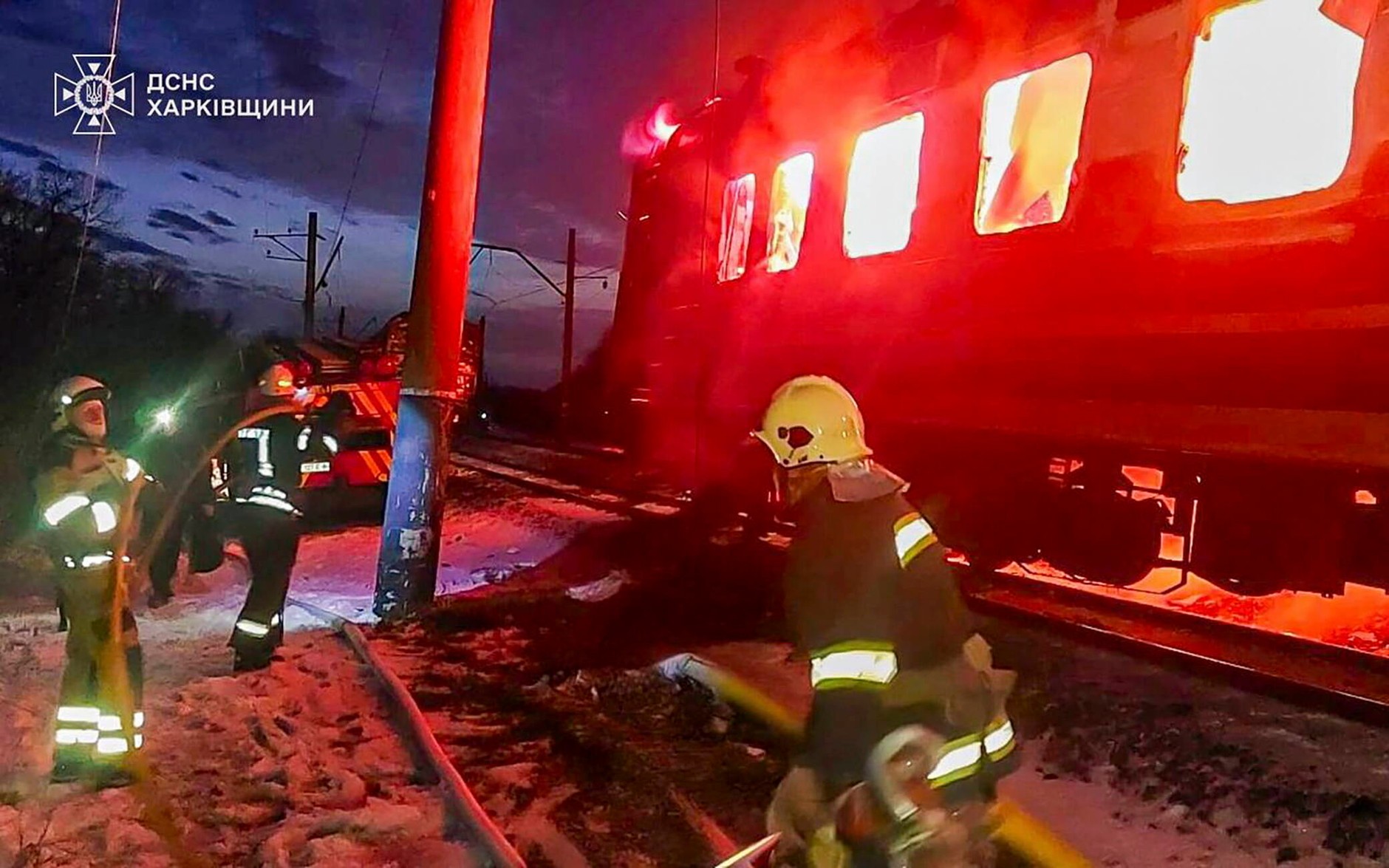
One drone hit one of the wagons, two more exploded in the immediate vicinity. According to the Ukrainian authorities, at least five people were killed and several others were injured. Ukrainian President Volodymyr Zelensky strongly condemned the attack that took place on January 27 this year. in north-eastern Ukraine, near Kharkov, over 50 km from the front line, calling it “terrorism”.
A passenger train burning as a result of a Russian drone attack in the Kharkiv Oblast, Ukraine, January 27, 2026.PAP/EPA/UKRAINE STATE EMERGENCY SERVICE HANDOUT / PAP
This marks another escalation of the drone war against Ukraine: for the first time, Russian kamikaze drones precisely hit a moving target far beyond the range of regular systems. For drone pilots to be able to use camera images to pinpoint a target at such a distance, they need communication systems from the West.
According to the latest analysis by the British think tank Institute for the Study of War (ISW), the latest Russian long-range drones are equipped with their own Starlink internet antennas, which enable communication with pilots at a distance of several hundred kilometers. According to ISW, Russia is equipping both smaller BM35 drones with a range of 500 km and Shahed drones with a range of over 2,000 km with satellite antennas from SpaceX, Elon Musk's space start-up. “The 500 km range for BM-35 drones equipped with Starlink means that most of Ukraine, all of Moldova, as well as parts of Poland, Romania and Lithuania are within the range of these drones if they are launched from Russia or occupied Ukraine,” ISW analysts warn.
After the train attack, Elon Musk quickly responded to criticism and suggestions that he turn off the Starlink satellite system in specific areas: when Polish Minister of Foreign Affairs Radosław Sikorski asked him on X: “Why aren't you stopping the Russians from using Starlinks to attack Ukrainian cities? Making money from war crimes can damage your brand,” Musk called him a “salivating imbecile” and explained that “Starlink is the basis of military communications in Ukraine.” So turning off the service is simply not possible.
However, Musk apparently is actually trying to cut off Russian drones from the satellite connection. On Sunday, he said that actions against “unauthorized use of Starlinks by Russia” have already brought results. Ukrainians claim that SpaceX cooperated with them to prevent the Russian military from using satellites.
The company informed the US government already in 2024 that it was trying to prevent Russians from using Starlinks. However, distinguishing between the two sides is extremely difficult and resembles a game of cat and mouse. Russian soldiers have repeatedly posted online photos of Western networking technology being used on the Russian side, including Starlink antennas on armored vehicles, in trenches and even on horses.
The article continues below the video
Ubiquiti Wi-Fi technology in use on the front
However, not only Starlinks are used on both sides of the front: As an alternative to satellite Internet, Russian troops are increasingly using the so-called mesh networkswhich are chains of Wi-Fi transmitters that transmit Internet data packets between devices. Devices from an American manufacturer of network technology have been particularly popular for several months Ubiquiti.
The brand's white devices are, in fact, optimized for connecting smart home devices, for complex Wi-Fi installations in private homes and companies, for connecting hotels or entire universities. However, radio technology has particularly appealed to the Russian military: American investigative startup Hunterbrook this week published research results on the use of Ubiquiti devices on the Russian side of the front to quickly and easily connect troops in front positions with Russian command structures using directional radio links.
A Ukrainian communications officer estimated in an interview with American journalists that more than three-quarters of the Russian radio bridges observed on the battlefield were Ubiquiti products. According to research, exports of this company's devices to countries neighboring Russia have increased by over 60 percent, which apparently means that external distributors are circumventing the ban on exporting network technology to Russia.
Ubiquiti relies heavily on third-party electronics retailers to distribute its devices outside the United States. After the report was published, the company's shares dropped significantly. The company has not yet issued any statement, and user questions on internal forums have been blocked.
Chinese civilian smart home monitoring technology also appears on the Russian side in the war in Ukraine. According to research by Western and Ukrainian camera analysts Hikvision and Dahua are used in occupied areas and frontline positions – for example, to monitor the terrain, secure supply routes and observe Ukrainian movements.
Both manufacturers continue to supply their products to the Russian market through civilian distribution channels – despite international sanctions. Due to the potential for their connected systems to be used for military purposes, countries such as the United States and the United Kingdom have banned the use of Hikvision and Dahua technologies in sensitive national areas. The Ukrainian government recognized both companies as “international sponsors of the war.”
On the Ukrainian front, a structural problem of modern warfare is revealed: the fight using drones and networks is conducted using advanced civilian technologies that are widely available around the world and remain largely beyond state control. Satellite Internet, Wi-Fi connections, cameras and routers have long become part of military infrastructure, often without the knowledge or influence of manufacturers. The attack on a passenger train near Kharkov shows how quickly this technology can transform from a product providing comfort into a tool of terror.
I’m Ashley Davis as an editor, I’m committed to upholding the highest standards of integrity and accuracy in every piece we publish. My work is driven by curiosity, a passion for truth, and a belief that journalism plays a crucial role in shaping public discourse. I strive to tell stories that not only inform but also inspire action and conversation.