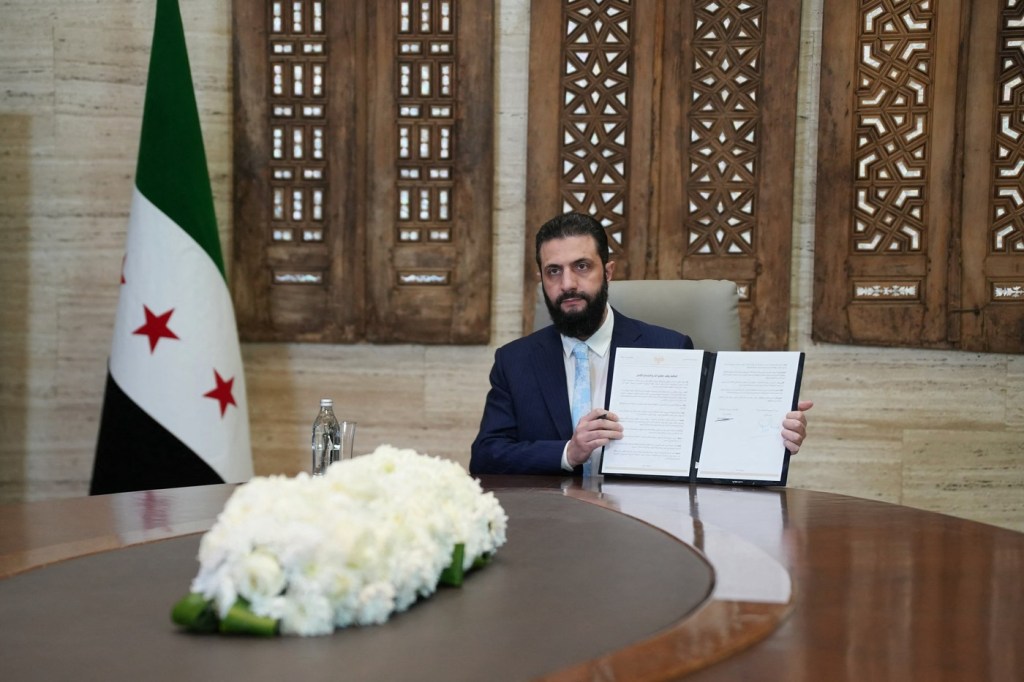
The agreement concluded on Friday between the Syrian government and the armed alliance led by the Kurds, the Syrian Democratic Forces (SDF), puts an end to the autonomous administration established by the Kurds and their partners in 2013, after the uprisings that shook the country during the Arab Spring, reports EFE, taken over by Agerpres.
The announcement that the Kurdish-Syrian institutions will integrate into the state structure comes after another previous pact, concluded a few days ago, was not successful, a pact that was made after government troops captured vast territories from the FDS-led alliance.
As early as March 2025, the two parties had reached an agreement in similar terms, which, however, did not materialize due to disagreements in several areas.
 Cease fire in Syria. The government in Damascus prevailed over the Kurdish militias
A 12-year autonomy for the Kurds
In March 2011, a popular uprising broke out in Syria, in the context of the Arab Spring protests, which degenerated into a civil conflict between the insurgents and the government of the then president, Bashar al-Assad.
In 2013, following the deterioration of the Syrian regime's control over the country's northeastern provinces due to popular uprisings, the Democratic Union Party (PYD) Kurds and their partners established an autonomous administration to manage the affairs of the region, which represented about a third of Syrian territory.
Kurdish militias gradually consolidated and, in 2015, drove the Islamic State (IS) organization from their stronghold of Kobani. While receiving US support in their fight against IS, the Kurds were being bombed by Turkey, which was expanding its war on its own territory against the PKK Kurds into Syria.
In March 2016, the Kurds unilaterally declared the creation of the Democratic Federation of Northern Syria, a federalized state within Syria, unrecognized by the authorities in Damascus and the opposition. In August, the Syrian regime bombed Kurdish areas of Al Hasaka for the first time, and in September the Kurdish militias, organized in the FDS armed alliance, accepted a truce promoted by Washington and Moscow.
2018, the year of maximum expansion of the Kurdish territory
In July 2018, the Syrian government and the Syrian Democratic Council (SDC), the political wing of the SDF, agreed to negotiate an end to the war and prepare a “road map” for a “decentralized and democratic” Syria.
At that time, the Kurds controlled most of the territory between the eastern bank of the Euphrates River and the borders with Turkey and Iraq, almost a fourth of Syria, distributed between the provinces of Aleppo, Al Raqa, Deir al-Zor and Al Hasaka. However, the agreement was not translated into concrete measures, nor did it recognize Kurdish autonomy, which Turkey is radically opposed to.
In March 2019, the defeat of IS in Syria was confirmed, with a decisive participation of the FSD militias, supported by an international coalition led by the USA, which conquered the last jihadist stronghold in eastern Syria, Al Raqa. A few months later, in October, the Syrian government offered FSD members to join the army loyal to President Bashar al-Assad, but the initiative was rejected by the Kurdish militia.
The offer coincided with the offensive launched by Turkey in northern Syria against the Kurds, who, after the defeat of IS, no longer counted on the same support from the Americans.
In October 2019, the Autonomous Administration of North and East Syria announced an agreement whereby the Syrian army would have access to Kurdish territories and deploy to Syria's border with Turkey to “prevent aggression” from Ankara. A few days later, the US and Turkey announced a truce, to which the FSD joined, leaving the security zone it requested on Syrian territory in the hands of Ankara.
Despite the truce, Turkey's fighting and bombing of the Kurds continued in the following years, triggering a humanitarian crisis after the February 2023 earthquakes in the region.
The new regime in Damascus
On December 8, 2024, the Levant Liberation Organization (the successor to the former Syrian branch of Al-Qaida), a coalition led by the Islamist Abu Mohamed al Jolani, alias Ahmed al-Sharaa, formed by several insurgent groups and supported by Turkey, overthrew the regime of President Bashar al-Assad, who fled to Moscow, after 12 days of siege.
In March 2025, the new Syrian president, Ahmed al-Sharaa, signed a historic agreement with the FSD to integrate Kurdish institutions into the Syrian state, establishing a truce as well as joint control over the northern and eastern regions of the country. However, the agreement did not become effective. Negotiations continued while clashes between Kurdish militia and government forces continued, with the latter retaking ground in Kurdish territories. The UN experts asked for the protection of Kurdish civilians and denounced the abuses committed during the offensive.
On January 19, SDF commander Mazlum Abdi confirmed a deal had been agreed with the central government in which the Kurds agreed to withdraw from two northeastern provinces to avoid a major conflict. The agreement materialized on Friday with the announcement of Damascus and the FDS regarding a “comprehensive” pact to integrate the Kurdish-Syrian institutions into the state structure.