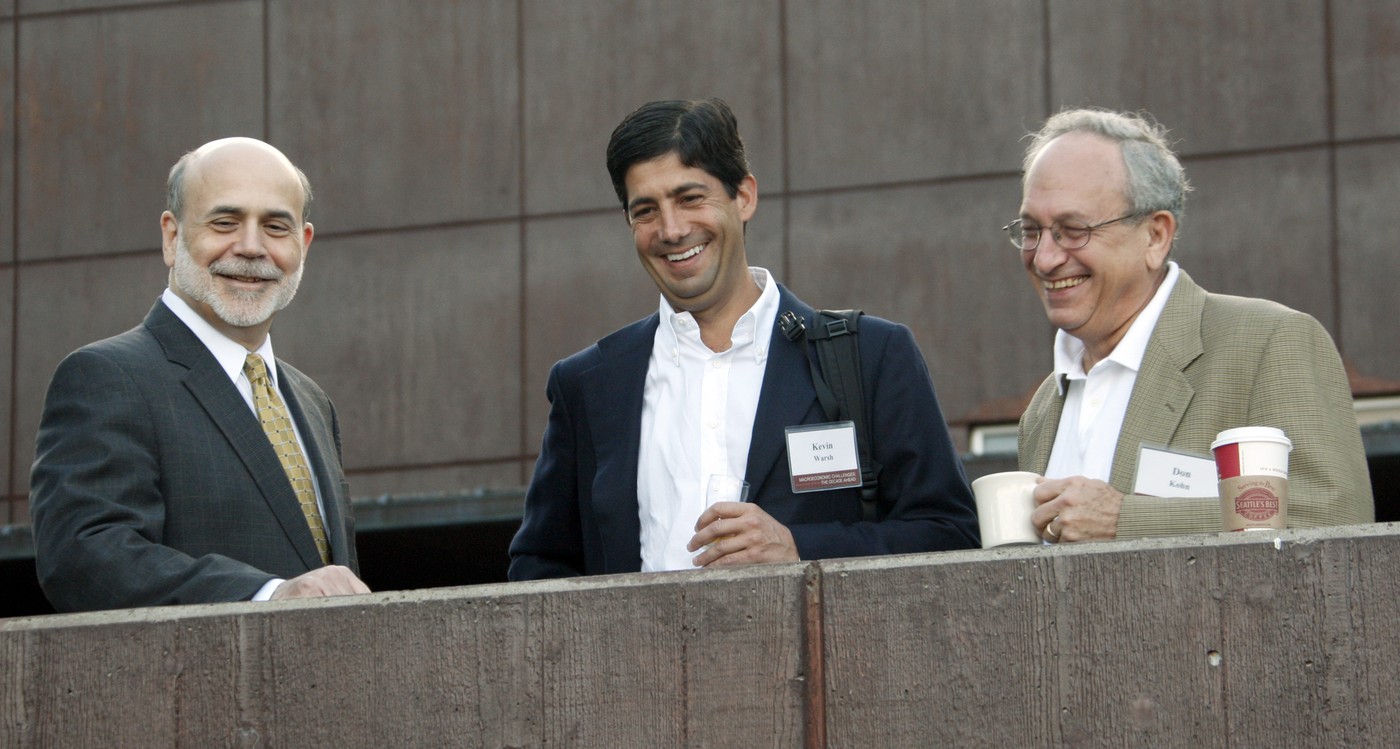
Former Fed Chairman Ben Bernanke (left) with Kevin Warsh, Trump's favorite to head the Fed, and Donald L. Kohn, former governor of the Dallas Fed. Credit line: Reed Saxon / AP / Profimedia
Kevin Warsh is an American financier and lawyer, best known for being a member of the Board of Governors of the Federal Reserve (the US central bank) from 2006 to 2011. He was instrumental in managing the 2008 global financial crisis and is frequently mentioned as a possible future Fed chairman.
Business card
Full name: Kevin Maxwell Warsh
Born: April 13, 1970, Albany, New York
studied:
- BA in Public Policy – Stanford University
- Doctor of Laws (JD) – Harvard University
- in economics and public policy at MIT
Career:
Member of the Federal Reserve Board of Governors (2006–2011). When appointed, he was the Fed's youngest governor.
He was a key intermediary between the Fed and Wall Street during the 2008 crisis.
He represented the Fed in the G20 and in economic dialogues with Asia.
Prior to the Fed, he was economic advisor to the president and executive secretary of the National Economic Council in the George W. Bush administration.
After Fed:, he was a Senior Fellow at the Hoover Institution (Stanford).
He teaches at the Stanford Graduate School of Business.
Member of the boards of directors of some large companies.
In 2026, Kevin Warsh is seen as a leading candidate for the post of chairman of the Federal Reserve, a possible successor to Jerome Powell, with support from the political zone of former President Donald Trump.
How Kevin Warsh thinks about the economy
Inflation: “it's not an accident, it's a failure of economic policy”
Warsh is from the hawkish camp. The “hawkish” camp in the Fed is the group of Federal Reserve members who prioritize fighting inflation, even at the cost of slower economic growth or the risk of higher unemployment.
In monetary policy jargon, “hawkish” describes a stance in favor of higher interest rates to keep inflation under control.
Hawkish members typically support rate hikes or keeping rates high and are less willing to ease monetary policy quickly.
Warsh believes the Fed reacted too late to post-pandemic inflation and sees inflation as the result of too cheap money and tolerating fiscal excesses. He rejects the idea that inflation is only “temporary” or “external”.
Money printing (QE): “we overdid it”
Warsh is a vocal critic of prolonged quantitative easing (QE); the Fed's huge balance sheet and the idea that the central bank can solve any economic problem.
He says, in short: The Fed has become too big, too political and too comfortable.
Fed Independence: The Warsh Paradox
Here it is interesting: declaratively, he is a defender of the independence of the central bank. But practically, he is close to Donald Trump, who has frequently attacked the Fed.
The risk perceived by the markets: a more “politicized” Fed, even if the speech is pro-independence.
What Warsh would mean at the helm of the Fed
For financial markets:
❌ less tolerance for speculative bubbles
❌ fewer “gifts” for scholarships
✔️ a stronger dollar
✔️ higher volatility in the short term
Wall Street wouldn't love him. But interest rate traders would take it very seriously.
The difference with Jerome Powell
Powell is cautious, incremental. Warsh is tougher, more doctrinaire.
Powell prefers “reassuring” communication. Warsh a sharper one
Powell favors a gradual reaction. Warsh prefers decisive reactions
Conclusion: If Warsh becomes Fed chairman, inflation becomes enemy no. 1, no excuses; markets will be more nervous. And the Fed will look more like an “old school” central bank, less like a stock market stabilizer.