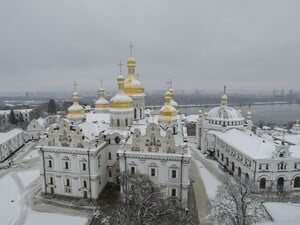
“For the first time since the Second World War, the Kiev-Pechersk Lavra facility was hit as a result of military operations. Every time Moscow is behind this, as it was in 1918; as it was when, on orders from Moscow, the Assumption Cathedral was blown up in 1941, and on orders from Moscow, Shahed-type drones and missiles are now flying across Kyiv, including causing damage now Kiev-Pechersk Lavra,” said Ostapenko.
The director of the reserve clarified that buildings No. 66 (entrance to the Far Caves complex) and No. 67 (Annozachatyevskaya Church) were damaged.
According to him, some of the windows and doors were knocked out by the blast wave. Fragments of plaster finishing were also damaged. The caves themselves were not damaged, Ostapenko said.
He also noted that for the first time the Lavra received direct damage as a result of an explosion of an air target. Previously, damage from shrapnel was recorded, and debris from downed objects was also found.
The general director also said that due to a power outage, the seismic sensor, which allows determining the impact of the explosion on the objects of the reserve, did not work.
Deputy Prime Minister for Humanitarian Policy – Minister of Culture Tatyana Berezhnaya said that specialists from the reserve and the National Police worked on the spot.
“Today we will conduct a detailed technical examination and immediately begin restoration and conservation,” she wrote on January 26 on Facebook.
Berezhnaya also stated that since the beginning of the full-scale invasion, 1,640 cultural heritage monuments and 2,446 cultural infrastructure facilities have been destroyed.
“This year the Lavra celebrates its 975th anniversary. And right now Russian missiles are hitting it. The world should know: this is a war not only against Ukraine. This is a war against world culture,” added the Deputy Prime Minister.
Context
The cultural heritage site “St. Sophia Cathedral and adjacent monastic buildings and the Kiev Pechersk Lavra” has three international statuses. Since 1990 it has been a UNESCO World Heritage Site, and since 2023 it has been a UNESCO World Heritage Site under threat. It is also included in the international list of cultural properties that are under enhanced protection (since 2023). The mechanism provided for by the Second Protocol to the 1954 Hague Convention for the Protection of Cultural Property in the Event of Armed Conflict is applied to it.
On the night of January 24, the Russian Federation fired 396 missiles and drones at Ukraine, including two 3M22 Zircon anti-ship missiles, six Iskander-M/S-300 ballistic missiles, 12 Kh-22/Kh-32 cruise missiles and one Kh-59/69 guided missile. Air defense forces shot down 15 missiles (in particular, nine Kh-22/Kh-32) and 357 UAVs. Two missiles and 18 drones were hit at 17 locations. Drone debris fell in another 12 locations.
As a result of the attack, destruction was recorded in five districts of Kyiv, the mayor's office reported. On the left bank of the capital there were interruptions in heating and water supply. In the morning, the “green” line of the Kyiv metro operated in limited mode due to shelling. The Roshen factory was damaged, where a woman died.