The frescoes that caused a stir in the station in Hunedoara, in danger. Socialist paintings, admired even by Nikita Khrushchev

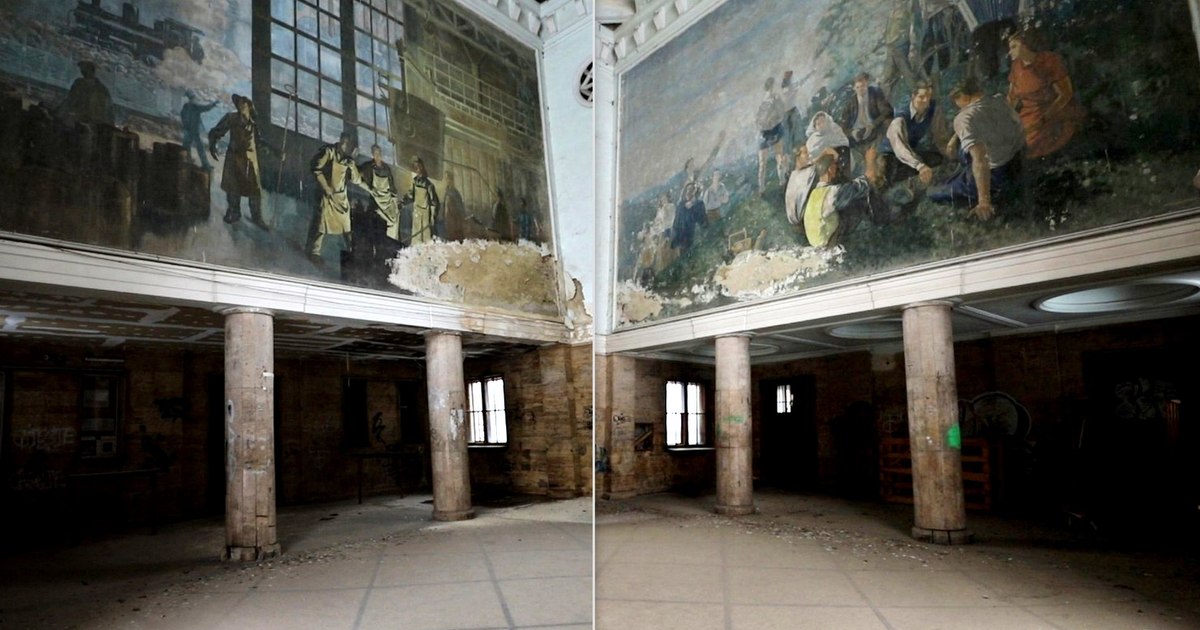
Two monumental paintings that have adorned the station in Hunedoara for over seven decades have reached the threshold of disintegration. In the past, they attracted all eyes, but the station has been closed for eight years, and the paintings have been left to their fate.
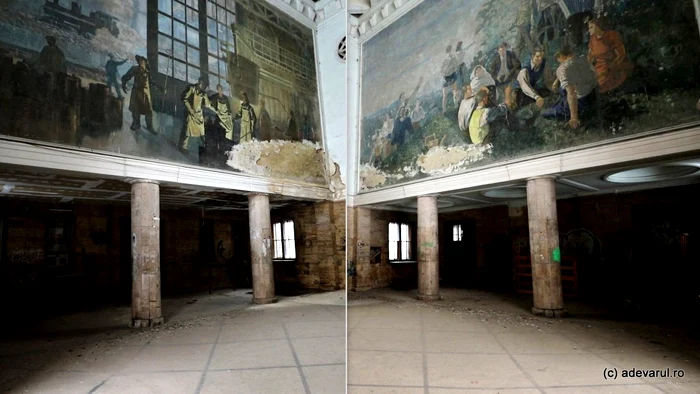
The paintings in Hunedoara train station, increasingly degraded. Photo: Daniel Guță. TRUTH
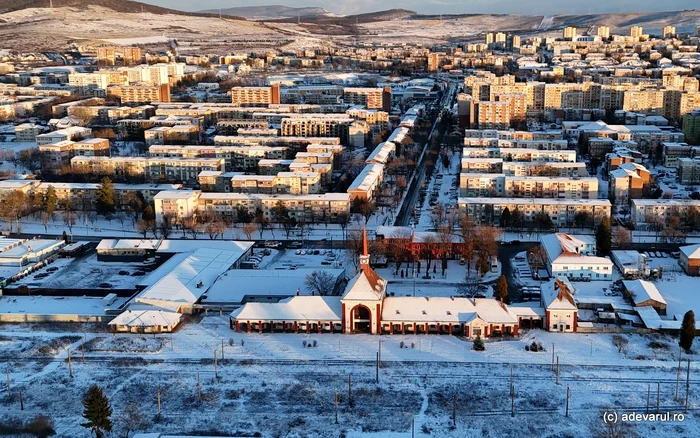
Built in the early 1950s, the station of Hunedoara municipality has been closed since 2018, when train traffic on the Simeria – Hunedoara route was stopped indefinitely. Meanwhile, access to the premises of the passenger building was prohibited, in order to delay its degradation.
Among the broken windows and iron bars of the entrances to the station hall, visitors to the CFR station can see two large frescoes, made in the socialist-realist style that dominated the art of the 1950s.
The paintings that caused a sensation in Hunedoara
The paintings were made by Paul Miracovici (1906–1973) and depict work in the city's steelworks and locals relaxing on a hill in Hunedoara. The scenes were admired even by Nikita Khrushchev, leader of the Soviet Union, who was received with honors in Hunedoara railway station, during his visit in 1962.
“The passenger entrance hall is of monumental size, with two openwork portals towards the square and platform, made of prefabricated reinforced concrete elements, and on the side walls, two panels decorated in fresco by the painter Paul Miracovici. The ceiling is treated in boxes. In the facade, this hall is expressed by a raised body with an arrow, dominating the whole composition and constituting, at the same time, the architectural element that forms the end perspective of the main artery”, it is shown in the sketch presented by the architects, published in the book “Windows to the Red Furnace. Urbanism and daily life in Hunedoara and Călan (1945-1968)”, by Mara Mărginean.
The works at the Hunedoara CFR station were carried out in 1953, and the new station since then took the place of an older railway station, built around 1884, together with the Simeria – Hunedoara railway line, about 18 kilometers long. His appearance was appreciated by specialists.
Hunedoara train station. Photo: Daniel Guță. TRUTH
“Taking a series of realist-socialist compositional “citations” in a very close form, such as the roof line or the decorative sequences of the facades, the building became, shortly after its completion, an emblem of the city, even if none of the architects involved in the design, Titu Dan Elian and Dan Virgil Marinescu, were famous names in the profession. The plans made by the two were supplemented by the contribution of the painter Paul Miracovici, whose fresco painted in the central hall of the building, in turn, took on the Soviet influence, through the idyllic representation of foundry work and daily life”, stated the researcher Mara Mărginean.
The station remained closed, the frescoes increasingly degraded
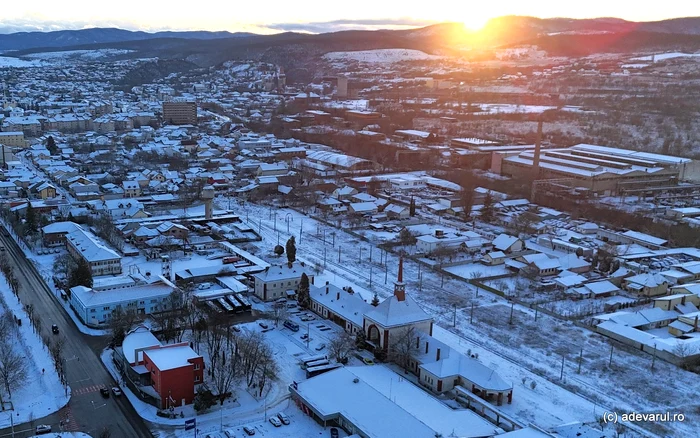
Eight years after the closure of the station, it has remained in preservation, but its frescoes are increasingly affected by dampness and mold. In 2021, the Hunedoara City Hall sent the Timișoara Regional Railway Branch an address expressing its definite desire to take over the administration of the CFR station building in the municipality, but the efforts were not successful.
The station remained closed and the frescoes continue to decay, along with the roof and tower decorated with a socialist star. A layer of fallen paint has gathered beneath the paintings, while the damp-affected surface continues to spread over the painting. Many locals have complained about the condition of the paintings and claim they need restoration.
Hunedoara train station. Photo: Daniel Guță. TRUTH
“Those paintings show, on one wall, people working, and on another wall, people relaxing happily with their families on green grass. They should be urgently restored.” advertises a Hunedorian, on Facebook.
Others remember the many commuters, employees of the steel plant, who kept their eyes fixed on the old frescoes.
“God, I can't get enough of looking at them, with their imposing size… they are gorgeous!”, recalls a local woman.
Others look at them with nostalgia, remembering the atmosphere in the spacious hall of the station.
“The train station of my childhood gave me emotions. That train station used to hang out and wait for me from vacations at my grandparents. It used to be the most beautiful train station”, someone else remembers.