The war in Ukraine is not fought only on the front. Its facilities operate thousands of kilometers away – in Chinese drone factories. It is there, on the same production lines, that Russian and Ukrainian buyers purchase key components. The story of Oleksandr Yakovenko shows how Chinese industry has become an invisible participant in the conflict – he writes in the Financial Times.
At first glance, a short story about Oleksandr Yakovenko, currently one of the largest drone manufacturers in Ukraine – TAF Industries. During his numerous visits to factories in southern China, Yakovenko noticed an “interesting” relationship. The hosts are increasingly planning his arrival with precision worthy of a Swiss watch. Sometimes they also ask him to wait and then they lead him through side doors, through technical corridors or into empty rooms.
It took some time for Yakovenko to understand why extreme punctuality and rotating schedules were practiced. This is because there were Russians in the factories at the same time, either they had just left or were on their way – we read further in the FT.
Customer management as a strategy?
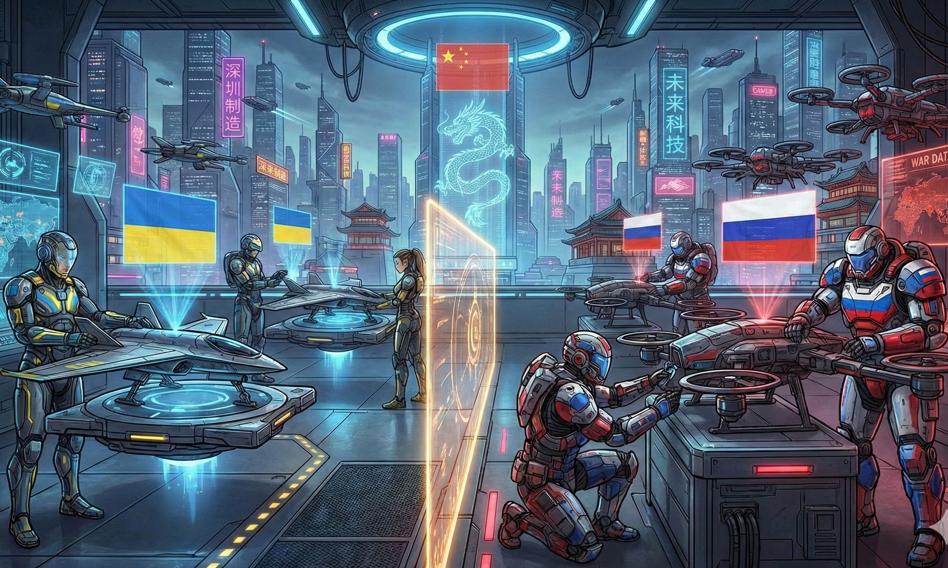
The idea is to prevent customers from Ukraine and Russia from being in the factory at the same time. In the same factory and the same case. So, when a car leaves from Russia, a Ukrainian one comes in.
Because drones are currently one of the most effective and fastest-growing weapons, accounting for three-quarters of recent casualties – both Ukraine and Russia are taking steps to expand their own production capabilities, using mainly components from China.
Armies now depend on the same Chinese suppliers whose processors, engines and cameras determine how far the drone can fly and how clearly it “sees”. These components cost one third of what their Western counterparts cost.
Hundreds of kilometers from the front, Russian and Ukrainian supply chains intersect in industrial parks and anonymous office buildings in Guangdong and Shenzhen. In these places, small drone components are created that keep the war going, and factories try to organize production so that neither side is ever in the same plant at the same time – we read further in FT.
“Okay, we can sell it to you too.”
Technological progress reaches both sides almost simultaneously. “When we see a new video transmitter on a Russian drone, we can immediately identify the Chinese manufacturer,” says Oleksiy Babenko from Vyriy Drone, another major supplier to the Ukrainian army. “We contact the company and at first they deny it. After a few questions, however, they agree to sell us these components.”
This mechanism also works the other way round. “We order something specific for ourselves, and soon the same technology goes to Russia.”
For Oleksandra Yakovenko the situation is somehow ironic. On the front, his team has to improvise due to parts shortages, while the opponents seem to have full access to the latest Chinese technological solutions – we read further in FT.
China remains neutral in the conflict
Although China officially maintains neutrality in the conflict and has suspended the export of sensitive drone technology to both Russia and Ukraine, Western intelligence sources and Ukrainian experts say Beijing still controls access to these technologies. In practice, wealthier Russian companies can buy entire production lines and move them to Russia, despite international sanctions and China's own regulations.
Ukraine is trying to develop domestic production of drones, but according to Yakovenko still in about 85% of cases it has to rely on Chinese components. This applies primarily to simple drones with a first-person view, remotely controlled and equipped with on-board cameras, often used in precision attacks – reports FT.
Chinese domination and WeChat groups
According to Drone Industry Insights analyses, China is currently responsible for 70-80% of the global production of commercial drones, and also dominates the production of key elements such as speed controllers, sensors, cameras and propellers.
This technological advantage makes China a silent but strategic player in the Ukraine conflict. Catarina Buchatskiy from the Kiev think-tank Snake Island Institute emphasizes that Beijing in practice has a huge influence on the course of the war: They could decide at any time whether to supply the Ukrainians or not. The drone has become an indispensable weapon today, and this shows China's real influence on the outcome of the clashes.
The Chinese Ministry of Foreign Affairs assures that the country maintains an objective and fair stance towards the crisis in Ukraine. It certifies that it has never supplied lethal weapons to either side and that the export of dual-use goods, including drones, is strictly controlled.
However, many decisions regarding the war are made thousands of kilometers from the front, in production halls in Guangdong and Zhejiang. It is there, in virtual discussion groups on WeChat or during informal meetings over baijiu in hotels, that important decisions are made.
“It's crazy,” he says Buchatskiy – because there is a fierce war going on, and at the same time both sides are negotiating in the same group chat, where the Chinese factory says: Russians pay more, we are sorry, but come back next year – we read further in FT.
prepared by WM