The viral speech of the Prime Minister of Canada and the lesson for Romania: “If you are not at the table, you are on the menu”. Expert: “The ostrich policy is not helping us”

“The middle powers must act together, because if we are not at the table, we are on the menu“, Canadian Prime Minister Mark Carney said in Davos. What this means for Romania was translated by foreign policy analyst Ștefan Popescu.
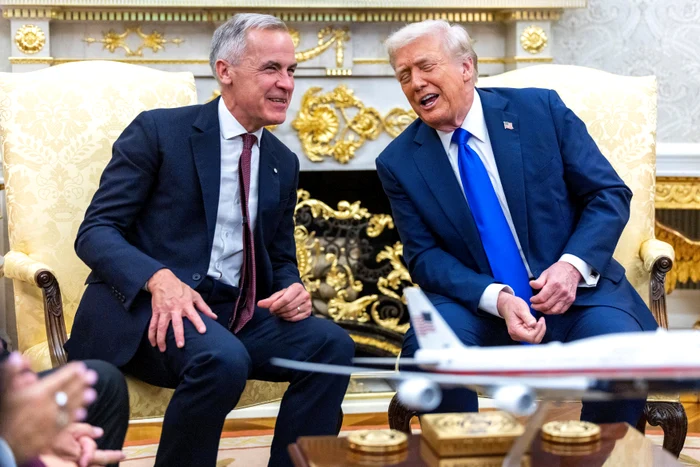
Canadian Prime Minister Mark Carney charged Trump at Davos. PHOTO: Profimedia
Canadian Prime Minister Mark Carney delivered one of the most direct and uncomfortable diagnoses of the postwar international order at the World Economic Forum in Davos on Tuesday: the rules-based global system dominated for decades by the United States is over.
Several accounts note that his speech was very well received, and some sources write that he received a standing ovation from the attendees. It is also reported in the international press that Carney's speech was considered by some of the participants to be remarkable and went viral after it was posted on the Prime Minister's Facebook page.
Since entering Canadian politics in 2025, Carney has repeatedly warned that the world will not return to a pre-Trump normalcy. He reiterated that message Tuesday in a speech that did not mention Trump but offered an analysis of the president's impact on global affairs.
“We are in the middle of a rupture, not a transition”Carney said.
He noted that Canada benefited from the old “rules-based international order”including “American hegemony”which “contributed to the provision of public goods: open sea lanes, a stable financial system, collective security and support for dispute resolution frameworks”.
A new reality has set in, Carney said.
“Let's call it by its name: a system of increasingly intense rivalry between great powers, in which the most powerful pursue their interests using economic integration as a tool of coercion.“
In an apparent warning against attempts to appease the great powers, Carney said states like Canada can no longer hope that “following the rules will buy them safety“. “He won't”he said.
“The question for middle powers like Canada is not whether they have to adapt to this new reality. They have to. The question is whether we adapt by simply building higher walls – or whether we can do something more ambitious.”
“The middle powers must act together, because if we are not at the table, we are on the menu”Carney said.
“The great powers can, for now, afford to go it alone. They have the market size, the military capability and the leverage to dictate terms. The middle powers do not“, the prime minister concluded.
Ștefan Popescu: “The ostrich policy does not help us”
The speech was considered “historic” by many international and Romanian analysts. Security analyst Ștefan Popescu analyzed for “Adevărul” what lessons Romania should learn from this speech.
“The Truth”: Prime Minister Carney has announced that the global rules-based system is on the way out. In this context, should Romania also change its international policy strategy?
Stefan Popescu: So there is no doubt that Romania's foreign policy strategy had to be changed a long time ago, because we had the signs of the world changing, of the repositioning of the United States of America since the last year of Joe Biden's presidency, when the United States entered a phase of dialogue with the Russian Federation.
One could also anticipate the consequences for the European project of the crisis in Ukraine and, of course. This anticipation could all the more be realized with the installation of the Donald Trump administration in power, with the first steps taken by the Trump administration in foreign policy. One could look for anchors, dialogue partners with interests in the Black Sea region. The relationship with China could be protected from a dull strategy, devoid of any vision and framed in some small ideological patterns. The launch of new forms of cooperation with neighboring countries and those in the extended Black Sea basin, which will increase Romania's relevance, including for the United States of America, as well as a more active European policy.
It is incomprehensible that the president of Romania sits awkwardly at summits in which European leaders participate. In 8 months I believe that all the capitals of the European Union could be visited and exposure could be gained, to gain familiarity in the dialogue with European interlocutors, to improve our ability to evaluate EU positions.
All these things, unfortunately, have not been done and the crowning achievement is our absence at the highest level from the World Forum in Davos. I think ostrich politics is not helping us. All the more so since at Davos, first-rate economic actors also participate, business is discussed, and Romania, beyond this shock in the transatlantic relationship, the shock represented by the economic consequences of this crisis, and by the reconfiguration of the economic models of our main economic partners, primarily Germany, seems more dangerous to me.
“This direction evoked by the Canadian Prime Minister is a confusion of wishes with reality”
The Canadian Prime Minister says at one point that the old rules-based world order is not coming back, and from this fracture a more honest and balanced order can be born. What kind of fairer and more balanced order is he referring to? How can this be born?
I think it's more of a wishful thinking. A desirable if most states of the world will cooperate in this direction. Because at the moment we are in a period of transition. As we know from history, transitional phases are marked by power relations, dysfunctions in the institutions and rules that characterized the past international order.
And from these points of view, I think that a more balanced order is a desire that we all share, but which I do not think is a safe direction considering the appetite of the big actors with the capacity to act on the international system – I am thinking first of all of the United States of America, but also of the Russian Federation, China – to privilege agreements between the big ones, to appeal to force, that it is about military force, but also economic and political pressures. This direction evoked by the Canadian Prime Minister is a wishful thinking (a confusion of wishes with reality-no).
The middle powers must act together or risk becoming simple objects of the game of the great powers – says the Prime Minister of Canada. What does this entail?
If they will act in unity, but for the moment I do not see this unity even in terms of the great European powers. So those that are from the European Union do not ensure a unitary and clear direction of the European Union.
We learn that Germany wants to temper the momentum of France, of President Emmanuel Macron to give an answer also in the commercial and economic field to the United States of America. I noticed the lack of alignment of the countries that sent troops symbolically to Greenland. Germany and the Netherlands withdrew them after two days, without coordinating with the other countries participating in the Arctic exercise. For the moment Italy did not associate, on the contrary it criticized the approach of the coalition of countries that sent troops to Greenland. There is also no unified European position on whether or not to join the Peace Council proposed by the President of the United States, Donald Trump.
In this context, is the EU-Mercosur agreement part of this joint action of the middle powers?
I'm ready to prove him right on paper. But the question is to what extent the impact of this agreement on Romania has been analyzed in depth, both in terms of benefits, but also risks, and at the same time the materialization of the agreement in the conditions in which the United States of America does not seem willing to accept rival powers, including from an economic point of view, in the continental bloc.
Reference is made to Article 5 of NATO, with Canada's Prime Minister claiming that his country is “unwavering” in its compliance…
Statements showing commitment to Article 5 show willingness to participate in coalitions of the will. But the degree of uncertainty about the application of Article 5 is greater than ever, but it has never been an automatic process, the triggering of Article 5. Even in the best times of the North Atlantic organization it was not automatic.
“Speeches of small and medium powers at Davos are more image exercises”
The Canadian Prime Minister proposes a kind of counterbalance for the great powers.
This is all about confusing wishes with reality. At the moment, I do not perceive that critical mass that would stop the worrying evolution we have reached. Even within the European Union I do not see that critical mass.
I know of no effective counterweights to the great powers in history. Maybe there is, but I don't know.
Even the European Union, which does not have a foreign policy, is not united. Not even economical. From the point of view of some economic measures, of some energy strategies, I do not see unity between the member states.
Beyond the excitement I see in certain circles, what are we left with from this discourse?
In Romania, we get inflamed very quickly, we pick up slogans, we don't really have the ability to look with detachment. The speeches of the small and middle powers at Davos are more image exercises. We have to see beyond the applause. We have to see if these speeches will translate into decisions. I believe that each country in a selfish, pragmatic way will make its calculations and seek to adapt. That some countries will create certain coalitions, certain formats that will allow them to go through this period more easily, I agree, I think it is possible, but… the transitional phases in the international system are always marked by power relations and the dysfunctionality of the old rules. That's why references to international law, sure, from an ethical, moral point of view, matter, but only that.
“The worst sufferers are the middle powers of the Western world”
And in this context do you think we are moving towards a world where the great powers do more or less what they want?
It's the 19th century idea of balance. The balance of great powers. I don't know if that's where we're heading, but that's where we are at the moment. And the middle powers participate in this balance to a greater or lesser extent. But the worst sufferers are the middle powers of the Western world, who are delegitimized at the moment. And also hit by the emancipation process of the countries of the Global South. Therefore, their ability to have an international audience is very low. Canada is certainly an average power, but it is an average power located towards the bottom of this category. The middle powers located at the upper threshold of the Western world, France, Great Britain, are strongly delegitimized by this emancipation and cultural, cultural-strategic phenomenon in the Global South. You saw the ease with which France lost the French-speaking Sahel. Elites and local societies were crossed by a current of emancipatory history that caused everything to collapse in a very short time, without any effective reaction capacity on the part of the French state.
And do you agree with this picture that we are moving towards a world without rules, without principles, where the most powerful decides?
I do not entirely share this situation, because we are not in a world without rules. Balance of power, strategic dialogue, all these exist. Even if they are the rules of the big ones. There are certain rules that apply, even if they are more about the foundations of relations between states established after the Peace of Westphalia and then after the defeat of Napoleon.