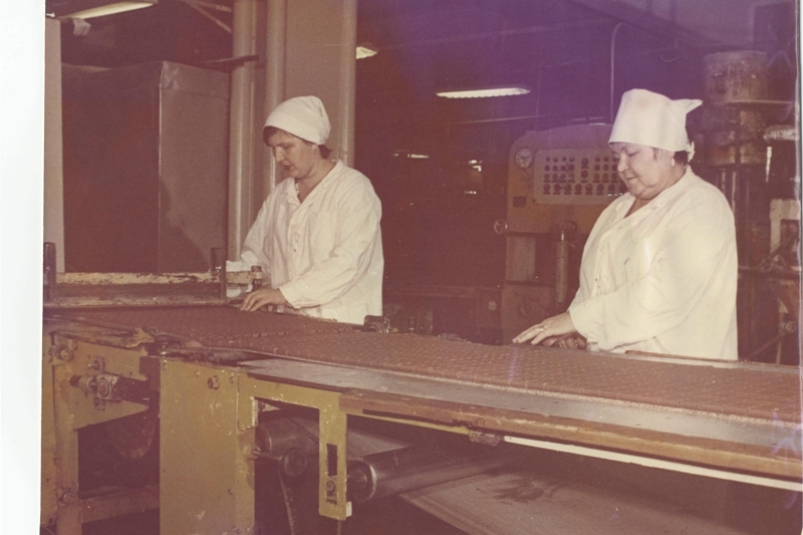
Birobidzhan confectionery factory. The process of packaging sweets. 1990s
Photo: State Archive of the Jewish Autonomous Region
January 21, 1947
In the newspaper “Birobidzhan Star” (12+) on January 21, 1947, an article was published that the Birobidzhan confectionery factory, built in accordance with the government decision on measures to strengthen and develop our region, came into operation and already on January 15 the factory produced its first products.


Confectionery shop of the Birobidzhan confectionery factory. 1955. Photo: Photo: State Archive of the Jewish Autonomous Region
“The launch of the factory coincided with preparations for the elections to the Supreme Soviet of the RSFSR. Our team decided to celebrate the national holiday – election day by exceeding the production plan. The gingerbread shop should bake 600 kilograms of gingerbread per shift, but in fact one ton is baked. The first batch of four varieties of sweets was made for testing. Construction work did not stop with the launch of the factory. All workshops have a water supply system, and shower equipment is being completed. workers. Soon the engine we have will be started, and the factory will receive its own electricity…”

Clippings from the newspaper “Birobidzhan Star”. Photo: Photo: Regional Library
The same newspaper published a large material about the elections to the Supreme Soviet of the RSFSR and the candidate for the Birobidzhan electoral district – Ratner Shakhno Izrailevich – professor, doctor of medical sciences.
January 21, 1977
The newspaper “Birobidzhan Star” on January 21, 1977 published on its pages the Decree of the Presidium of the Supreme Soviet of the USSR on awarding orders and medals of the USSR to the leading agricultural workers of the RSFSR.
In the Jewish Autonomous Region, the following were awarded the Order of Lenin: Kuznetsov Anatoly Borisovich – manager of the Dobrinsky state farm, Leninsky district; Matafonov Sergey Markovich – manager of the Nadezhdinsky state farm, Birobidzhansky district; Smolyakova Olga Iosifovna – pig farmer of the Birushkinsky state farm, Birobidzhan region; Tonkikh Vladimir Evstafievich – manager of the Pogranichny state farm, Oktyabrsky district.

Clippings from the newspaper “Birobidzhan Star”. Photo: Photo: Regional Library
The Order of the October Revolution was awarded to: Budaev Alexander Grigorievich – unit leader of the Bidzhansky state farm, Leninsky district; Budnitskaya Sarra Abramovna – Chairman of the Executive Committee of the Birobidzhan District Council of Workers' Deputies of the Jewish Autonomous Region; Voronchikhina Vera Ivanovna – poultry worker at the Partizan poultry farm in the Smidovichi district; Zalevsky Vyacheslav Iosifovich – manager of the Pogranichny state farm, Oktyabrsky district; Kalugina Valentina Emelyanovna – foreman of the collective farm “Zavety Ilyich” in the Birobidzhan region; Kovalchuk Tamara Aleksandrovna is a milkmaid at the Novotroitsky state farm in the Leninsky district.
The same newspaper lists the names of residents of the Jewish Autonomous Region awarded the Order of the Red Banner of Labor – 26 people, the Order of the Badge of Honor – 33 people, the Order of Labor Glory II and III degrees – 46 people, the medal “For Labor Valor” and the medal “For Labor Distinction”.
The article by A. Mordukhovich “And our spirit is young” tells about a former forge worker and foreman at the Dalselmash plant, Viktor Pavlovich Astafiev. Viktor Pavlovich came to the plant immediately after the Great Patriotic War in 1947, on his tunic there was the Order of the Red Star and two medals “For Courage”. Victor started out as a hammer hammer, then mastered welding and setting up presses. I began to work not only on an equal footing, but also to outstrip my teachers. No one was surprised when he became a foreman, then a senior shift foreman, a mentor to young people.
In 1971, Viktor Pavlovich was awarded the Order of the October Revolution.
January 21, 1964
The Bureau of the Regional Committee of the CPSU summed up the results of the socialist competition of agricultural workers in the region for 1963. The collective farm “Trudovaya Niva” and the state farm “Partizansky” were recognized as winners; they were awarded the challenge Red Banners of the regional committee of the CPSU, the regional executive committee, and the regional trade union committee. Leading teams are included in the Book of Labor Glory, on the regional Board of Honor and awarded Certificates of Honor from the regional committee of the CPSU, the regional executive committee and the regional trade union committee.
At the same meeting, a resolution was adopted to spread the initiative of the team of the electrical machine-building association “Electrosila” of the city of Leningrad, which took patronage over the lagging state farm “Krasnaya Slavyanka” of the Leningrad region in order to help this farm overcome the backlog and become one of the leading ones. It was noted that the initiative of the Leningraders was supported by the workers of Birobidzhan, who took upon themselves the obligation to produce 50 transplanting machines for the collective farms and state farms of the sponsored Birobidzhan region, to build 60 houses for migrants, to prepare and send 25 combine operators and 60 tractor drivers to the village for the period of spring-summer field work, to provide practical assistance in the mechanization of labor-intensive processes in the village. livestock farms, greenhouse farming, and organizing mass political work among rural workers.
January 21, 1975
The Bureau of the Khabarovsk Regional Committee of the CPSU recognized the Smidovichi district of the Jewish Autonomous Region as the winner in the socialist competition for increasing production and procurement of agricultural products in 1974, which significantly exceeded the plan for selling grain, potatoes, soybeans, and vegetables to the state.
The district was awarded the challenge Red Banner of the regional committee of the CPSU, the regional executive committee and the regional trade union.
January 21, 1979
The newspaper “Birobidzhan Star” on January 21, 1979, in the “Origins” section, wrote about the history of the village of Radde, Obluchensky district. Radde is an old Russian village that arose as the Cossack village of Raddevskaya in 1858. Its name is a tribute to the deep respect of the Russian public for the works of the naturalist, traveler, ethnographer G.I. Radde, who then worked in the vicinity of the present village.
“The village of Raddevskaya was originally located upstream in a rounded valley with rich floodplain meadows. But already in the second year the village was flooded by the August flood and the peasants, abandoning the young village, moved three miles downstream, cutting down houses on a slope inaccessible to water… As in the old days, Radde is famous for its magnificent nature, which, along with agricultural production, brings great benefits to the state. In the vicinity The village produces furs and meat from wild animals, rich honey plants make it possible to keep large apiaries here, cedar forests produce nuts, and in any year there is an abundance of mushrooms in Radda.”
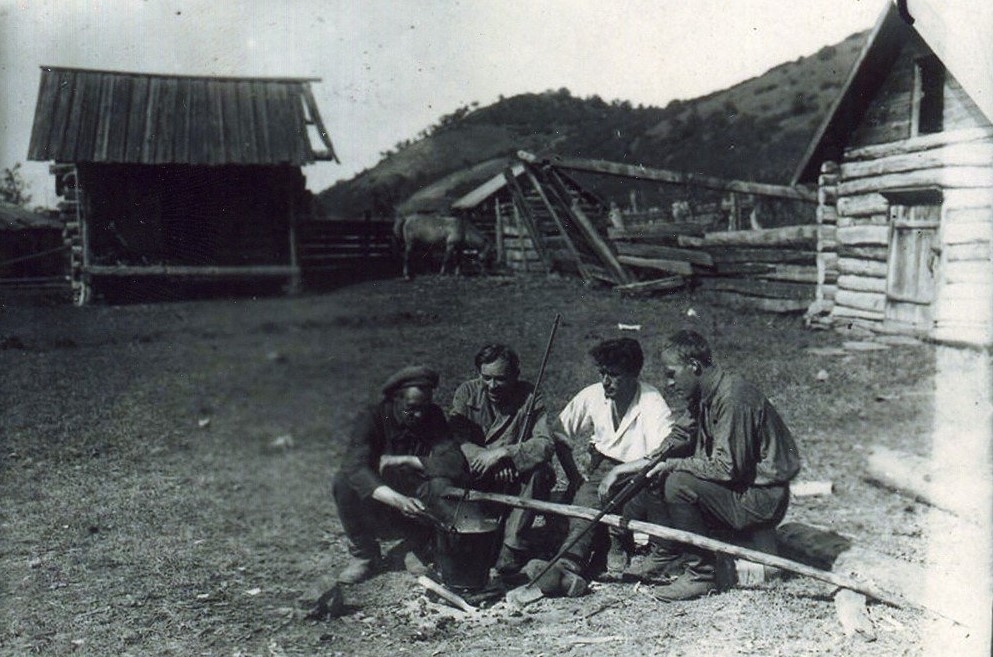
Film expedition to the village. Radde. 1932. Photo: Photo: State Archive of the Jewish Autonomous Region
In the same section, Viktor Gorelov, in the article “Where to be a reserve,” wrote about the need to create a protected area in the spurs of the Lesser Khingan.
“Of course, an important question arises: where should the reserve be? Fortunately, on the Lesser Khingan there are preserved zones that meet the spirit of the reserve, including many variants of relief, soils, plant communities, fauna, characteristic of the entire nature of the Khingan. We are talking about a mountain-taiga massif, covering the upper reaches of the Mami, Lugovaya, Bidzhan and Pompeevka rivers. It stretches along the Amur for about 50 kilometers, starting from the village of Pompeevka and the approach to the village of Samara. The entire territory of this massif occupies a relatively small area – 150 thousand hectares with 2.2 million hectares of the entire forest zone of our region… The second century has passed since the intensive development of the Amur region began. No matter how carefully and wisely people approach the use of nature, losses must be taken into account. But nature should not lose its original appearance. is a reserve for natural restoration, one of the most important aspects of rational use of resources.”