UNKNOWN HISTORIES, EPISODE 36 The models of the Dinamo stadium with which the fans were deceived after '90 » The first version was a copy of a stadium in Italy and was supposed to have 60,000 seats


Article by Octavian Cojocaru – Published Tuesday, January 20, 2026, 3:52 p.m. / Updated Tuesday, January 20, 2026, 3:52 p.m.
The Dinamo Stadium, inaugurated in 1951, benefited from an excellent location, close to the center of Bucharest. But the arena in “The Pit”, whose demolition started todayi, was always considered among the ugliest stadiums in the country. And it caused the most discussion about the need to tear down that “basin” and build a modern arena on the same site.
Throughout the last 36 years since the Revolution, Dynamo fans have been periodically fooled with models of new arenas in “Ștefan cel Mare”.
Here are just a few of the projects that were heavily touted but never came to fruition:
1990. First variant: copy of the “San Nicola” stadium in Bari
Less than a year after the Revolution, in the “România liberă” newspaper of November 14, 1990, Marin Gostin, from the management of the club in “Ștefan cel Mare”, spoke about the project of the new stadium.
“The stadium we thought of is a covered arena and has a capacity of 60,000 seats, being equipped, of course, with night installations. Something similar to the existing arenas in Bari and Brussels, Anderlecht's stadium.
The project also provides for the construction of a tartan athletics track, a covered swimming pool and a jumping hall, covered rooms for most sections in this area. Add to all this a hotel and a large restaurant, confectioneries, a recovery complex, electronic scoreboard, filming mobiles, a conference room”, said Marin Gostin at the time.
The “San Nicola” Arena in Bari, the one on which Romania debuted at the 1990 World Championship (2-0 against the USSR) and on which the 1991 European Champions Cup final between Red Star Belgrade and Olympique Marseille took place, was one of the most beautiful in Europe at the time.
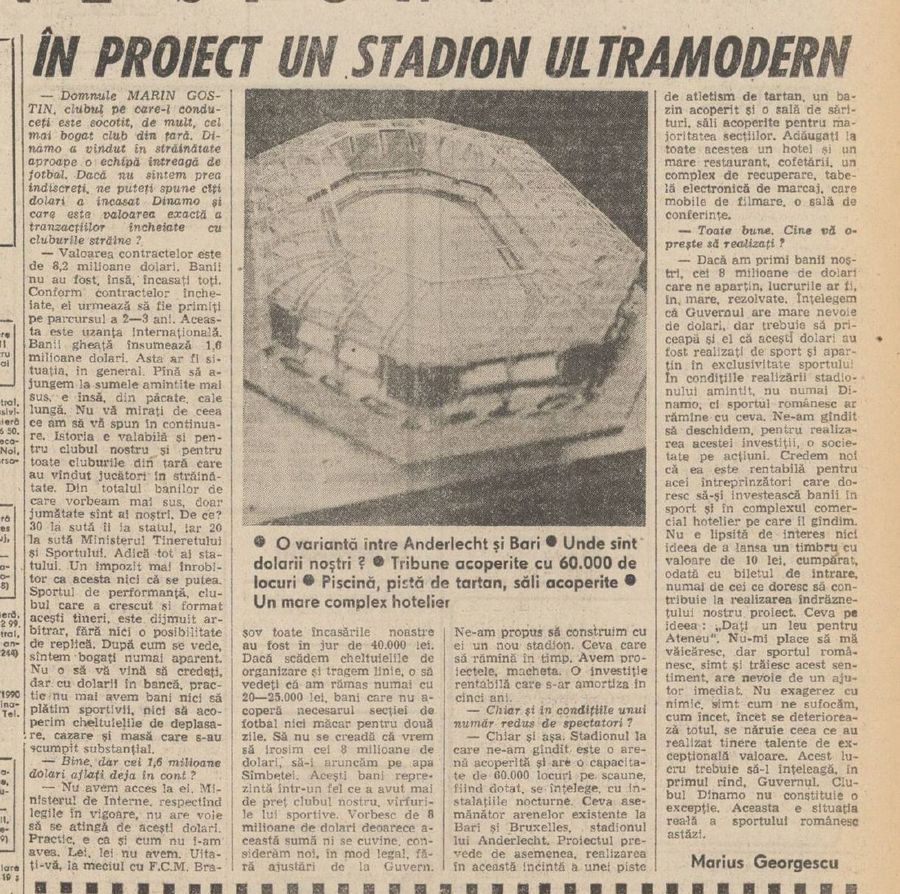
Article from “Romania Liberă” from November 1990
Vasile Ianul squandered the money for the stadium
Dinamo had, theoretically, 8.2 million dollars in its accounts from the massive sales of players abroad in the summer of 1990: Răducioiu – to Bari, Lupescu – to Bayer Leverkusen, Ioan Ovidiu Sabău – to Feyenoord, Dănuț Lupu – to Panathinaikos, etc.
“If we received our money, the 8 million dollars that belong to us, things would be, by and large, resolved. We understand that the Government is in great need of dollars, but it should also understand that these dollars were made by sport and belong exclusively to sport. In the conditions of the construction of the mentioned stadium, not only Dinamo, but Romanian sport would be left with something”the “dogs” official also said.
Meanwhile, Vasile Ianul, the president of the Dinamo club's football section, squandered all this money. And the idea of a new stadium is over.
In 1991, the stadium “grew” on paper: 65,000 seats!
In “Gazeta Sporturilor” of April 11, 1991, another project for a new stadium in “Ștefan cel Mare” was discussed.
“(…) First impression: something like this cannot be built here! We are used to thinking that something like this belongs only to others, that is, to foreigners. (…)”, enthused Radu Timofte, the signatory of the article.
“Here is the enumeration of the subassemblies which becomes, in itself, illustrative: 65,000-seat stadiumathletics halls (250-meter track), gymnastics, basketball, bowling, badminton, volleyball, handball, tennis, table tennis, wrestling, boxing, judo, strength training, swimming pool, recovery areas, massage, sauna, research center, medical center; test center with rooms intended for press conferences, telex, mail, audiovisual transmission spaces, buffet, hotel with up to 1,000 seats and for athletes, separately, with all the annexes necessary for the cantonments (dining room, recovery room, library, kitchen); cinema halls, possibilities for concerts, meetings with a large number of people.
The striking remains not only the functionality, but also, or especially, the impression of CIVILIZATION, which we need so much. Club Dinamo – and not only it – needs this sports and cultural complex!”.
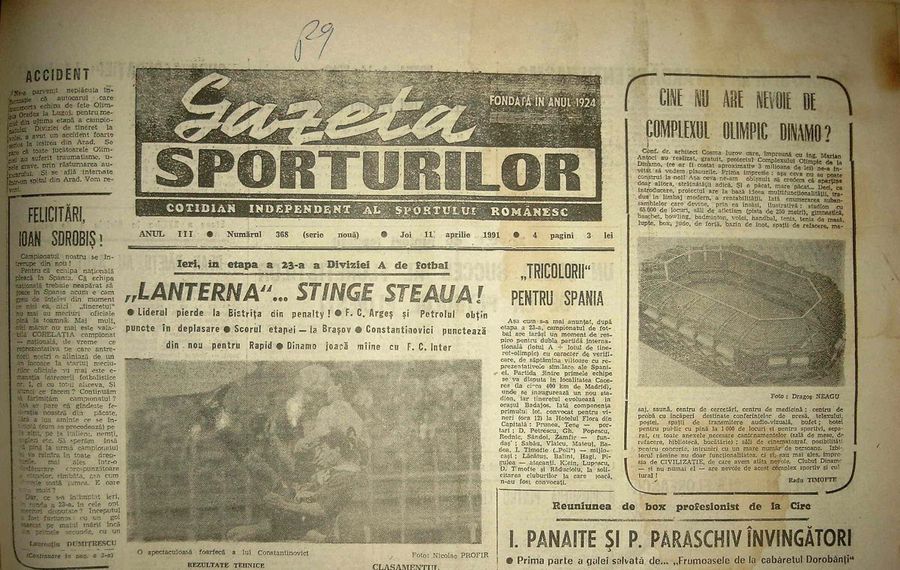
Article from “Gazeta Sporturilor” from April 1991
And this story remained in a corner of the newspaper.
In April 1999, the new Dinamo stadium had reduced to 30,000 seats!
In 1999, after becoming number 1 at Dinamo, Nicolae Badea was also not satisfied with how the “Pit” looked, but he did not think of a complete demolition, but asked for a modernization and enlargement project. The stadium was to have 30,000 seats and covered stands.
And that announcement remained just a story.
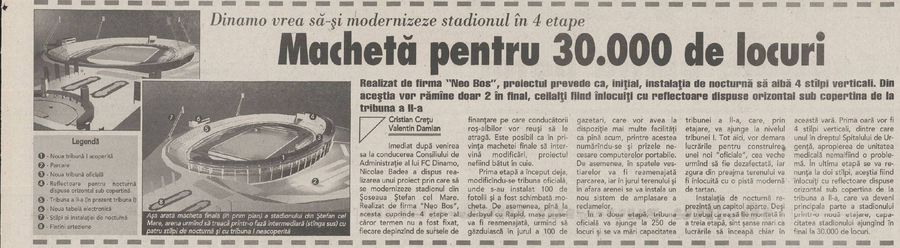
The 1999 mockup featured in Pro Sport
In September 2006, another project for a 30,000-seat stadium
Another project for a new stadium, made in 2003, was supposed to start in 2004 and be completed in 2007. Dinamo was still dreaming of the Champions League groups and the management thought that it had nowhere to organize the matches.
“The new arena was to have a capacity of 30,000 seats. In the first phase of the project, there were two primary objectives: the coverage of grandstand zero and grandstand I, as well as the commissioning of the new electronic table. In the last stage, the second tribune was to be elevated and covered. Currently, the team and management are thinking about the Champions League groups, but the stadium in “Ştefan cel Mare” looks the same as before the project was completed. Thus, it came to the embarrassing situation that, in the event of qualification in the League groups, the “red-whites” could only play at the stadium of their lifelong rival, Steaua, the only one that meets UEFA's requirements”, wrote the “Jurnalul Național”, from September 29, 2006.
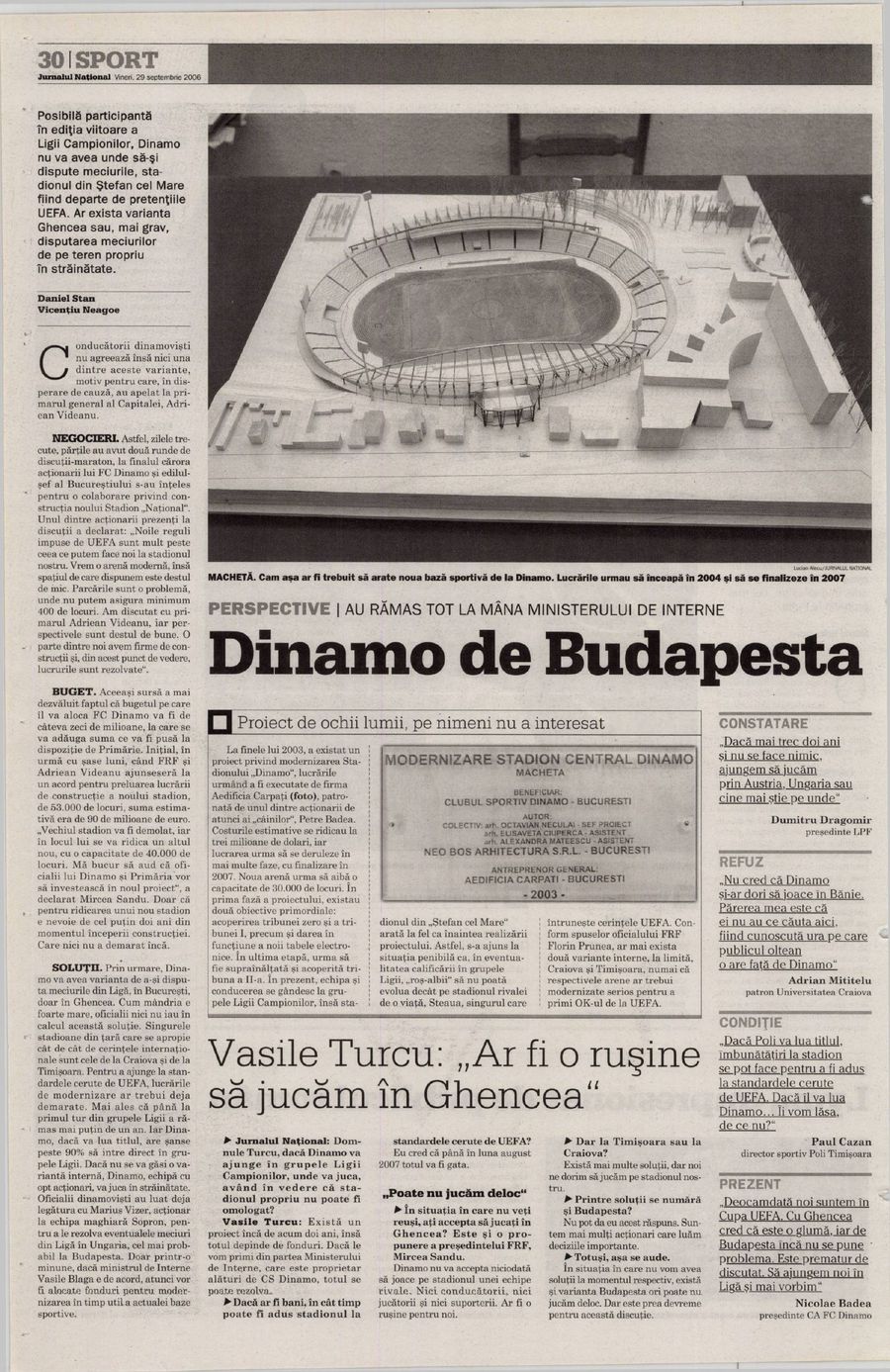
What Dynamo fans were deceived by in 2006. Article from “Jurnalul Național”
These were just some of the projects waved in the noses of fans after the Revolution.
When Romania was designated among the co-organizing countries of the final tournament of the European Championship in 2020 (held in 2021, due to the pandemic), the Dinamo stadium had to be demolished. The story is known. While “Arc de Triomphe”, “Star” and “Rapid” were rebuilt from scratch, “Dinamo” remained untouched.
Now all these empty promises seem outdated. A new stadium will even be built in Ştefan cel Mare.
Initially, “Dinamo” was supposed to have 80,000 seats!
Dinamo Stadium was inaugurated on October 14, 1951, with a capacity of almost 20,000 seats. And the project of the old stadium seriously entered “water”. On September 26, 1948, when Dinamo was only five months old, in “Scânteia”, the official newspaper of the new communist regime, the idea of building a stadium in “Ștefan cel Mare” was mentioned for the first time:
“From now on, they study at OSP (People's Sports Organization, the body through which the communist regime seized all the sports in the country) the possibility of building an even bigger stadium with 80,000 seats, on the land of the former Velodrome in Şoseaua Ștefan cel Mare”.
The idea of a large stadium was expressed on other occasions, but never materialized.
Elena Ceaușescu and Marta Drăghici fought at one of the first Dinamo – Steaua duels!
The Dinamo stadium was a basin with irregular edges, with one stand higher, another lower, with an athletics track and with very poor visibility. Furthermore, the 'oval' was 'broken', not continuous. In addition, a unique fact in the architecture of our stadiums, the official tribune was somehow separated from the whole stadium, being raised several meters behind the stands. The well-known journalist Marius Mitran recently told in a podcast that that construction, carried out a few years after the inauguration of the stadium, would have been made further from the stands at the express request of Gheorghe Gheorghiu-Dej.
The anecdote says that during one of the first Dinamo – CCA (later Steaua) duels from the beginning of the 1950s, Elena Ceaușescu, the wife of Nicolae Ceaușescu, who was in charge of Steaua, and Marta Drăghici, the wife of the dreaded Alexandru Drăghici, the minister of the interior from the infamous 1950s, would have fought in the stands. Moreover, the scandal degenerated into a physical fight. And Gheorghiu-Dej requested that the “official” be built away from the eyes of the world, so that possible similar scandals will not take place among “working people”.