The West as we knew it after 1945 is history. Donald Trump's threat to take over Greenland – a territory belonging to a NATO ally – including by military force, in parallel with Vladimir Putin's attempt to annex Ukraine, marks the entry into a new era: a post-Western world, dominated by illiberal international disorder, writes British historian Timothy Garton Ash in the Kyiv Post.
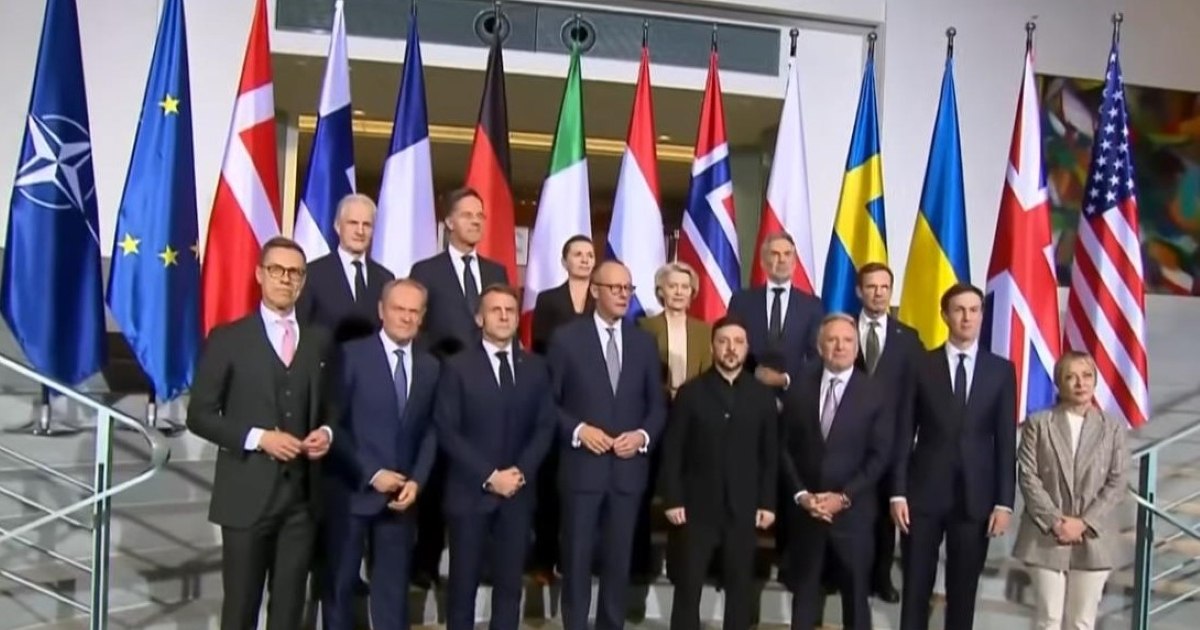
European leaders, meeting with Trump's representatives in Berlin/PHOTO: EPA/EFE
Even if Trump doesn't go all the way, the mere fact that an American president publicly evokes such an option is a game-changer. For liberal democracies, and especially for Europe, the challenge is twofold: to understand the world as it is now and to decide what it can do in a context where the old certainties have collapsed.
A global opinion poll recently published by the European Council on Foreign Relations provides a relevant starting point. Conducted in 21 countries, the survey shows the evolution of international perceptions from the full-scale Russian invasion of Ukraine in 2022 to today. If then there was still a “West” united in outrage but separate from the emerging great powers, today we find ourselves in a post-Western world without a coherent West to act as such.
In 2022, Western sanctions against Russia were counterbalanced by China, India, Turkey and other states willing to continue economic relations with Moscow. The Russian economy survived not because the West was weak, but because the rest of the world had become strong enough to balance it. The West still existed, but no longer dominated.
Trump 2.0, however, radically changes the data of the problem. Today we no longer have just a post-Western world, but one in which the West itself is fragmented. The vision of the Trump administration, bluntly expressed by cronies like Stephen Miller, is one in which the world is governed by force, power and coercion—a logic far closer to that of the Kremlin than to the postwar American strategic tradition.
Europe got the message. Fewer than one in five citizens of the EU states surveyed still see the United States as an ally. In Great Britain, the proportion is only a quarter, and in Ukraine – 18%. America remains a “necessary partner” but is no longer perceived as a reliable ally.
And the rest of the world is adapting. If two years ago most Chinese saw the US and Europe as part of a single Western bloc, today this perception has eroded massively. The West, as a unitary entity, has ceased to exist.
what to do
The biggest mistake would be for Europe to continue mechanically invoking the “rules-based international order”, applying international law selectively – firmly in Ukraine, hesitantly in Gaza – while practicing a policy of appeasement towards Trump. It would be equally wrong to copy the behavior of authoritarian leaders.
Europe needs a new internationalism: faster, more flexible, tougher. An internationalism that rejects the use of force but accepts the use of power. Fewer procedures, more results. Less obsession with rigid structures, more pragmatism in building variable partnerships, case by case.
This is a direct challenge to the institutional European Union, built as an expression of the liberal order of the 90s: slow, bureaucratic, dependent on consensus. However, in the case of Ukraine, Europe has already started to move differently – through coalitions of will and accelerated decisions, according to the standards of Brussels, the British historian claims.
Greenland, the decisive test
In the case of Greenland, any European action must start from the will of the elected governments of Greenland and Denmark. This is the fundamental difference between liberal democracies and authoritarian imperialisms.
Sending additional troops by Denmark and NATO allies is a first step. Discussions in Washington with the US administration show, however, that the fundamental disagreement remains. And all signs point to Trump becoming increasingly unpredictable as domestic problems deepen.
That is why Europe must also act symbolically, not just technically. A joint visit to Greenland by the leaders of Germany, France, Great Britain and Denmark, along with the Prime Minister of Canada, would send a clear message. If I can go by train to Kyiv, I can fly to Nuuk. In an image-dominated era, Trump will get the message from the televised frames.
The European Union must also rapidly increase its financial support for Greenland and open a strategic discussion on a special future relationship with the territory, including the prospect of eventual independence. Tomorrow's EU will work through personalized relationships anyway – with Great Britain, Ukraine, Turkey, Canada. Greenland should not be excluded.
In parallel, Europe must discreetly but seriously analyze the economic response options in the event – still improbable, but not impossible – of an American military intervention. The mere existence of contingency plans can have a deterrent effect, the historian says.
A Europe that needs to believe in itself again
Perhaps the most worrying result of the cited survey is the high level of European pessimism. Almost half of Europeans do not believe that the EU can deal on an equal footing with the US or China.
A new internationalism, firmer and more realistic, is not only a strategic necessity. It is also a condition for Europeans to start believing in their own power again. In a post-Western world, Europe can no longer afford nostalgia. It needs lucidity, will and courage, warns Timothy Garton Ash in the Kyiv Post.