The testimony of an Iranian intellectual: “How can I not cry knowing that a 16-year-old child goes out into the street, aware that he can be killed?”


Iran is going through one of the most violent and dramatic periods in its recent history, and the images of protesters shot, teenagers arrested and cities cut off from the rest of the world are only part of the reality described by Mohammadifard Gholamali.
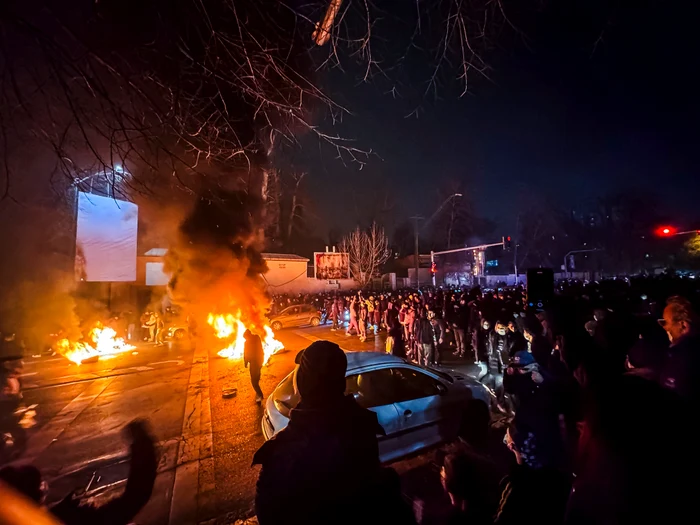
Bloody protests continue in Iran. PHOTO: AFP
Mohammadifard Gholamali, Iranian psychologist, professor, doctor of political sciences, settled in the Republic of Moldova, spoke on the podcast of journalist Nicolae Chicu about the situation in Iran.
An Iranian university professor and psychologist, a refugee in the Republic of Moldova, he talks about a regime that “feeds on bloodshed” and about a people reaching the limit of survival.
“Iran is no longer a functioning regime. It is a corpse. A sick corpse, but still extremely dangerous”says Gholamali. “Like a dead animal, full of viruses, that can still do harm.”
Repression is not an accident, but the essence of the system, he asserts. “These people cannot exist without blood. That is their ideological basis. Without bloodshed, the regime does not last.” According to testimonies from inside the country, hundreds of protesters were killed, thousands arrested, and more than 10,000 people ended up in prisons. Internet and electricity were deliberately cut to prevent the transmission of images.
“There's no internet anymore, there's no electricity anymore. People can't film, they can't show the world what's happening to them”explains the teacher. “The only images that still get out are taken out of Iran covertly, with phones physically taken across the border.”
The drama is also personal. For days, Gholamali could not get in touch with his family. “It's been four days since I've talked to anyone. Everything's off. Phone, internet, nothing.” One of his granddaughters, only 16 years old, called him to tell him just one thing: “I'm going to the protest.”
“How not to cry knowing that a 16-year-old child goes out into the street, aware that he can be killed”
“How can I not cry knowing that a 16-year-old child goes out into the street, aware that he can be killed?“, he says. “That is no longer courage. It is despair, beyond despair.”
According to Gholamali, the protests are not just about political freedoms, but about survival. “People have endured the lack of freedom, the lack of media, the lack of democracy. But when you have no more food, water, air, then you have nothing left to endure.” In Tehran, he says, there were periods when the water was completely shut off: “Nothing was running at the tap at night. Nothing.”
Repression is carried out by several layers of the force: the police, the Revolutionary Guard and the Basij militias. “When the Basij and the Revolutionary Guard come in, there are no more people. There is only the hand, the gun and the trigger,” says Gholamali. “They don't see people. They're trained to kill.”
At the center of this system is Ayatollah Ali Khamenei, unequivocally described by the professor: “He's a paranoid narcissist. He sees himself as God's representative. To him, people don't exist.” Its legitimacy, says Gholamali, “it does not come from the people, but from a pretended divinity”.
Even so, the regime is faltering. “It is a political corpse. It can no longer be repaired, it can no longer be reformed“, he states. “Even if he kills more, even if he represses more, he has no future.”
“Revolutions cost millions of lives. I don't want a bloody revolution”
However, the professor warns of the risk of total chaos. Iran is a patchwork of ethnicities and religions, and the violent collapse of central power could lead to civil war. “We have Kurds, Azeris, Baluchis, Arabs, dozens of ethnicities. Any sudden weakening of the center can produce tragedies.”
That is why Gholamali does not want a classical revolution. “Revolutions cost millions of lives. I don't want a bloody revolution.” His ideal is a change through justice: “Not to shoot them on the first day, but to judge them fairly. Even the supreme leader.”
Regarding possible external interventions, the teacher acknowledges the dilemma: “On our own, it will be very difficult for us. The dictator only knows fear.” However, he does not call for bombings: “I wouldn't want my house bombed to get away from a murderous father.”
In the end, his appeal is human, not geopolitical. “The people of Iran need solidarity. Of empathy. Of a word.” For him, every message counts: “A comment, a sign that they are not alone. That can save souls.”
“Iranians do not demand death. I ask for life. I demand dignity. I want them to be people“, says Mohammadifard Gholamali. “And that's something no criminal regime can stop indefinitely.”