Ayatollah regime in Iran, at the end of the road? “The Islamic Republic is in a tight vise”


Anti-government demonstrations in Iran are expanding, despite a harsh response from the regime. Middle East expert Ioana Constantin-Bercean analyzes the events in Tehran and explains to what extent it is possible for the current power to be removed and Iran to become a monarchy again.
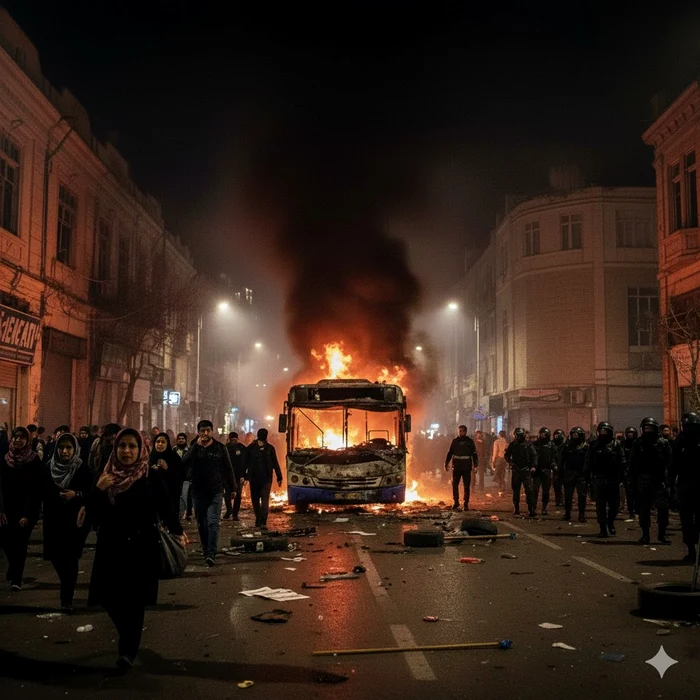
Iran has been the scene of violent events for more than two weeks, after the population took to the streets in what now looks like a true revolution against Iran's clerical regime and its repressive organs. Iranologists believe that this is the biggest street movement since the outbreak of the “Women, Life, Freedom” protests in September 2022. Then, the dictatorship in Tehran survived, but emerged weakened after receiving a real blow to its foundation.
At the end of 2025, in the very last days, Iranians took to the streets again to demand freedom. As expected, the authorities did not remain passive and caused real carnage. Horrible images of hundreds of dead people lying in the burning streets were broadcast on news bulletins.
Hundreds and thousands dead on the streets of Tehran
The Iranian government is doing what it does best: brutally suppressing these movements and killing unarmed civilians. The same Iranian authorities blame Israel and the United States of America and claim that the people who took to the streets are representatives of these foreign powers or manipulated by the intelligence services of the two states. As a result, the Government in Tehran instituted three days of national mourning for what the Iranian regime considers to be the martyrs killed in the battle with the United States and Israel.
Reza Pahlavi, the heir to the throne in exile, entered the scene. The son of Iran's last shah dreams of restoring the monarchy and has urged Iranians to fight for freedom, but it is unclear whether he has enough support at home and abroad to return to power.
But the big question for international political analysts is whether the clerics in power will hold on any longer, or whether this time the tide is strong enough to turn into a tsunami that sweeps away the temporal authorities that seized the country.
Ioana Constantin-Bercean, a well-known expert on the problems related to the Middle East, starts the discussion and posts on Facebook a text fragment from a material published on “Adevărul”, almost 6 years ago, but just as relevant today.
“Iran is unpredictable. Such a succinct statement can truly encapsulate the nature of Iranian politics, but also the characteristics of society over the past four decades. The protests that erupted in November 2019, and then in January 2020, represented more than civil disobedience and evaporated the sense of national unity during the funeral of General Qassem Soleimani, assassinated on January 3, 2020. In January 2019, when Iranians took to the streets again, many commentators predicted the imminent fall of the Tehran regime. But every collision between an angry citizenry and an inflexible power structure leaves cracks in the system. In the end, as happened 40 years ago in Iran, even the best-established regime will fail people to wait for better days. There is currently no realistic trajectory to address a future scenario, and even if the government has managed to reduce tensions at this stage, using all its security and political tools, the lack of real solutions to the economic crisis will only temporarily ease the situation. However, tensions may return at higher rates and with a much wider impact.”wrote Ioana Bercean, recalling that the said text is part of an article from January 2020. The fact is that although the years have passed, Iran seems to be in exactly the same phase.
How Iran has changed in half a year
Ioana Constantin-Bercean's analysis practically starts from this remark. Flash forward to 2025, during the fighting with Israel, the Iranians reacted and fought against the Jewish state. Half a year later, the same people practically turned their guns and turned against the totalitarian government in Tehran. The popular revolt, says Ioana Constantin-Bercean, could this time lead to the intervention of a foreign state, most likely the US. It is true, the protests were mainly caused by the country's economic problems, starting with the collapse of the country's currency, the rial (toman).
“During the June 2025 war, Iranians rallied around the flag, and the regime responded by relaxing religious rules, particularly regarding the wearing of the hijab. But the current protests, which began on December 28, 2025, present a dilemma: too harsh a crackdown could undo the fragile understanding the regime formed with the population after the war, while allowing their expansion could open the door to foreign interference”, says the expert.
Starting from the example of the Arab Spring, it would not be excluded to witness an American or even an Israeli intervention. In fact, the president of the United States of America, Donald Trump sent a series of contradictory messages, threatening Iran veiledly. The White House leader also left a door open for negotiations, but uncertainty seems to be the watchword for everything that is happening these days in Iran.
The situation increasingly resembles that of Libya and Syria
“Obvious parallels are with Libya and Syria during the Arab Spring, when the US and some European governments invoked the 'responsibility to protect' protesters to justify military intervention. These popular uprisings quickly turned into foreign-led regime change efforts, eventually leading to civil war and the collapse of the state. In particular, Iran's Islamic Revolutionary Guard Corps is largely populated by veterans of the conflict in Syria, but also those of the war sparked by the invasion of Iraq in 1980. They have witnessed the hijacking of genuine protests and their transformation into civil wars. The imperative to avoid the fate of Libya and Syria is the driving force behind Iranian decision-making today.”adds Ioana Constantin-Bercean.
Iran's problems exist and will not be solved even after the current uprising topples the government or ends up being crushed by the authorities. Regardless of how things turn out, the future of the country is uncertain, and popular anger seems to have not yet reached its peak.
“Even if Iran can avoid a direct confrontation with the US, and even if the current wave of protests subsides, the country's economy is in a downward spiral. This means that public anger will only grow in the medium to long term. The Islamic Republic is in a vise, gripped by the external threat from the US and Israel, and domestically by deepening and widening insurgencies.”the expert believes.
In his opinion, there is no easy way out of this impasse. The ayatollahs can still save themselves, and the outcome remains completely unpredictable.
“A total collapse of the Islamic Republic is not necessarily imminent, but the revolutionary cycle that began in 1978 is coming to an end. The third generation of asabiyyah could bring change, and the sustainability of the peaceful transition could be ensured by the current president, alongside reformist political figures, currently marginalized, such as Mohammad Khatami, Mir-Hossein Mousavi Khameneh or Hassan Rouhani”, explains Ioana Constantin-Bercean.
Iranians do not want the restoration of the monarchy
Interestingly, the population is fundamentally opposed to the restoration of the monarchy. The reasons are diverse, and Ioana Constantin-Bercean explains them, also stating that the opposition to the restoration of the monarchy is particularly strong in the western provinces of Iran and in regions with important ethnic minority populations.
“Videos from Tabriz, the capital of East Azerbaijan province, show protesters chanting slogans against both Khamenei and Reza Pahlavi. In Azeri Turkish, protesters called both figures “shameful” and described their province as a “symbol of deminity”. This resistance is linked to the right-wing nationalist views of many monarchist supporters, who often equate ethnic claims with separatism. A A similar mood exists in Kurdistan province, where the Women, Life, Freedom movement began now fears that under a restored monarchy, Kurdish demands could be marginalized even more than they are under the Islamic Republic.“, claims the expert.
At the same time, Iranians are not very convinced that the Shah's successor has the ability to solve the country's problems and lead it as it should. Last but not least, Iranians do not have the best memories of Mohammad Reza Pahlavi, the last shah of Iran, ousted by the revolution that led in 1979 to the establishment of the current theocratic Islamic republic, then led by Ayatollah Ruhollah Khomeini.
“Furthermore, doubts about Pahlavi remain widespread, beyond Donald Trump's remarks suggesting he is not ready to lead the country, and his closeness to Israel, the MEK and the diaspora loyal to the monarchy, are issues that are not easy for most Iranians inside the borders to digest. His family's legacy is marked by repression, forced modernization and reckless economic policies. Reza Pahlavi was also partly responsible for the failure of the so-called “Georgetown Coalition”, which sought to unite the exiled opponents of the Islamic Republic of Iran. Moreover, his political and governance skills have not yet been proven and he lacks a well-trained team capable of effectively supporting him.” points out Ioana Constantin-Bercean.