What was once a “productivity advantage” is now a starting point. The first draft of a report, data analysis or variant of a concept is created almost immediately. The value of work no longer lies in the rate of production, but in the ability to synthesize, interpret and choose.
Experts on the future of the labor market from the technology company Gloat, in their December summary of the labor market transformation, emphasize the rapid increase in demand for roles related to AI skills and the changes that result. McKinsey analyzes suggest that the adoption and use of AI in organizations requires not only technological readiness, but also strategic employee competencies – the ability to translate the potential of AI into business goals and changes in workforce planning.
Pure creativity – divorced from management tools and decisions – is today valued lower than creative synthesis: the ability to make sense of what systems generate.
New tasks on the labor market: managing AI agents
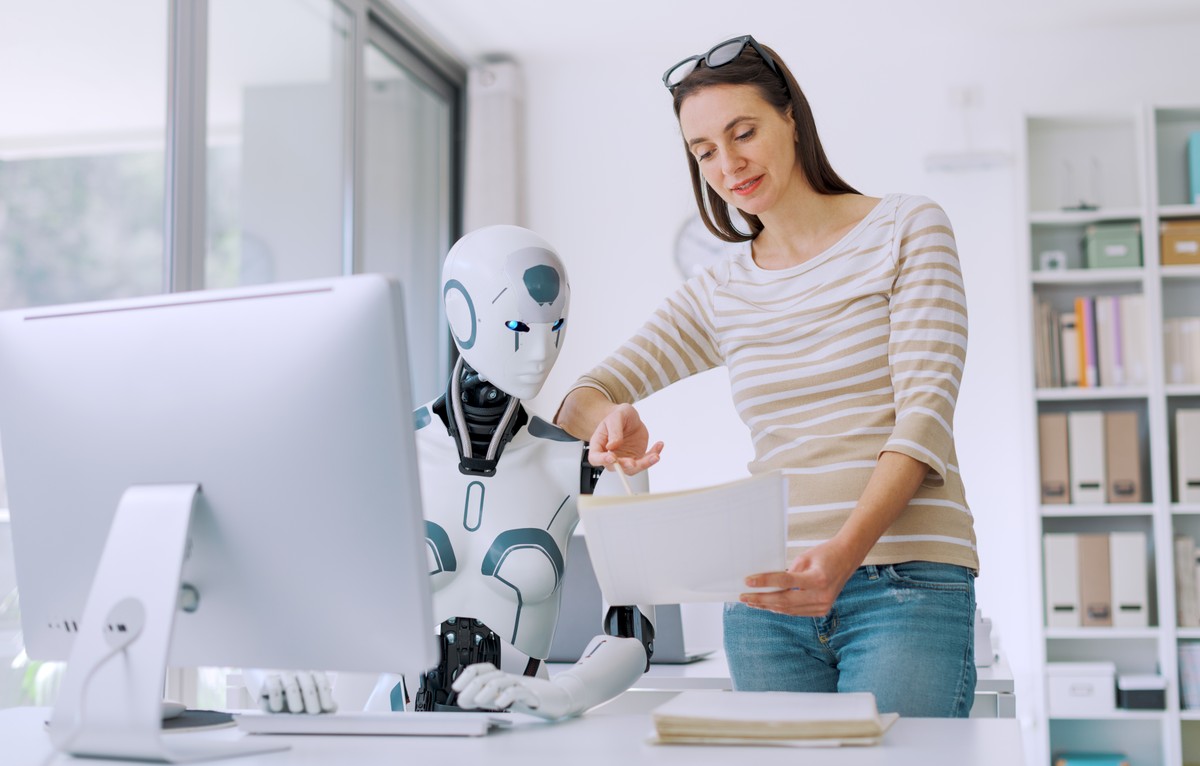
In 2025, Microsoft introduced the concept of an AI agent manager (Agent Boss) – a person who does not work with AI tools but manages a fleet of agents performing autonomous tasks. Today, an agent can conduct initial CV selection, prepare market analysis, generate strategy variants or draft communication. The human role is no longer to perform the task, but to supervise the process, assess quality and make decisions.
Data from Microsoft's Work Trend Index 2025 show that almost half of leaders (46%) declare that their companies use agents to fully automate selected processes. In practice, this means that probation ceases to be a development option and becomes the default mode of work among white-collar workers.
Read also: In 2026, AI will become a worker, enter the physical world and enforce a new order of trust
From the creator economy to content curation
This shift towards curation is well illustrated by the evolution of social media. Adam Mosseri, head of Instagram, in one of his recent posts draws attention to the shift in emphasis in the creative model – from mass production of content towards its selection, context and responsibility for recommendation.
In a world where AI can generate images, videos and narratives that are difficult to distinguish from reality, authenticity is no longer a sufficient differentiator. For years, the advantage of creators was their authenticity. Today, this “authenticity” can be simulated, and the appearance of the content itself is less and less often a proof of its credibility.
Therefore, the focus shifts from the question “what do we see?” to “who shows this and why?”. As Mosseri notes, trust is increasingly built by the authority of the source – the person or institution that selects, filters and takes responsibility for the content.
In practice, this means that in the labor market in 2026, the value of roles serving as the ultimate information filter increases. Regardless of whether it is an analyst in an organization or a creator working online, the key is the extent to which one's work reduces information noise and makes it easier for others to make decisions.
Read also: “AI slop”. The sloppiness is obvious. And I can't tell my employees: I'm firing you
Risks of working with AI: liability and isolation
However, curation is not free of costs. ADP research from the end of 2025 draws attention to the weakening of relationships in teams. The curator – managing agents, not people – increasingly works in isolation, which becomes a new challenge for organizational culture and leadership.
The issue of legal and ethical responsibility for the results of machines' operation is also important. As further obligations under the AI Act come into force, companies will have an increasing role in oversight functions and human responsibility for the use of AI – from quality to regulatory compliance.
Read also: A scientist on what not to ask AI. “It's undecidable”
Junior gap and competence crisis – new challenges of the labor market
One of the most severe effects of this transformation was the so-called the junior gap, which in 2025 has become one of the main topics of HR debates. Experts warn against the erosion of foundations: companies stopped employing juniors for simple analyses, research or preparation of materials, because these tasks were taken over by AI. The result is a lack of a “reserve bench” for senior roles – and a growing risk of loss of continuity of competences in organizations.
Read also: Generation Alpha is losing the ability to read. The experiment with an upside-down book is hard to believe
Competencies of the future 2026. AI will not automate this
At the beginning of 2026, the conversation about competences in the labor market is no longer limited to the division into “hard” and “soft”. In an era of rapid technological change, key competencies include adapting to change, critical thinking and the ability to solve complex problems – skills that cannot be replaced by AI algorithms.
The OECD in its report 'Governing with Artificial Intelligence' notes that AI most often supports analytical tasks and decision-making, which strengthens the role of people as decision-makers and data interpreters. In addition to the concept of proficient work with AI, there is the competence of strategic synthesis, understood as the ability to translate the results of artificial intelligence into specific decisions.
It's not about knowing one tool, but about fluency in designing work with AI: from creating and supervising simple agents, to assessing the quality, risk and sense of their actions. Companies will no longer pay for the fact that an employee knows how to use AI, but for the fact that he has the competence to sign its results with his own name – and bear the consequences of a possible error.