The minimum gross salary will increase to 4,325 lei from July 1. How much money will receive “in hand” over 1.7 million employees and what the state earns


The gross minimum basic salary per country guaranteed in payment will be increased to 4,325 lei monthly, starting on July 1, 2026, 6.8% more than in June this year, an increase that will benefit a number of 1,759,027 employees, according to a draft normative act initiated on Friday, January 9, by the Ministry of Labor. The measure will increase budget revenues by almost 970 million lei this year.
The draft decision on the establishment of the minimum gross salary was sent to the Economic and Social Council for approval, a mandatory step before this act is adopted by the Government.
The level of the minimum gross salary at 4,325 lei per month was established following consultations with the social partners (unions and employers – na), during the meetings of the Tripartite National Council for Social Dialogue on October 20, 2025, respectively December 10, 2025, the document states.
In Romania, a number of 831,382 employees currently benefit from the gross minimum basic salary guaranteed in payment, which represents a percentage of 14.6% of the total number of active employees.
A number of 1,759,027 employees will benefit from the increase of the minimum gross basic salary per country guaranteed in payment to 4,325 lei, it is mentioned in the explanatory note.
The Ministry of Labor expects the proposed increase to have positive effects on economic growth by stimulating employment, increasing the purchasing power of employees and reducing undeclared work.
The minimum net salary will be 2,699 lei from July 1
The government decided in December of last year, through the train ordinance, that the increase in the minimum gross salary from July 1, 2026 be correlated with the reduction from 300 lei to 200 lei of the non-taxable amount.
This will mean that from July 1, 2026 the minimum net salary will be 2,699 lei, an increase of 125 lei, while costs for the employer will increase by 284 lei, compared to the current situation.
“Employees choose with very little, employers have to take extra money out of their pockets, and the winner is the state,” accounting expert Cosmin Dumitrașcu declared for HotNews.ro last month.
Moreover, IMM Romania demanded that the non-taxable sum of 300 lei be kept even after July 1, 2026 on the grounds that the minimum net salary would increase by 167 lei.
Current situation
At the current minimum salary, of 4,050 lei gross, from January 1, 2025, the minimum net salary that an employee receives “in hand” is 2,574 lei, with the application of the tax exemption on the amount of 300 lei from the minimum salary.
In order to benefit from this exemption, the maximum level of the gross income from wages and salary equivalents made by the employees concerned must not exceed a ceiling of 4,300 lei. Companies currently bear a full salary cost at the minimum salary of 4,134 lei, according to Startupcafe.ro.
What changes
After the governing coalition initially only announced that the gross minimum wage would increase to 4,325 lei from July 1, the Government decided to increase the gross minimum wage to 4,325 lei, with only 200 non-taxable lei, from July 1, 2026.
In order to apply the tax exemption on the amount of 200 lei, the income ceiling from salaries and salary-related income will increase to 4,600 lei from July 1.
Why did the Government make these changes?
First of all, we should mention that the measure of increasing the minimum wage to 4,325 lei with the decrease to 200 lei of the non-taxable amount is one of the proposals made at the end of October by the National Trade Union Bloc (BNS), but the trade unionists requested that it apply from January 1, 2026.
The SNB also explained then how hundreds of thousands of employees will be affected if the 300 lei non-taxable minimum wage is kept. According to the BNS, approximately 1.8 million employees are paid 4,050-4,350 lei.
“Maintaining the tax deduction of 300 will additionally affect, from July 1, 2026, more than a quarter of a million workers in the range of 4,326 lei – 4,525 lei as they will have lower net salary income than those paid with the minimum salary of 4,325 lei”, warned the National Bank of Romania on December 18.
The SMEs asked to keep the amount of 300 lei non-taxable
On the part of the private sector, IMM Romania requested on December 23, before the government meeting in which the Train Ordinance was adopted, “to keep the amount of 300 lei non-taxable (for which no income tax and mandatory social contributions are due) and after July 1, 2026, when the gross minimum wage increases in the country, to ensure an increase in the net income of employees (reduction of the amount) non-taxable is basically a disguised increase in labor taxation).
The simulation regarding keeping the non-taxable amount of 300 lei even after July 1, 2026 shows that the net salary would be 2,741 lei, compared to 2,574 lei at present, higher by 167 lei, IMM Romania claimed at the time.
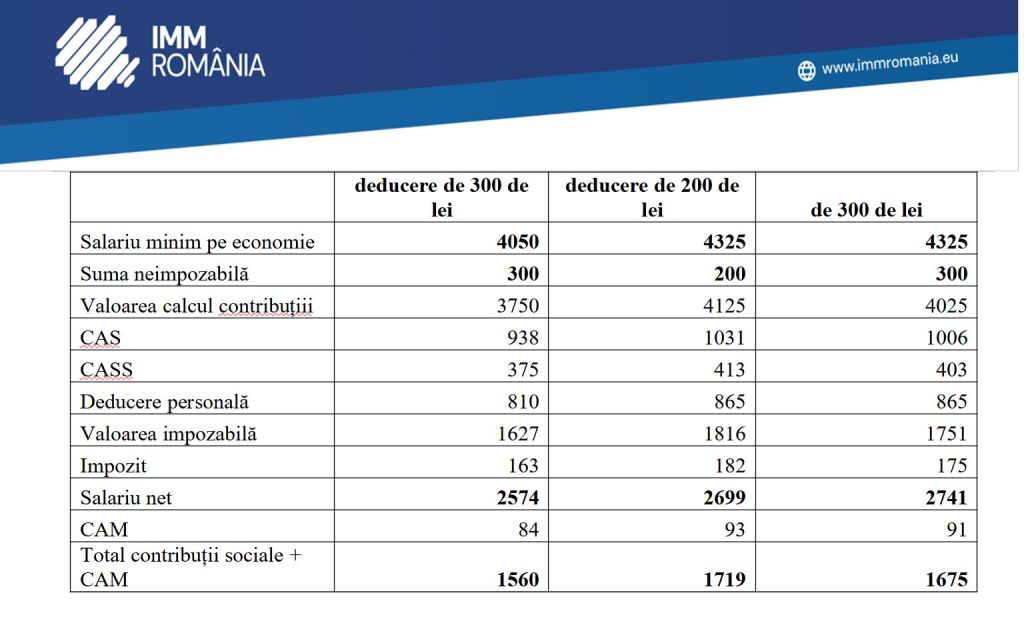
However, the SME Association did not mention anything about the fact that the government's emergency ordinance links the reduction from 300 lei to 200 non-taxable lei to the increase of the maximum ceiling to 4,600 lei.
“The difference of up to 4,600 lei can be represented by meal vouchers, premiums, etc., but these have a variable character and it is not possible to know what their exact value is. That is why the reference was made only to the minimum gross salary”, IMM Romania officials told HotNews.ro at the time in relation to this aspect.
If the maximum ceiling had remained at 4,300 lei as it is currently, the danger previously signaled by the National Bank would have remained: over a quarter of a million workers in the 4,326 lei – 4,525 lei range would have had lower net salary incomes than those paid with the minimum salary of 4,325 lei.
Photo source: Dreamstime.com
 Changes to the minimum wage from July 1, 2026: How much do employees earn, what costs will employers have and what is the stake of 300 lei or 200 lei without taxes