Italy from the center of Bucharest / The story of the bookstore that was born from the passion for one of the most famous Italian writers


On Lascăr Catargiu boulevard in Bucharest, on the 1st floor of an interwar building, there is the “Pavesiana” bookstore, dedicated to the Italian writer Cesare Pavese. Housed in a generous apartment, the bookstore serves as a cultural center with books on Italian culture and history, Italian lessons and film screenings. The founder of the bookstore, teacher and translator Mara Chirițescu, gave an interview to HotNews, in which she talked about the passion she shared for many years with her husband.
- In 2022, Mara Chirițescu was decorated by the President of Italy, Sergio Mattarella, with the Order of the Star of Italy.
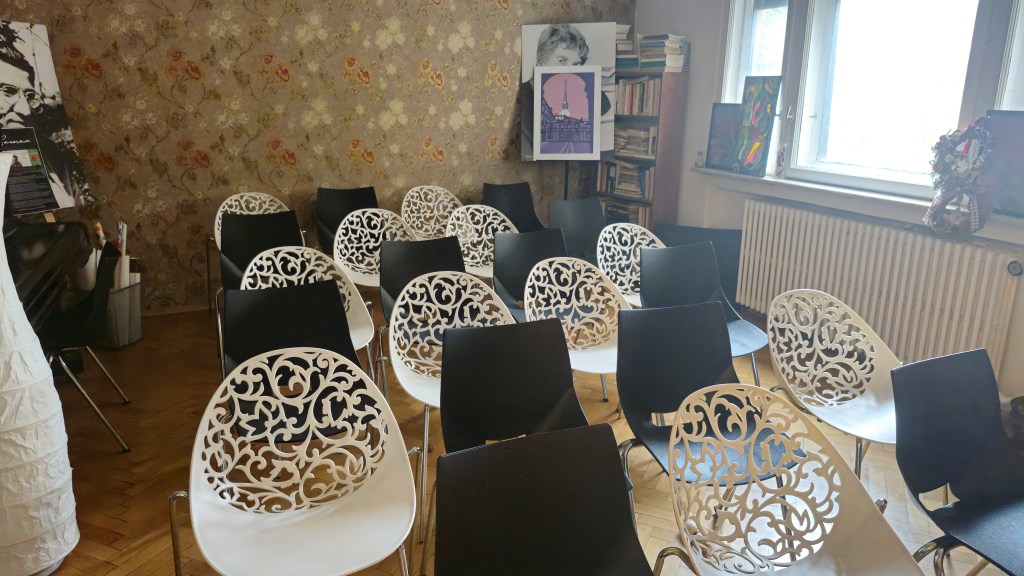
The main room of the bookstore “Pavesiana” usually serves as a cinema hall, where every week 20-25 people gather to watch Italian films.
On the walls of the bookstore there are portraits of personalities from the history and culture of Italy, such as Luigi Einaudi, president of Italy between 1948 and 1955, Giulio Einaudi, one of his sons, who founded the publishing house that bears his name and which is one of the most important in Italy. There are also portraits of the writer Fernanda Pivano, but also of the writer who gives the center its name, Cesare Pavese. The place is frequented by both the Italian community and other culture lovers.
The bookstore was founded in 2014, but since then it has changed several premises, and appeared as a complement to the publishing house of the same name, founded in 2012. Among the books translated at the “Pavesiana” publishing house are “A short history of Romania told to young people” and “Among the Orient and the West”, both signed by Neagu Djuvara.
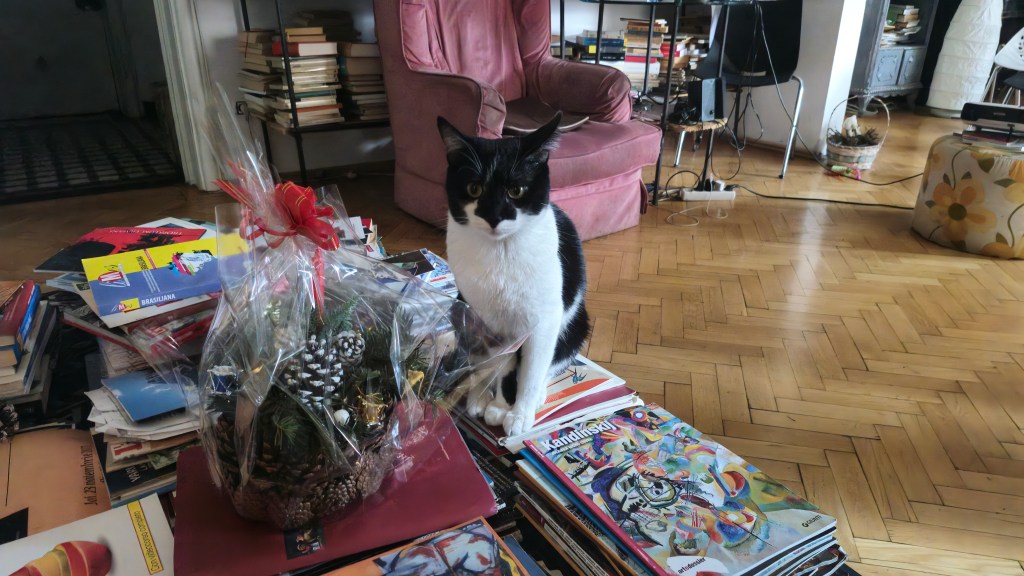
The “boss” and mascot of the bookstore is the motan Pave, who welcomes guests or walks through the rooms of the apartment.
Recorder Award
Another important project carried out by the publishing house is the New Review of Human Rights, whose scientific board includes the dissident Gabriel Andreescu, sociologist Gelu Duminică and Jean François Renucci, university professor at the University of Nice Sophia Antipolis.
The publication collaborates with the National Council for Combating Discrimination and annually awards an award. In previous years, the prize was awarded to people like Cristi Dănileț or Andrei Ursu. The 2025 award will go to the Recorder editorial office, with the event to take place early next year.
“Friends of Pavese”
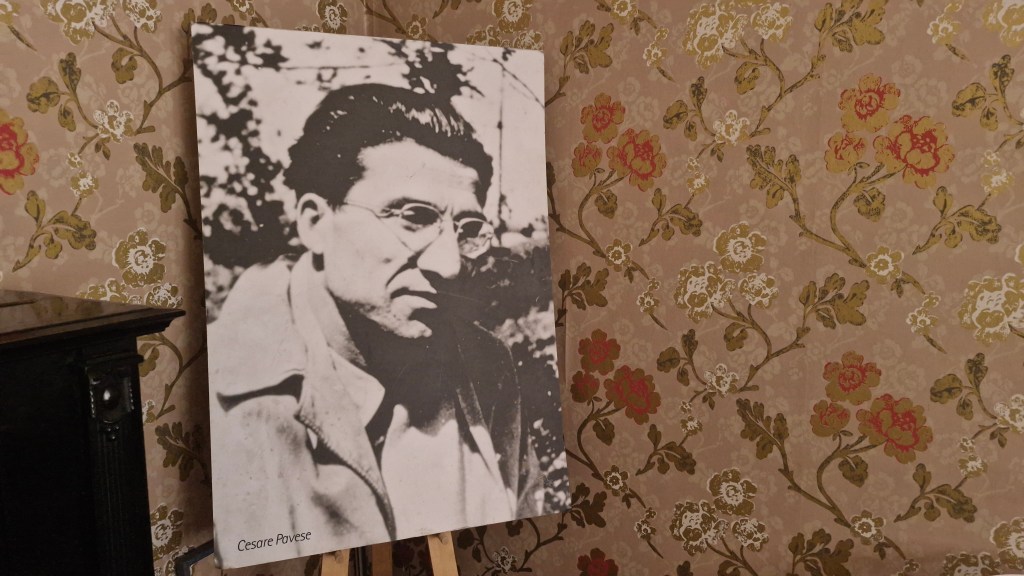
Behind these projects is the teacher and translator Mara Chirițescu. In 2008, on the 100th anniversary of Cesare Pavese's birth, she decided to found the “Friends of Pavese” association.
“The idea was to make a republic of Cesare Pavese's work, to keep alive, in a way, this extraordinary work of training any intellectual, because this is what Pavese's work meant to many intellectuals from the communist period. Under this association, the two entities, the publishing house and the bookstore, appeared,” Mara Chirițescu tells us.
Italian newspapers from communist Romania
Her relationship with the Italian language began in her native Brașov, when, on Republicii Street, she discovered a press outlet where, among many Russian newspapers, publications such as “L'Unità” were found.
“Although at that time we were already after the thaw, and the gaze was somewhat towards the West, it was very interesting that newspapers like “L'Unità” seemed to me very right-wing compared to our left,” says the translator.
Thus, in 1967, Mara Chirițescu decided, because she could give admission, using French, and to the Italian department, to study Italian in Bucharest, where she had well-known teachers, among them Nina Façon, who gives the name of one of the Italian rooms at the University of Bucharest.
The passion for Cesare Pavese came once he read “The Job of Living”, the writer's diary, one of his most famous books.
“That's how my journey towards Pavese began, with this book, which I read in 1968-1969. I started looking for Pavese's books, novels and translating them. The Italian editions reached me through some Italian colleagues. Then I translated “The Unforgettable Summer” and “The Beach”. I proposed them to the Univers publishing house, not knowing that the one in charge of the Italian collection was Florin Chirițescu, the one who translated “The job of living”” recalls Mara Chirițescu.
The coordinator of the Italian collection received the first translation, “The Unforgettable Summer”, with reluctance.
“He told me that I was too young to translate and understand Pavese. I left the translation to him, which at the time was done on a typewriter, not on a laptop, and it was some time before I called, not him. He told me that the translation was good and that he had some comments that I could accept or not, the responsibility being the translator's,” recalls the translator.
At the next meeting, Florin Chirițescu told him that another novel would be needed, because “Vara de neuitat” is a short novel, and it should be published in a volume with another work, so that he could make a larger book. Mara Chirițescu left “The Beach” to him. The volume continues to be republished, the latest edition being published by Polirom. Later, the two translators got married, and Mara Chirițescu worked as a translator in a foreign trade enterprise.
After the dissolution of the enterprise, the collaboration that continues to this day began at the “Aldo Moro” Italian School, and after 1989 he collaborated with high school and university institutions.
The propeller plane
After the Revolution of 1989, Mara Chirițescu arrives for the first time in Italy, which she knew so well. The first noticeable difference between Romania, barely out of the dictatorship, and Toto Cutugno's Italy, he noticed in flight.
“I left on a propeller plane. I landed at Ciampino (Ciampino Airport in Rome – ed.). From there I took another plane to Turin. It was no longer with propellers, which for me was a special technological advance on the aviation scale. I arrived in Turin, I saw the hotel where Pavese committed suicide (Hotel Roma – ed.), I saw the Porta Nova station that he talks about so often. After that I took the train that Pavese also took and we went to Santo Stefano Belbo (the native village of the writer – n. ed.)” says the teacher.
“The Italy of the 90s is different from today”
The translator is of the opinion that there are some differences between the country she found then and the one now.
“I knew a lot of things when I arrived, but the Italy of the 90s is different from the Italy of today. The Italy of that time seemed closer to the one we knew from the movies we could see in those years, it was closer to how we imagined it to be.”
Here, the translator has meetings that she says were formidable, with people like Giulio Einaudi or Fernanda Pivano, Italian intellectuals she calls “of the first magnitude”. The meetings and connections from then inspired her later, when she founded the “Friends of Pavese” Association and the entities that work within it.
In 1996, Florin Chirițescu, the one who translated the most important novel signed by Umberto Eco, “The Name of the Rose”, died. Currently, the association led by Mara Chirițescu awards a prize named after her for translations from the Italian language.
Decorated by the President of Italy
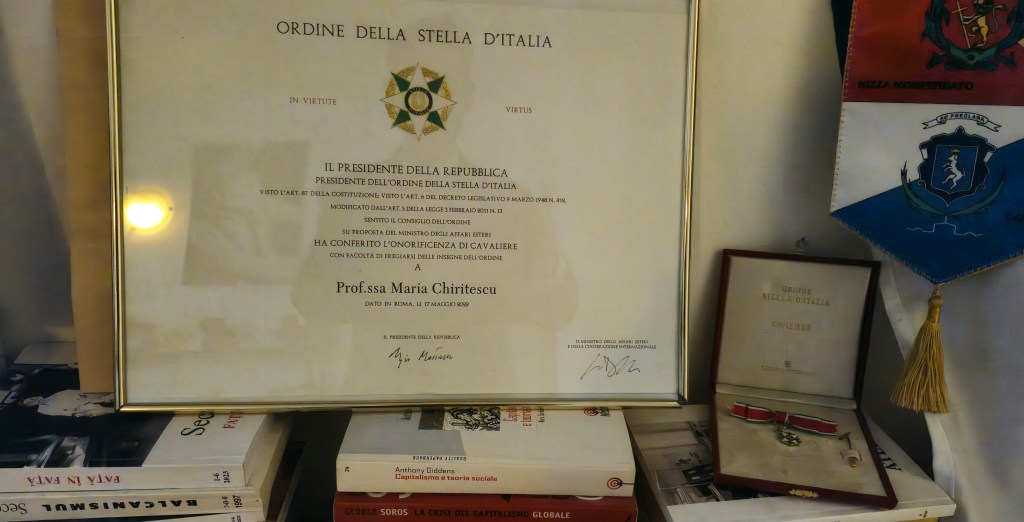
In May 2022, for the activity of promoting the Italian language and culture, at the proposal of the Minister of Foreign Affairs of Italy, the teacher Mara Chirițescu is decorated by the president Sergio Mattarella with the Order of the Star of Italy in the rank of Knight.
Looking back, the teacher says she can't name a time when it was really difficult for her to move the project forward. Maybe just a few projects that he had to abandon due to lack of financial support. The following projects relate to translations that he intends to publish, among them being the second volume of the volume “The last communist decade. Letters to Free Europe”, signed by Gabriel Andreescu and Mihnea Berindei, but also the organization of events on the occasion of the 30th anniversary of the death of the translator Florin Chirițescu. Also, a novel is to be published which the teacher calls “an extraordinary proposal”.
“It's a novel by a gentleman who works at the National Bank and it's an extraordinary proposal of how these young people, from this banking environment, see possible proposals for a different Romania. I think it's a debt of soul to this author and to his approach, because he's very talented and this version should be seen. Especially since we're talking about people who propose a version that we all aspire to and that we hope will become a reality or at least, if not the entire reality, a possible form of life, work for all of us”, concluded Mara Chirițescu.