Faced with mounting pressure from the international community over the bombing of the Gaza Strip and the ensuing humanitarian crisis, Israeli Prime Minister Benjamin Netanyahu has turned to an image from Antiquity: Sparta.
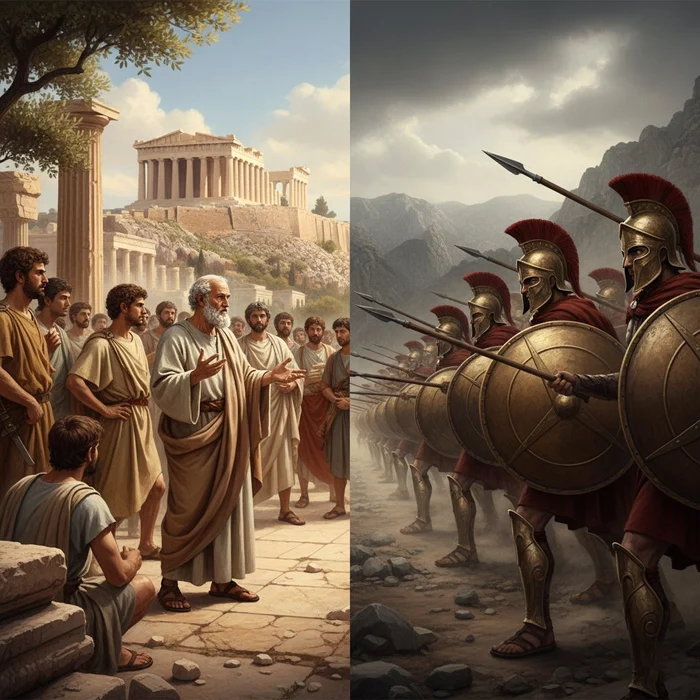
“We will be Athens and super-Sparta at the same time,” says Netanyau/FOTO:X
Amid restrictions imposed by some Western states on arms shipments to Israel, Netanyahu argued in a speech in September that his country must adopt a “super-Sparta” mentality — a self-sufficient, heavily militarized society capable of resisting isolation and developing its own defense industry.
However, the Israeli leader qualified this view. “We will be Athens and super-Sparta at the same time,” he said, suggesting that Israel would not completely abandon the values associated with democracy and openness symbolized by Sparta's historic rival.
The focus on “super-Sparta”, however, dominated the public debate and provoked critical reactions. For Netanyahu's political opponents, the message suggested a future that is more closed, harsher and less connected to the world — a society defined by militarization and isolation, writes The Washington Post.
Critics have pointed out that Sparta's self-sufficiency, often celebrated as a virtue, is difficult to reconcile with the realities of a globalized world. In their view, such a model would not lead to resilience, but to stagnation and decline. This debate is not new. As early as 1787, Alexander Hamilton, one of the founding fathers of the United States, described Sparta as “little more than a well-organized military camp,” lacking the economic vitality necessary for a prosperous state.
Why Sparta returns to political discourse
However, as the world approaches 2026, references to Sparta seem to take on renewed symbolic force. In many countries, the rise of nationalist and illiberal policies is accompanied by the strengthening of borders, increased military budgets and a withdrawal from global commitments.
According to some analysts, the weakening of the rules-based international order and the backlash of globalization—accelerated including by former US President Donald Trump's trade policies—created a favorable context for a “Spartan comeback.”
Swedish economic historian Johan Norberg, author of Peak Human, talks about the classic opposition between the ideals of Athens and those of Sparta. Athens symbolized exploration, trade and the exchange of ideas; Sparta, by contrast, emphasized the protection of what already existed, discipline and retreat.
“It's a very attractive idea in times of crisis, when the world seems dangerous,” says Norberg. “But it's also a view that treats the world as a zero-sum game.”
This perception of danger permeates Western political discourse. Migration, cultural change and the decline of Western influence are presented by some governments and political movements as existential threats. In this context, the myths of Sparta reappear.
From myth to political symbol
In recent years, Spartan symbolism has been adopted by various nationalist groups. At the January 6, 2021 storm on the US Capitol, some participants wore Sparta-inspired helmets and displayed the slogan “Molon Labe” — the phrase attributed to Spartans who refused to surrender their weapons.
In Europe, far-right parties and movements have used similar images and slogans. In Greece, the former neo-fascist Golden Dawn party held rallies at Thermopylae, the site of the famous battle led by King Leonidas. Although the party was banned, far-right formations continue to gain ground, including one that goes by the name “Spartans”.
However, historians warn that this idealization oversimplifies reality. Sparta was far from a model of pure self-sufficiency. In its later conflicts with Athens, it depended on Persian financial support, and its society was deeply unequal and brutal.
“Sparta was a state based on slavery”says British historian Paul Cartledge. “Even by the standards of the time, it was notorious for its treatment of the unfree population.”
This dark side of Sparta was also recovered by the ideologies of the 20th century. The Nazi regime praised the Spartan practices of selection and discipline, seeing in them a precedent for its own racial obsessions.
The limits of analogy
References to Sparta have also been used in modern geopolitical analysis—from the Cold War to the current rivalry between the United States and China. Political scientist Graham Allison popularized the idea of the “Thucydides Trap”, comparing the tension between a dominant and an emerging power to the conflict between Sparta and Athens.
But even Allison warns of the limits of these analogies. “The differences between our world and that of the Greek city-states are profound,” he says. “When one selects only the convenient elements of a comparison, it says more about one's own political view than about the reality one is trying to explain.”
In this sense, the invocation of Sparta remains a mirror of contemporary anxieties rather than a clear lesson from history—a powerful but dangerous symbol in a world that seeks certainties in an often mythologized past.