The disinformation techniques used by Putin at the year-end conference. Marriage proposal among threats


During the press conference at the end of the year, Vladimir Putin used several established disinformation techniques, according to an analysis by the EUvsDisinfo portal, which combats pro-Kremlin propaganda.
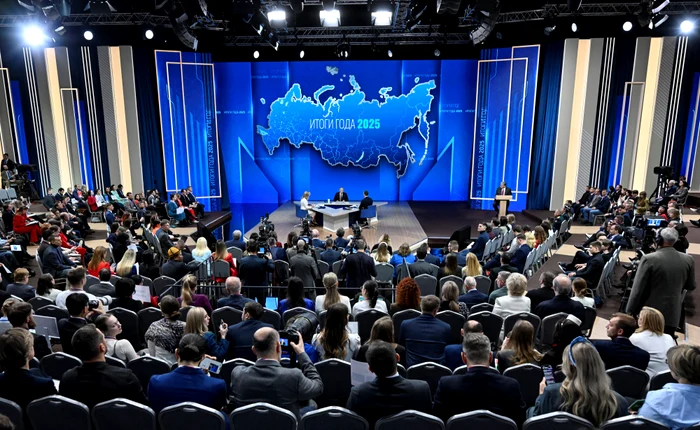
Putin's year-end conference was an orchestrated exercise in disinformation. PHOTO: AFP
On December 19, 2025, Russian President Vladimir Putin appeared again on his annual television call-in show, “The Vladimir Putin Hotline”, answering questions submitted by citizens.
“Putin's speeches and public appearances are a major pillar of Russia's Foreign Intelligence Interference and Manipulation (FIMI) campaigns. By framing disinformation narratives at the highest level, Putin's public statements provide legitimacy and key communication points that state media, FIMI actors and associated networks amplify globally to influence public opinion and distort reality“, according to an analysis by specialists from EUvsDisinfo.
EUvsDisinfo, part of the European External Action Service's East StratCom Task Force, was founded in 2015 to track, analyze and dismantle pro-Kremlin disinformation.
These occurrences typically include established disinformation techniques, some of which are identified below.
First broadcast in 2001, the show “Direct Line” has become a constant on the Russian political calendar, being organized almost every year with only a few interruptions. From 2023, it was merged with the previously separate year-end press conference and rebranded as an annual review with Putin.
Local problems? Putin's crystal ball has answers
The format of the show left no doubt that the questions were carefully selected and the answers prepared in advance. Many of the questions focused on very specific local issues, allowing Putin to demonstrate his knowledge of everyday issues and portray himself as personally involved in solving them. He often started his answers by saying he already knew about the problem. What was new this year, however, was the change in tone: in the past, Putin usually promised to intervene to solve the problems raised (whether or not he actually did), but this time he often claimed that things were already solved. Other questions were more personal or light-hearted – such as “Do you believe in love at first sight?”. This well-known disinformation technique, the appeal to emotion, appears to have been designed to humanize the authoritarian leader.
The stakes were raised higher when Kirill Bajanov, a reporter for the Yekaterinburg-based Channel 4 regional television, began his intervention before the president with a standard introduction. He came with a poster that said “I want to get married”.
“Vladimir Vladimirovich, hello. I'm Kirill Bajanov, from the regional television Channel 4, Yekaterinburg.”
“But you're dressed like you're getting ready for marriage”Putin told him, noticing his outfit.
“I know my girlfriend is watching the live broadcast now. Olycika, marry me. And since all this happened here, Vladimir Vladimirovich, we would like to see you at our wedding“, said the journalist.
Putin reacted with humor, advising the couple not to delay happiness, saying: “You can wait forever, so you better not delay.”
The moment brought smiles to the room and provided an unexpected break in the marathon conference.
Handling criticism by challenging its legitimacy
The merger of the Hotline and the press conference has also broadened the audience – it now includes journalists. Inviting journalists from countries designated by Moscow as “unfriendly” – this year media representatives from the US, UK and France were present – allows the pro-Kremlin media to claim that there is “no censorship” in Russia. By giving Western journalists space for critical questions, Putin used a form of false equivalency, turning the exchange into a performance for a domestic audience that dismissed criticism as unfair and presented the West as fundamentally biased.
Russia's peace offer – or rather, capitulation
In the days leading up to the event, a new round of peace talks on Ukraine took place, with the participation of representatives of the United States and Ukraine. Also, the day before Putin's show, European leaders agreed to a 90 billion euro loan for Ukraine. No wonder Putin began by addressing “issues of war and peace,” as the show's moderator put it. Putin reiterated that Russia is ready to end the conflict “by peaceful means”again using the technique of whataboutism to invoke the supposed “root causes” of war. He stated that it can only be concluded under the conditions he set in 2024 – namely the withdrawal of Ukrainian troops from Donbas and Ukraine's withdrawal from NATO membership.
Recycled disinformation: Repetition is key
Two other disinformation techniques – projecting and repeating false narratives – have also been used. “The ball is completely in the court of our Western adversaries, especially the leaders of the Kiev regime and their European supporters,” Putin said, as if the Russian military wasn't pushing the war forward. By projecting it, Putin tried to shift the blame for the lack of a peace deal onto Ukraine and the EU — a disinformation narrative familiar to the Kremlin. He also claimed that Russia did not start the war in Ukraine, but was merely reacting to hostile actions by the Ukrainian government, or, in Putin's parlance, the “Kiev regime,” which it accuses of attacking civilians in Donbas after what he calls a “coup” in 2014.
The constant repetition of false narratives follows a simple logic: if you say something often enough, it can come to be perceived as truth. Repetition can make even the most absurd claims seem plausible—if not in the eyes of democratic societies, then at least to the Russian public Putin is trying to persuade. Although at the beginning of the large-scale invasion the majority of Russian society supported military intervention, this trend appears to have changed given the human and economic costs of the war. However, using projection and repetition to blame the West for prolonging the conflict remains a highly effective manipulation technique in Russia.
Can't you win the war? Pretend you've already earned it
Putin spent a lot of time discussing the situation on the front, claiming that the initiative had completely shifted to Russia and that Russian forces were advancing along the entire line of contact. He categorized as “fake” the photos of Ukrainian President Volodymyr Zelensky in Kupiansk and stated that Ukraine no longer has strategic reserves to maintain or advance the front. In an example of fact-selection bias, Putin promoted the Kremlin's economic propaganda designed to project stability and resilience despite international sanctions. He emphasized that the state was successfully fighting inflation and that, for the time being, it had sufficient reserves to finance the war. This message is not intended for internal audiences only; it also serves to reposition Putin in the peace negotiations.
Referring to the possibility of using frozen Russian assets to support Ukraine, Putin described it as “a robbery”, echoing an old Kremlin FIMI narrative. He warned of “serious consequences”, threatening European countries with a loss of reputation and trust in the euro zone from other states that hold their reserves there.
“Are we really going to attack Europe? What nonsense is this?”
Responding to a BBC question about the possibility of future “special military operations”, Putin said there would be none as long as Russia was “treated with respect”. In his opinion, Western political leaders created the current situation and continue to escalate tensions by openly talking about preparations for war with Russia. The obvious strategy was to delegitimize critics by portraying them as biased and hostile. “Are we really going to attack Europe? What nonsense is this?”, he asked rhetorically, then argued that Western governments are deliberately portraying Russia as an enemy to mask their own economic and social failures. This narrative, which depicts the EU as fueling “Russophobia” to distract from domestic problems, is a constant element of Kremlin propaganda.
Putin also mocked NATO Secretary General Mark Rutte for saying that alliance members could be “Russia's Next Target”telling him to read the White House National Security Strategy, which does not designate Russia as an enemy or target: “Don't you even know how to read?At the same time, answering a question about the security of the Russian enclave of Kaliningrad, he warned that any threat in the region would trigger an “unprecedented escalation” that could lead to a full-scale military conflict. A journalist from a Belarusian state publication cited Putin's earlier statement about “European pigs” when asked about security guarantees for Belarus, and Putin stated that the security of the Russia–Belarus Union State “is in safe hands and will be fully guaranteed”.
Putin's annual telecast serves not only as a platform for controlled messages, but also as a powerful vehicle for disinformation from the highest levels of the Russian state. By combining carefully selected questions with rehearsed and staged answers, the Kremlin projects an image of openness while reinforcing narratives that shift blame for the invasion of Ukraine, portray Russia as the victim, and advocate economic resilience despite increasingly tough sanctions. These narratives, picked up by state media and amplified by FIMI actors, are designed to normalize aggression, undermine Ukraine's sovereignty, and erode trust in Western institutions. Recognizing and exposing these tactics is critical to countering their influence and protecting the integrity of public discourse.