The “coalition of the will”, between ambition and illusion. Why security guarantees for Ukraine remain, for now, on paper

The idea of a “coalition of the willing” constantly returns in Western discourse on peace in Ukraine. It sounds determined, mobilizing and promises a stronger role for Europe. In reality, however, the effectiveness of this political construction is deeply questionable, warns an analysis published by The Hill.
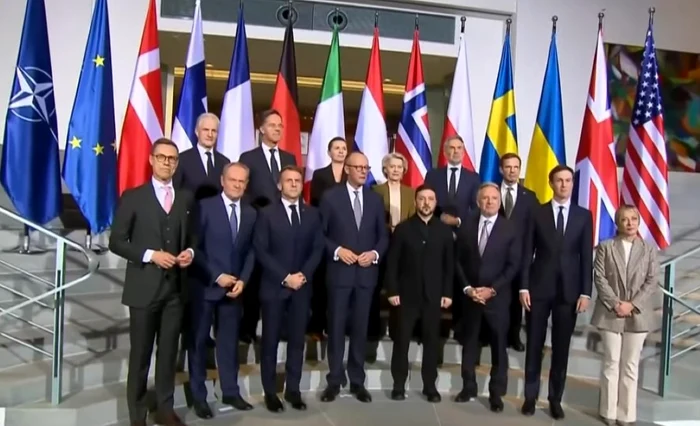
European leaders, meeting in support of Ukraine/PHOTO:X
The initiative was launched by British Prime Minister Keir Starmer after the London summit on March 2, 2025, with the ambition of creating multinational forces capable of providing Ukraine with security guarantees in a possible agreement with Russia. On paper, the mission seems clear: either the deployment of “reassurance forces” on Ukrainian territory, aimed at preventing breaches of the peace, or the establishment of a deterrent capability, ready to respond militarily in case of serious violations.
Starmer worked closely with French President Emmanuel Macron to expand the coalition, which today numbers 34 states. Most are NATO members – with notable exceptions, including the United States – to which are added countries such as Australia, Japan, Ireland or New Zealand. It's certainly a broad front, but not necessarily a coherent one, points out Eliot Wilson, national security expert and editor of Defense on the Brink magazine. Commitments differ significantly from country to country, both in scope and substance.
The “Coalition of the Will” appears to have been created in a political rush
The fundamental problem, however, is not related to the number of participants, but to the very meaning of the approach. The “coalition of the will” seems to have been created in a political rush, without anyone stopping at the essential questions. The most important of them: what exactly is this coalition for?
Public discourse is full of terms like “implementation,” “reassurance,” or “prevention,” but all of these concepts presuppose the existence of a peace agreement. However, more than nine months after the launch of the initiative, Ukraine and Russia have not even agreed on a minimal framework for ending the war. Under these conditions, it is difficult to understand how coalition leaders can anticipate the mission, objectives, or rules of engagement of forces they have virtually nothing to oversee.
Wilson's comparison is suggestive: “It's like choosing the cutlery for a meal without knowing what will be served.”
This detachment from reality is also found in the joint declaration of December 15, signed by several European states and the European Union, which speaks of the creation of “multinational forces for Ukraine”, led by Europe and supported by the United States. The missions invoked are ambitious: rebuilding the Ukrainian army, securing the airspace and maintaining maritime safety, including through operations on the territory of Ukraine.
It's just that, almost simultaneously, Moscow reiterated an old and firm position: the presence of NATO troops in Ukraine is unacceptable. The recent statements of the Russian deputy foreign minister, Sergei Ryabkov, leave no room for interpretation.
Behind the scenes, US officials argue that Vladimir Putin may eventually accept European forces, provided they do not operate under the NATO flag. Where this certainty comes from remains unclear, especially in the context of the rigidity demonstrated by the Kremlin leader so far. Even more problematic is the fact that the non-NATO states in the coalition have limited military capabilities, with the notable exception of Australia and Japan, but insufficient to sustain a robust military presence on the ground.
Without US support, the initiative risks remaining a “paper tiger”
Another sensitive point, avoided in political statements, is that of real capabilities. The documents speak of “US-backed” forces, but what does this mean, concretely? President Donald Trump has explicitly ruled out direct military support for the “coalition of the willing,” and potential “security guarantees” remain vague. US ground troops are not counted.
Without the support of the United States, the initiative risks remaining a “paper tiger”. Key capabilities such as intelligence, surveillance, reconnaissance and targeting are overwhelmingly dominated by the Americans. NATO, without the US, simply does not have comparable resources. The same goes for logistics, especially aerial refueling – essential for extended patrol missions. The difference is telling: NATO has nine joint tankers, while the US has more than 600.
In this context, the “coalition of the willing” seems more like an exercise in strategic imagination. If there were a clear peace agreement, if Russia accepted the Western military presence in Ukraine, and if the United States were willing to provide consistent military support, the initiative launched by Starmer and Macron could be considered a major diplomatic success.
In the absence of these conditions, the conclusion is a harsh but realistic one: Europe is projecting its desire for influence into a scenario that sounds comforting but remains, at least for now, imaginary.