The Frenchman predicted Russia's attack on Ukraine. He says about Poland: you would last longer than us


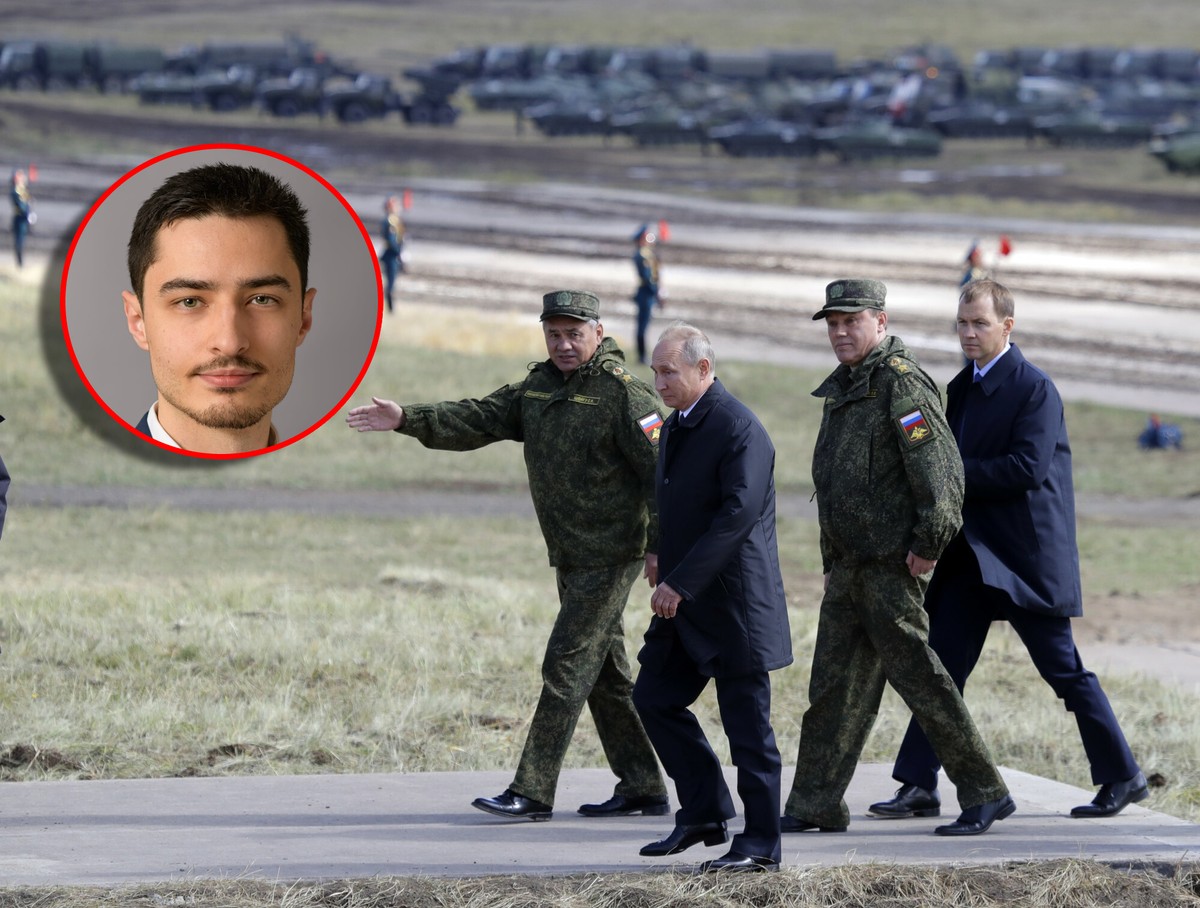
Marta Roels talks to Aurélien Duchên, expert and lecturer in the field of geopolitics and defense, author of the book “Putin against the West”.
Marta Roels, Business Insider: You warned about the Russian invasion of Ukraine already in 2018, when you were still a student. Where did this conclusion come from and how were you treated when in France they said it was just a “psychosis spread by the Anglo-Saxons”?
Aurélien Duchêne, author of the book “Putin against the West”: : I did something very simple, although to many it seemed naive or excessive – I assumed that Vladimir Putin was serious.
Read also in BUSINESS INSIDER
When in 2014, at official press conferences, he said that Odessa, Mariupol and other cities in southern and eastern Ukraine were “Russian” due to their history and imperial heritage, the prevailing interpretation in France was that this was just rhetoric, political theater, an attempt to divert the attention of Russian society from real internal problems. I noticed that Putin said exactly the same thing about Crimea just before the annexation. So I figured that if he had done something he had previously announced, he could do it again.
I admit that I expected it to happen in 2024–2025, because I thought Russia needed more time to prepare. The war broke out earlier than I expected, but the mechanism itself was exactly as I predicted.
I was wrong about only one thing – a few days before the invasion, I wrote that Ukraine would lose within three weeks, and then the war would turn into a long, guerrilla fight, with which Russia would have a huge problem. I did not believe that Ukraine would be able to put up such strong resistance from the very beginning.
In your opinion, the countries of Central and Eastern Europe understand Russia better than Western Europe?
Definitely yes. For years, France has been dominated by a sense of superiority towards the “small, eastern countries” that allegedly blindly listen to the Americans. Twenty years ago, Jacques Chirac said that Poland and other countries in the region “missed a good opportunity to remain silent” because they supported the USA. At that time, you were considered frivolous, Russophobic and politically immature.
Today, the narrative in France has changed and we hear more and more often that Central and Eastern Europe was right. Emmanuel Macron admitted this in 2023 in his speech in Bratislava, although almost no one in France paid attention to it. This shows that your perspective – based on history and experience – has proven to be more accurate than Western illusions.
See also: “Germany still lives mentally in the 20th century.” The author of the famous book does not mince his words
In your book, you write something even stronger, namely that regardless of whether Russia wins or loses in Ukraine, it will still try to attack NATO – either out of momentum after victory or out of a desire for revenge. Why?
It depends on the type of defeat or “victory” we will be dealing with. If there is a draw or a freezing of the front, we know from history that such a model does not work. If Russia suffers only a limited defeat or achieves what I would call a “mutilated victory,” it will have a strong incentive to finish things off. Either in Ukraine or through escalation elsewhere.
However, there is another type of failure that could realistically stop Russia, but today we are very far from it. It would be a real, severe defeat in Ukraine. Russia would have to come to the conclusion that if it paid such a high price in Ukraine, a possible conflict with Poland or Estonia would be even more disastrous. For now, however, there is no sign that Russia has suffered such severe losses.
Sometimes it is argued that Putin started the war to distract Russians from poverty and the terrible living conditions of Russians. Is it true?
This is a simplification. The main reason for the war is the ideology of “Ruski Mir” and the imperial vision of the country. I do not believe that the annexation of further territories is something that Putin was “forced” to do by the course of events. This was one of the goals from the very beginning. The second element is the desire to create a buffer zone in Europe – not because Russia is really afraid of a NATO attack, but because it wants to show that it still deals the cards on the continent.
Ukraine was to be transformed into something like a new Belarus – a puppet state with a controlled government in Kiev that would allow Moscow to tell Washington “get out of Poland and Central Europe and we'll stay here forever.”
There is also a third element – if the Russian economy begins to seriously collapse, war with NATO may become a way for the regime to regain legitimacy. We can already see that it is completely switched to war mode.
You write that the most likely scenario is an attack on the Baltic states in a way that would prevent the activation of Article 5. What could this look like?
A few years ago, I actually believed that the classic scenario of “protecting Russian minorities” in the Baltic countries was the most probable. Today the situation is changing because the eastern flank is strengthening. Poland is building a real “eastern shield”, is creating the strongest land forces in Europe, and Lithuania will have 5,000 troops in a few years. German soldiers. All this reduces the risk of a frontal attack, especially against Lithuania and Poland.
Estonia and Latvia remain the most vulnerable, but another scenario is emerging, which I did not write about in the book and which I heard in Estonia in the summer, during talks at the Ministry of Defense. This involves missile and drone attacks on capitals – Tallinn, Riga – without a full-scale land invasion. In Ukraine, Russia does this every day, and the Baltic countries do not have comparable air defense. What if NATO soldiers are not killed on the front, but there are hundreds of civilian victims in European capitals? This is still not a “classic” war, but something absolutely unacceptable.
There is also a third scenario, particularly dangerous for the West – escalation through disinformation, sabotage, arson, and provoking internal violence. In countries such as France or Great Britain with social and ethnic tensions, Russia may try to cause chaos by supporting extreme groups – e.g. Islamic extremists – so that violence breaks out “on its own”, without Russian tanks on the streets. This is a form of war for which NATO is still not prepared.
However, let's assume the scenario of an attack on the Baltic states. What should NATO's response look like, especially from the perspective of the eastern flank?
From a military perspective, there are different levels of response. In the “largest” model, we are talking about sending a full division, i.e. two brigades, approximately 10-12 thousand. soldiers, plus heavy equipment, air support – several dozen Rafale aircraft and anti-aircraft defense assets. However, it must be clearly stated that this sounds like something huge, but in Ukraine Russia loses about a thousand people a day, some of them killed, others wounded or missing.
In such a perspective, France or Great Britain, and even more so Germany, would not last long in a high-intensity war. And here we come to a thread that is crucial for Poland and the entire eastern flank – Poland is the “muscle” of Europe when it comes to land forces. You could last longer than us in a fight on the ground. France and Britain could instead bring superiority in air, satellite reconnaissance, intelligence, precision strikes and strategic capabilities.
The problem is that outside Ukraine, we are not prepared for what is becoming the core of the modern battlefield, i.e. drone warfare. No European army is ready on this scale – even if Poland had all the Abrams and tanks from South Korea tomorrow, it would still have to adapt to drone warfare just as the French army would have to adapt. Today we are preparing for war in 2022, not 2026.
What would you advise Poland then? You wrote about the need for closer cooperation with France – why this direction?
From the French perspective, rapprochement with Central and Eastern Europe is crucial, not only because of the Russian threat, but also for the future of Europe as a whole. I was criticized in France for this, because I say directly that we need stronger European defense, but we must not break ties with the US. This approach is quite obvious in Poland, but still controversial in France.
When it comes to Poland, my first piece of advice is to accelerate investment in drones and defense against them. Poland invests huge amounts of money in the army, but – like France – still not enough in this sector. This is a mistake that can pay off very dearly.
The second issue is more difficult politically – Poland, like other countries on the eastern flank, should seriously prepare for the scenario of functioning without the full American umbrella. The French must finally learn to listen to your warnings regarding Russia. At the same time, it must be made clear that NATO will not be replaced by Europe.
If we decide that “the world does not need Russia”, what would absolutely total sanctions achieve: a complete cut off of gas and oil, an end to trade and the use of frozen Russian assets? How long can the Russian economy last before it collapses?
I am strongly in favor of using frozen Russian assets. This would make strategic and political sense, although of course there would be consequences, I still believe it should be done. However, we must be soberly aware of one thing that France reminds us – we must not assume that the whole world thinks like Europe. Russia is not completely isolated.
Even if the European Union builds a “wall” and cuts itself off economically, much of the world will still trade with Russia. I saw it with my own eyes in South Africa: India, Brazil, Latin American countries – for them, the war between Russia and Ukraine is sometimes “one of many conflicts” in the world, and not a fundamental clash for the international order.
You also write that young Russians would like to live at European level, but they will never say directly that Western values are better. Why? After all, they have the Internet, access to information and do not live under full censorship. Why don't they revolt en masse even in Moscow or St. Petersburg?
The first word is denial. “My country can't be that bad.” We saw exactly the same thing in Germany – millions of Germans knew about the extermination of the Jews, but were unable to accept that their own state was committing such evil. Russia is a country deeply immersed in the mechanism of denial.
The second thing is that young Russians like Starbucks, McDonalds, a comfortable life and are frustrated that they no longer have it in Moscow, but at the same time they do not want Western values. They are not as conservative as the older generation, they are not obsessed with LGBT people, but they absolutely do not want to be “taught” by the West. The very fact that the West tries to tell them how to live makes them prefer Putin, even if privately they prefer the Western lifestyle.
The third thing is a feeling of superiority. The Russians know that life is better in Paris or Warsaw, they know that Poland coped better after 1989 than they did, but at the same time they believe that their system is “better” because it creates history, wages war and makes sacrifices. For them, it is proof of greatness, not failure.
Can Russia one day “wake up” and change?
Perhaps, but probably only after a total disaster. Today Russia is a fascist state – Timothy Snyder says it clearly and I agree with him. This is not a normal country. In my opinion, Russia is heading towards a second North Korea – even more closed and totalitarian. I do not believe in a scenario in which the West “fixes” Russia unless someone takes it militarily and carries out denazification and democratization there by force, as in Germany or Japan after the war. If any change comes, it will likely be through an internal breakdown, maybe a civil war, maybe after a series of defeats that will make the Russians see how far they have fallen. I don't know if I will live to see such a moment myself.