The negative aspects of Great Britain's exit from the European Union and how much the country lost due to Brexit are often shown. Parting with the Community disrupted many trade chains, made mutual trade more difficult, there were empty shelves in stores for some time, and there were problems with enterprises' access to labor. But when British economic results are compared, especially the latter, not with the entire EU, but only with the three largest economies of the community, the conclusions may not be so negative.
Let us recall the results of the largest economies of the European Union from the third quarter: Germany growth by 0.3 percent year to year, France increased by 0.9%, Italy increased by 0.6%.
The text continues below the video
Against this background, and not against the background of the entire EU, which is driven by smaller economies, the British result can already make a positive impression. In the third quarter in line with the second estimate GDP growth there amounted to 1.3 percent. — according to the British Central Statistical Office, i.e. ONS.
This is slower than in the previous quarter (+1.4% y/y), but at the level of the second quarter of this year. Such growth may not impress Asian countries or even Poland, which grew by 3.8% in the third quarter. y/y, but the largest EU economies are already looking with envy.
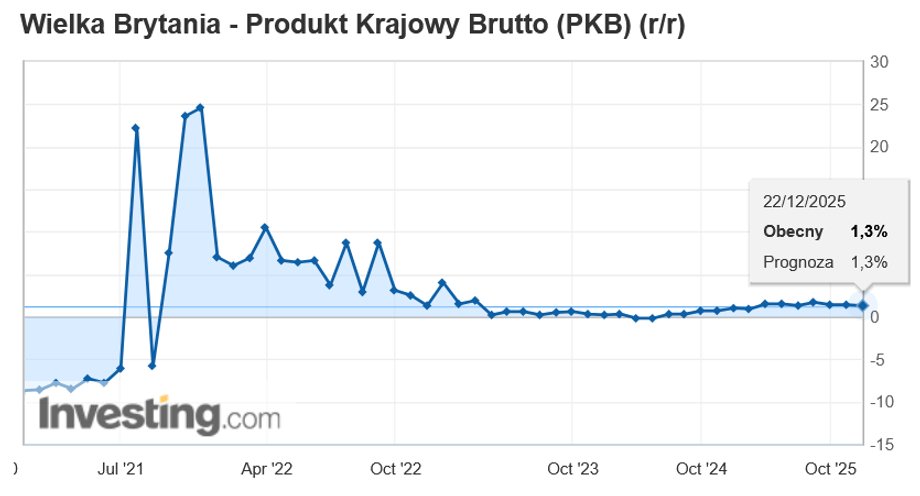
UK GDP
|
Investing.com
Since Poland actually left the EU In 2020, Great Britain's GDP increased by a total of 2%. including the third quarter of this year. In the case of Germany, it was a decrease of 0.1%. However, France grew faster (+5%), and Italy grew even faster (+6.3%). However, it is now easier to compete with France due to its political problems and problems with the state budget and debt, so Great Britain may have no problem taking second place at this growth rate.
For comparison, Poland gained 18.3% during this time, and in Europe, seven more countries overtook us, led by: Ireland (+49.8%), Turkey (+36.1%), Malta (+35.5%) and Cyprus (+30.1%), according to Eurostat data.
What determined Britain's GDP?
The biggest contributor to the annual GDP growth was services (+1.4% yoy), especially ancillary activities in financial and insurance services (+2.3% yoy). Industrial production decreased year-on-year by 0.2%, private consumer spending increased by 0.7%. y/y, government sector consumption by 1.6%, and capital accumulation by 2.9%, including investments – by 2.7 percent rdr.
Read also: Great Britain and the budget for next year. Plans to raise taxes
The UK's real gross domestic product (GDP) increased by 0.1%. quarter to quarter without adjustment, compared to an increase of 0.2%. in the second quarter. In detail, growth in the last quarter was driven by services (up 0.2% qoq) and construction (+0.2% qoq). “The manufacturing sector recorded a decline of 0.3 percent.” – we read in the ONS information.
It is estimated that real GDP per capita did not increase in the last quarter, but increased by 0.9%. compared to the same quarter a year earlier.
Decline in disposable income in the UK
Real disposable household income per person fell by 0.8%. in the last quarter, after no changes were recorded in the previous quarter.
The household savings rate decreased by 0.7 percentage points to 9.5% in the quarter, driven by a decline in the share of non-pension savings.
It is estimated that nominal GDP increased by 1.0%. in the third quarter of 2025 (down from the original estimate of 1.2 percent) and is currently 4.8 percent higher than in the same quarter a year ago. The level of nominal GDP in the third quarter of 2025 compared to the fourth quarter of 2023 is currently estimated at 10.7%. higher, up slightly from the original estimate of 10.6 percent.
Compared to the same quarter a year earlier, the implied GDP deflator increased by 3.5%. in the third quarter of 2025, mainly due to household spending, general government spending and exports.