The behavior of the Russians says it all. The panic is becoming more and more visible. They are preparing for a rainy day

The United States is at the forefront of statistics: many institutions, from government agencies to universities, conduct surveys and measurements to produce a variety of indicators. However, quasi-scientific instruments are no less popular here, such as the commonly known “Big Mac index” or the lipstick index. This is because they are tangible, authentic and clear.
In Russia, indicators have also appeared that give a clearer picture of the situation than, for example, inflation: the borscht index, the shish kebab index before the May holidays, or the Olivier salad index before the New Year. But perhaps it's time to introduce two more indicators that reflect citizens' perception of economic realities: nail index and pantry index.
The president of the Association of Cosmetics Entrepreneurs, Lalia Sadykowa, talked about the recently observed phenomenon. According to her, women are losing interest in the beauty industry. Beauty salons panicked: usually the pre-New Year's season brought them profits comparable to several months of normal work and allowed them to survive until spring, when women began to prepare for the holidays. But this year disaster struck. Demand for eyelash extensions and comprehensive hair coloring – the most sought-after holiday services – fell by 40% in December. compared to previous years.
Demand for other services dropped by 20-35 percent and revenues by 15-30 percent.
Why did this happen? Probably because 49 percent companies surveyed by the Aktion group gave up organizing traditional New Year's Eve parties. Neither the companies themselves nor their employees have money, and the latter now prefer not to flash fan-like eyelashes and amazing shades of hairstyles in front of their colleagues, just leave money for a rainy day.
Even services that were previously considered common have fallen in demand — for a manicure! Please forgive me, but because of my gender, I can confidently say: when a woman gives up on her “nails”, she is on the edge. Even the most ardent feminists and natural beauty enthusiasts who condemn eyebrow waxing and permanent makeup sit down at their manicurist's table once a week and say: “As always – only manicure, no nail polish.” Even those women who boast long hair come in from time to time to have their hair laminated or have an inch of their ends cut off with hot scissors. I'm not even mentioning cosmetic treatments for women over 30 – purely out of women's solidarity.
The article continues below the video
Manicure, haircut and beautician are the “holy trinity” for a woman, and if she doesn't go to the salon, it means that her finances and future forecasts are really bad.
Of course, there is another theory. Most showrooms will start paying VAT next year, that's why They began to raise the prices of their services in advance. Sadykowa, mentioned above, notes that revenues have decreased less than the number of customers. Which could mean that the same beauty salon workers and hairdressers could go home offering their services illegally.
But this version is doubtful.
Salons are needed by stylists no less than stylists are needed by salons. There is a huge flow of customers there, there is the possibility of purchasing tools, paints, varnishes and other materials wholesale, i.e. cheaper, and there is often equipment that cannot be placed at home, much less taken to the customer's home.
Moreover, complicated coloring, nail treatments, Christmas hybrid varnish, not to mention “beauty injections” and other gold threads – performing these treatments at home is difficult and often simply dangerous.
And since the difference in price is small, stylists most often work at home with those who live nearby or who are not comfortable with the salon's opening hours. This means that they serve a small fraction of their customers. It couldn't be otherwise: a salon can easily accommodate 20 clients a day, but try visiting 20 addresses, especially in a big city!
No, giving up manicures is not a sign that manicurists have gone underground or that women have started growing their nails.
Soviet-style stockpiling
Especially since there is one more fact that confirms the lack of money theory: citizens started stocking up on food products again.
Younger people may not remember buying buckwheat, salt, sugar, pasta in bags, sunflower oil, soap, washing powder, canned food in boxes – basically everything that could be stored. However, anyone who was over five years old in the 1990s certainly remembers this unforgettable smell from the attic: the smell of lumpy washing powder, rancid oil and moldy cereals. And moths! Not these clothing parasites, but food parasites whose larvae made grain, flour, nuts and dried fruits inedible.
When cockroaches suddenly disappeared in Moscow in the early 2000s, many theories emerged: from toxic Chinese anti-cockroach pencils to radiation from microwaves and cell phones. I think the answer is much simpler: at the beginning of the 21st century, even the most persistent and stubborn people finally threw away the supplies they had accumulated in the 1980s. Cockroaches simply had nothing to eat.
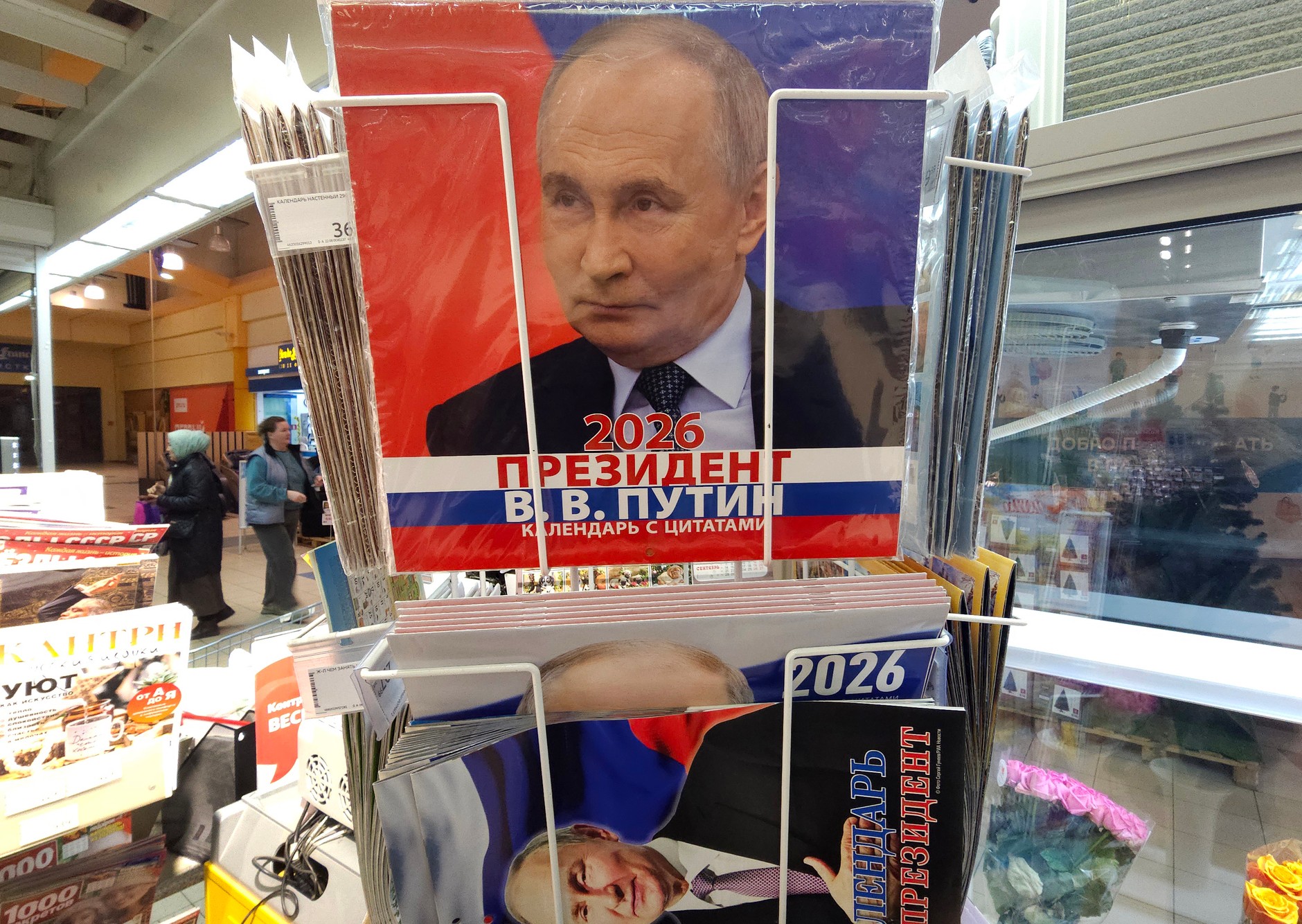
Customers walk in a supermarket next to calendars for 2026 with a portrait of Vladimir Putin, Moscow, December 6, 2025.Contributor/Getty Images/Getty Images
And now the children of these prudent citizens are repeating the experiences of their fathers and mothers: 59 percent. optimists stock up for a week or two, 27 percent realists – per month, and 5 percent pessimists are preparing for “dark days” lasting half a year or more. They collect the same products: groats (79%), pasta, sugar and salt (68%), tea and coffee (71%), canned food (61%). Every fourth respondent in the survey conducted by H5 Klub collects supplies of chocolate or candy. Another 40 percent accumulates stocks of household chemicals, and 46 percent — only basic items, i.e. soap and toothpaste.
These are no longer women's whims (although they are not whims at all), but undoubtedly the purest reaction to panic. Stockpiles are made in case of financial difficulties (29%) and – attention! — not being able to visit the store (40%).
Why do I think this behavior is panicky? Because not having money to buy buckwheat, salt or sugar is theoretically possible, but practically – only in the event of a major disaster, such as mass bombings or crowds of rioters in the streets. And the inability to visit a store (in times of advanced delivery!) – only if going out onto the street is deadly dangerous.
Can you imagine this picture? Here, citizens walk around the beautified Moscow, impossibly decorated before the holidays, and other, perhaps less beautified, but also decorated cities and towns – and after the walk, they go to the shops and take out bags of sugar and salt, packages of buckwheat and pasta, boxes of canned food, bought with money that would have previously been spent on a manicure and a hairdresser. Then they hide it all on shelves and in compartments. How to reconcile this? Only in a state of panic, when on the one hand you want to take a walk, and on the other hand, you want to prepare for the siege.
Of course, you can analyze the statistics and argue whether Rosstat is lying. You may or may not believe in economic growth or decline in inflation. You can finally believe your friends and strangers who tell you how wonderful everything is.
But when these same citizens show you their hands without manicure, with blisters from carrying bags, and packets of buckwheat fall out of their fashionable wardrobes – all other arguments are unnecessary.