Chancellor of Germany, announcement about the security guarantees granted to Ukraine by the US and Europe. The role of Western troops after an armistice

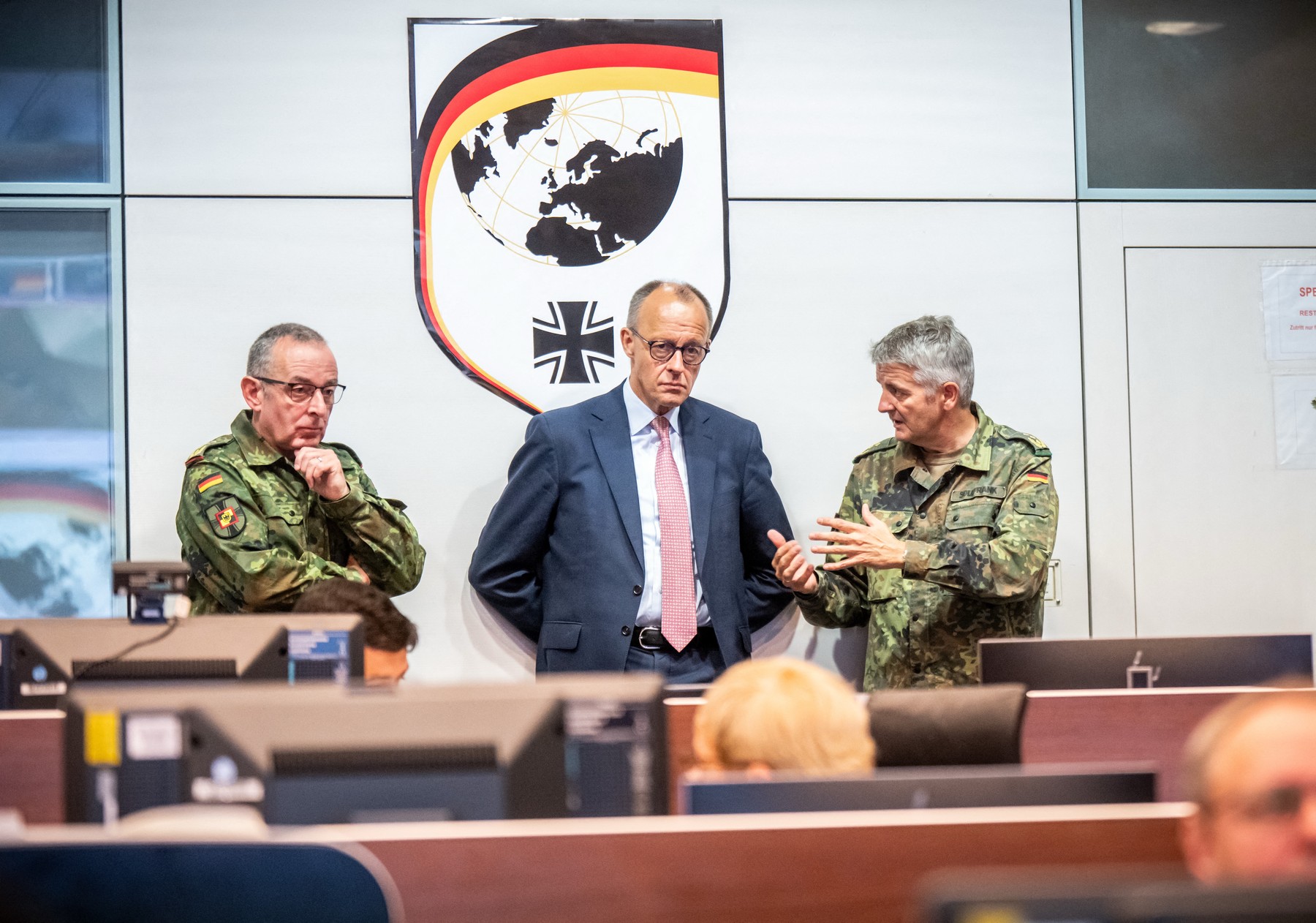
Chancellor Friedrich Merz with Generals Carsten Breuer (left) and Alexander Sollfrank, the highest-ranking officers in the German armed forces, PHOTO: Michael Kappeler / AFP / Profimedia Images
Under the post-ceasefire guarantees given to Ukraine by the United States and Europe, peacekeepers could, under certain circumstances, repel Russian forces, German Chancellor Friedrich Merz said in an interview with public broadcaster ZDF, adding however that this remains a distant prospect, Reuters reports on Tuesday.
Pressed by German journalists to provide details of possible security guarantees proposed by the United States during Monday's talks in Berlin with Ukrainian President Volodymyr Zelenskiy, Merz said the guarantees would have to repel Russian forces should there be a violation of any terms of the truce.
“We would secure a demilitarized zone between the warring parties and, to be very precise, we would also act against corresponding Russian incursions and attacks. We are not there yet,” the federal chancellor said.
“The fact that the Americans have made such a commitment — to protect Ukraine in the event of a ceasefire, as if it were NATO territory — I think is a remarkable new position for the United States of America,” Merz added.
Russia has yet to accept a ceasefire, which both the US and Europe have said is a prerequisite for any security guarantees. So far, Moscow has also rejected the presence of Western troops on Ukrainian soil to help end the full-scale war that began when President Vladimir Putin ordered Russia's invasion of Ukraine in February 2022.
“50%” chance of sending frozen Russian assets to Ukraine
In the interview, Merz also stated that, in his opinion, there is a “50% to 50%” chance of reaching a European agreement on the use of frozen Russian assets to finance the ongoing defense of Ukraine. He added that this is essential because Kyiv will need funding for at least two more years after the current round of European funding ends in the first quarter of 2026.
“There are reservations all over Europe and I understand them very well,” he said. “But… if we don't act now and take the decision we could take to stop the advance of the Russian army, when will we do it?”, the German chancellor pointed out.
The hostile tone toward Europe in the new US National Security Strategy did not surprise him, he said, as it reflected much of the criticism leveled at Europe by Vice President JD Vance in his speech at the Munich Security Conference earlier this year.
But Merz said any isolationist trend on the part of the US was unlikely to be sustained.
“America first” (America first, nr) is very good, but “America alone” would not be good for America either, said the head of the Berlin government. “And looking at the economic data in America, I imagine that the Americans will eventually come to us and say, 'Don't you want to talk about some things that we can benefit from together?'” concluded Merz.