Christmas tree: how to check how long it has been since harvesting, when to buy and how much it costs

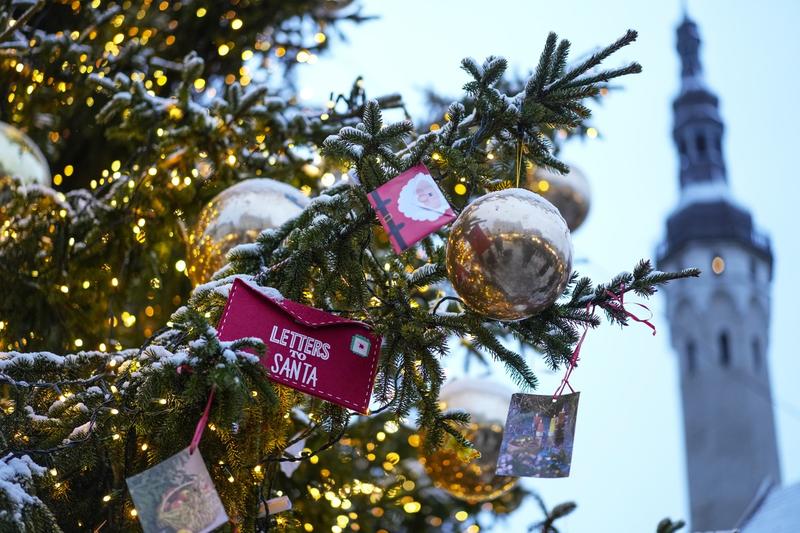
We call it a Christmas tree, although technically, the best-selling species in Romania are firs, spruces and those of the Douglas species, as explained by a Romsilva specialist with whom HotNews spoke. Fir is a genus that includes about 45-55 species of conifers, but the best known are fir, spruce and pine.
Once harvested, its lifespan until the “drying” process occurs depends on how it was preserved, the expert says.
“If it was kept in low temperature conditions, it can be kept for about 3 weeks. If it was kept in rooms with higher temperatures, obviously less. But it must be taken into account that by the time they are bought in a market in the Capital, a week may pass since harvesting”, says specialist Romsilva.
“Think that maybe they were harvested somewhere in Maramureș, then they were stored, after which they got on a truck and transported to Bucharest. So they probably already have 4-5 days when they reach the market, where they wait another 2-3 days until they find a buyer”, he says.
Three methods by which we can check how much has passed since the time of harvest
One method is to shake it up a bit. If the needles are already starting to fall out, it's clear that it won't last long at room temperature.
Another method is to look carefully at how the needles of the tree are arranged. They should be arranged in a comb shape. If they are already facing down or no longer follow that comb structure, the tree is old.
Advertising
Finally, a third method is to gently squeeze a fir branch in your fists. If needles remain in your palm, it means that the tree has run out of sap and will not last long, especially at 20-22 degrees when they are in a room.
How long does a Christmas tree “last” at room temperature?
At an average temperature of 22 degrees, a fir tree does not last more than a week to 10 days. After this period, it starts to “shake” (its needles fall out). Its duration of “use” can be extended if we periodically spray a little water on the branches.
Therefore, the Romsilva specialist recommends that the Christmas tree purchase period be around 5-7 days before Christmas. “But that's everyone's personal decision, of course,” he mentions.
Natural or artificial fir? “I have planted a tree in my yard that I decorate. For children, I use an artificial indoor tree. But I repeat, everyone has their own options,” says the specialist.
How much does the Christmas tree cost?
The prices of a Christmas tree vary greatly. The National Forestry Authority – Romsilva offers a total of 16,415 Christmas trees for sale, according to a statement from the company.
Of these, 13,462 are of the fir species, and another 2,953 are of the spruce or other softwood species. The prices for direct purchase, from forestry centers, warehouses or harvesting sites, start from 17 lei for a Christmas tree of the spruce species, with a height of up to 1.3 meters, and reach 39 lei for a fir specimen with a height of between 2 and 3 meters. Requests for specimens over 3 meters in height are considered special orders.
At Dedeman, the prices for natural firs start from 129 lei for a natural fir, Abies Nordmanniana, with a height of 170-210 cm.
On eBrazi.ro, a Nordman fir under 1.5 meters costs 99 lei, and a Nordmann Standard 150 – 175 cm costs 165 lei.
At Hornbach, a natural Christmas tree Nordmann GOLD Standard 1.7-2.2 m costs 129.00 lei per piece, and a natural Christmas tree Nordmann Basic 1.1-1.5 m costs 75 lei/piece
Artificial firs are obviously more expensive, prices starting from 270 lei
The most famous species of Christmas trees
Norway spruce (Abies) – Known for its beauty, it has a long shelf life and its stiff branches make it an excellent tree for heavy ornaments such as wreaths or garlands. r.
The silver fir – It is highly appreciated in our country due to the fact that the tree is resistant to drought, heat, smoke and dust. These things make the silver fir a very easy ornamental tree to maintain. The silver fir was the first tree species used as a Christmas tree, but along the way it was replaced by other species that grew more easily and with less expense.
Fraser fir – Fraser fir branches have a slight tendency to grow upwards. They have an excellent shape and good needle retention. They are blue-green in color and have a pleasant smell.
Douglas fir – It has soft green or blue-green needles in dark shades, radiating in all directions on the branch. When crushed, these needles have a sweet fragrance. It is one of the most important Christmas tree species in the US. The Douglas fir is said to be the tallest conifer ever recorded. In 1939, the head of the American forest service estimated the height of one specimen at 120 m, with a woody mass of 515 cubic meters.
Spruce (Picea abies) – The main differences between fir and spruce consist in the color of the bark (white in the fir, reddish in the spruce), in the appearance of the crown of mature trees (rounded at the top and with horizontal branches in the fir, pointed at the top and with the branches left down in the spruce) and the morphology of the leaves (flattened on two sides and colored white on the back, in the fir and four-edged and dark green, in the spruce). The two species also differ in terms of the cones (females): raised up in the fir and bent down in the spruce. Fir is a more demanding tree in terms of living conditions, preferring wetter soils and mountain faces warmed by the sun. In Romania, the spruce occupies 22 percent of the area of the forest fund (over 1 million ha) and occurs throughout the Carpathian chain, except for the Semenic, Almăjuli and Locvei massifs. In the Eastern Carpathians the upper altitude limit is 1500-1550m, and in the Southern Carpathians it is 1700-1800m.
The white spruce – It is excellent for ornaments; its short, stiff needles have a blunt tip and a slightly pungent smell when crushed. It has an excellent light blue-green color and a very beautiful natural shape. Needle retention is much better than other spruces. It is a native species of North America, and the lujers are glabrous (ie devoid of hairs).
pin – It has long and beautiful needles. It stays fresh for a long time and is part of the pinaceae family. On the territory of our country, there are several species of pine – Scots pine (Pinus sylvestris), Black pine (Pinus nigra var. banatica), Zâmbrul (Pinus cembra) and Juniper (Pinus mugo). The ram is an indigenous species, which can reach 26m in height and 2m in diameter. The general range of the species is exclusively European. In Romania, it grows at the upper limit of the forest zone, often in former glacial cirques. It is found in the Rodnei, Căliman, Bucegi, Făgăraş, Ţarcu, Godeanu, Retezat Mountains. The growth of the goat is slow, he lives over 1000 years. In our country, the zambr is protected as a monument of nature. Juniper is a species of pine in which the stem has a greater horizontal development.
Scots pine or Scots pine – The needles of this pine do not fall off even when dry, providing excellent needle retention. The color is a bright green. A very common Christmas tree in the US, the Scots pine has an excellent survival rate, is easy to replant, has great resilience and will stay fresh throughout the holiday season.