2025-12-13 14:00
publication
2025-12-13 14:00
36 percent seniors experience loneliness in everyday life, and every fourth person declares social contacts less frequently than once a month – according to the published “Research on the social needs of seniors 2025”. 41 percent elderly people live in blocks of flats or tenement houses without an elevator.
The report was presented during the National Citizens' Congress of Senior Policy organized in Warsaw by the MANKO – Głos Seniora Association.
During the congress, among others, lectures by experts and practitioners dealing with senior policy, discussion panels devoted to the role of seniors in civil society and presentation of good practices implemented by organizations and local governments.
The congress was attended by, among others, Secretary of State in the Prime Minister's Office Marzena Okła-Drewnowicz. As she informed, the Council of Ministers is to adopt a new multi-annual Active Seniors program “in the next few days”. She explained that the program will combine two existing projects – “Senior plus” and “Aktywni plus”, the aim of which is to activate seniors.
“Study on the social needs of seniors 2025” was presented by the president of the MANKO Association, Łukasz Salwarowski.
As he pointed out, the report highlighted the scale of loneliness among older people – 36 percent seniors experience it in their everyday lives. Every fourth person declares social contacts less frequently than once a month. He pointed out that this problem is systemic and significantly affects mental health, sense of security and quality of life.
25 percent respondents declare long-term low mood or sadness, nearly 20 percent cannot clearly assess his or her emotional state. The authors of the study concluded that, combined with increasing life expectancy and the weakening of intergenerational bonds, social isolation is becoming one of the key challenges of senior policy in Poland.
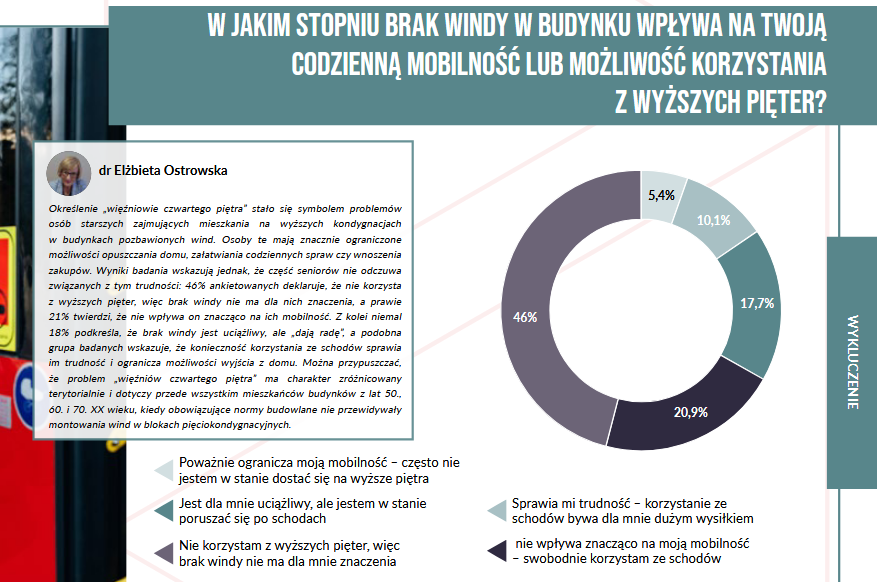
In addition 41 percent respondents live in blocks of flats or tenement houses without an elevator. Although 31 percent respondents are considering moving, only less than 18 percent points to architectural barriers as the main reason.
According to the report, a major problem is difficult access to specialist doctors, rehabilitation and long-term care. 38 percent seniors also have financial problems. 47 percent had to give up treatment or buy medicines, and 44 percent uses paid medical visits.
The study also shows that 8 percent respondents were victims of fraud, compared to 31%. fraud was attempted. According to Salwarowski, these data confirm the need for further education and continuation of the “Safe Seniors – Stop Manipulation – Don't be deceived” campaign, as well as the need for systemic actions to counteract crimes against older people.
The study involved 1,756 people aged 60 and over, including: 28.6 percent from large cities, 23.6 percent from medium-sized cities, 19 percent from small towns, 28.9 percent from rural areas. The online survey was completed by 72 percent. respondents, and the paper version – 28 percent
The National Citizens' Congress of Senior Policy is co-financed by the government's Multiannual Program for Older People “Aktywni plus” for 2021-2025, 2025 edition. (PAP)
kkr/ joz/