US stock markets fell off their highs. In the background there are problems with Oracle and Broadcom


2025-12-12 22:21
publication
2025-12-12 22:21
Wall Street once again has doubts about the astronomical valuations of AI companies. On Thursday, Oracle focused attention, and on Friday there was a strong decline in Broadcom shares. As a result, the S&P500 and Nasdaq fell just before returning to bull market highs.
The Nasdaq Composite Index ended Friday's session with a loss of 1.69% and a level of 23,195.17 points. On Wednesday, this benchmark was only 1.3% from the October peak of the bull market. The S&P500 fell by 1.07%, reaching 6,827.41 points. Just a day earlier, analysts speculated that reaching the level of 7,000 points may be a matter of the next few days.
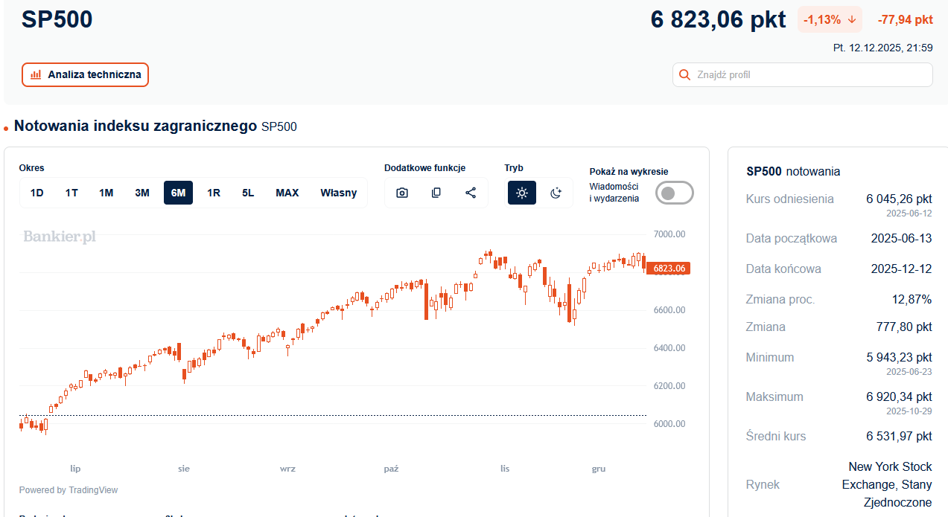
However, problems have returned with extremely high valuations of shares of companies related to the AI revolution. The catalyst for these doubts was Wednesday's release of Oracle's quarterly report. Some analysts drew attention to the alarmingly high debt of this technology and software provider specializing in databases and the cloud. On Thursday, Oracle shares fell by more than 10%, and on Friday they fell another 4.6%. This means that since the September shot, their prices have already dropped by 44%.
The second red flag was Broadcom's shares, which were depreciated by as much as 11.4%. A day earlier, the computer equipment supplier warned that rising sales of cheaper chips were threatening margins. This is another pinch with which the market is testing the pressure in the artificial intelligence balloon. Let's add to this a more than 3% decline in the price of Nvidia's shares and a nearly 5% drop in the valuation of AMD.
However, the prevailing narrative on Wall Street is that generative AI is the future and that it is worth every investment. And in 2026 alone, the six largest technology companies are expected to spend nearly $600 billion. However, the somewhat forgotten “DeepSeek moment” should remind us that money is not everything in this technology and it is possible that someone else will be able to achieve even better results for a small fraction of the costs incurred by Silicon Valley.
Let's not forget, however, that the Federal Reserve added fuel to the stock market bulls this week. The Fed not only lowered the federal funds rate in line with the market's wishes, but quite unexpectedly announced a program of “quantitative monetary easing” (QE) on a scale of USD 40 billion per month. The history of the previous 15 years teaches us not to play against the Fed and its “printers”.
Some analysts believe the recent pullback on Wall Street may be due to caution among some investors looking to take profits before the end of the year. All the more so because next week the “overdue” macroeconomic reports from the US will be released on the market: labor market data for October and November and the November CPI inflation reading.
K.K