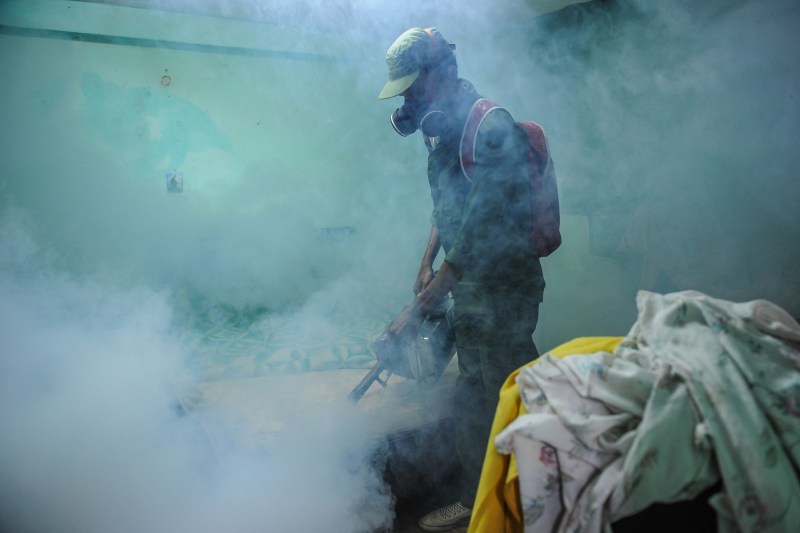
A member of the Cuban military spreads substances against Aedes mosquitoes to prevent the spread of the Zika, Chikungunya and Dengue viruses in Havana on February 23, 2016. PHOTO: YAMIL LAGE / AFP / Profimedia
Cuba on Monday confirmed the deaths of 33 people from mosquito-borne diseases in recent months, in an epidemic that has affected at least a third of the population, according to official reports.
Deputy Health Minister Carilda Peña announced that 12 people died from dengue (an infection caused by a mosquito-borne virus) and another 21 from chikungunya (an arbovirus also transmitted by mosquitoes). Dengue fever is also known as “broken bone fever” because the bone pain can be so intense that it feels like the bones are breaking.
The two viruses circulate widely in this Caribbean island nation. At least 21 of the people who died were under 18, Peña said.
The minister did not specify the period in which the deaths occurred.
The deaths and the epidemic that continues to wreak havoc are bad news for Cuba, as the country's health system is already facing existential challenges due to a severe economic crisis that has caused widespread shortages of food, fuel and medicine.
Dengue fever has long plagued Cuba, but the situation has worsened as a lack of funds and fuel hampers the government's ability to disinfect, clear trash from roadsides and repair broken pipes. The Chikungunya virus, once rare on the island, has spread rapidly in recent months.
There is no specific treatment for chikungunya, which is spread mainly by Aedes mosquitoes, which also carry the dengue and Zika viruses.
Chikungunya causes severe headaches, skin rashes and joint pain that can persist for months after infection, causing long-term disability, although it is rarely fatal.
Havana and Santiago, Cuba's two largest cities, have seen some of the highest infection rates in recent weeks.
Peña reported 5,717 new cases of chikungunya in the past week, although officials say many cases go undetected because most patients do not see a doctor or report being sick.
In July, the World Health Organization (WHO) issued an urgent call for action to prevent a repeat of the chikungunya virus epidemic that swept the globe two decades ago, as new outbreaks linked to the Indian Ocean region spread to Europe and the Americas.