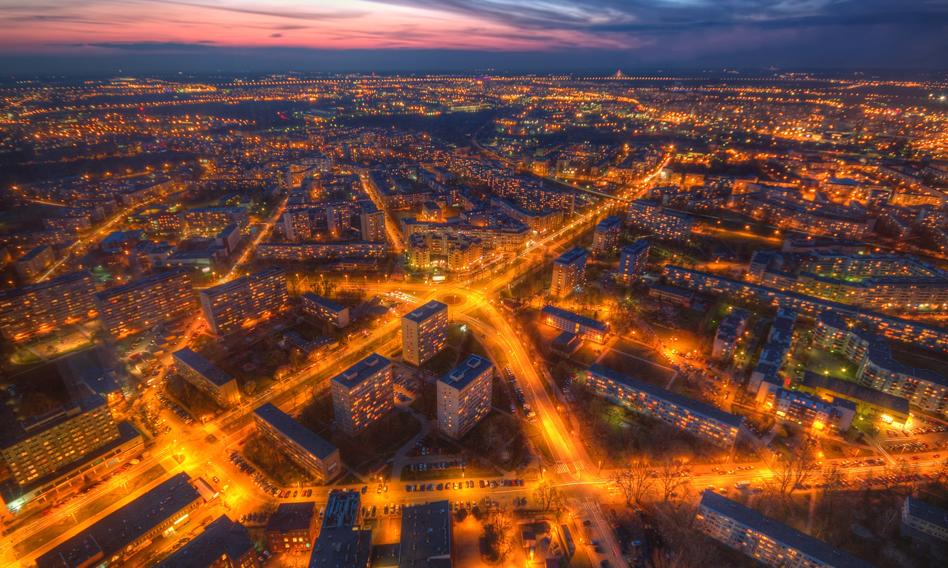
Five large urban centers are sucking young people out of smaller towns. The situation of the so-called the eastern wall and the peripheries of voivodeships, and the Kielce region is absorbed by neighboring regions. These are the results of research on the migration of Poles conducted by sociologists from the University of Łódź.
Ph.D. Piotr Szukalski, prof. The University of Lodz, from the Institute of Sociology of this university, presented the results of demographic research on the migrations of young Poles in Łódź. The research shows a trend indicating that Poland is experiencing depopulation at the local and regional level with a slow concentration of population in metropolitan areas.
Demographic map of Poland
According to prof. Szukalskiego, thanks to the stable inflow of Polish youth and immigrants, the largest cities, together with the surrounding suburban areas, are strengthening their position on the demographic map of Poland at the expense of smaller centers.
– In the research, we took into account two age groups – children aged 10-14, when they still live with their parents, i.e. in their place of origin, and 30-34-year-olds – the same people after 20 years, when it can be assumed that they live where their final place of residence will be – said Piotr Szukalski, presenting a report on research comparing demographic data from 2004 and 2024.
– Over these 20 years, the number of inhabitants increased in five voivodeships – Masovia, Pomerania, Lower Silesia, Lesser Poland and Greater Polandand the five most attractive cities are next to the leaders – Warsaw, Kraków and Wrocław – also Tricity and Poznań. Only later do several voivodeship capitals appear, which in themselves constitute a strong magnet attracting young people from their region. These include Lublin or Rzeszów, said Szukalski.
He added that “the largest cities, by attracting young people, suck out what is best from the regions – the strength of young people, their vitality and energy.”
– By attracting young people, large, attractive centers contribute to deepening depopulation processes in the area – Szukalski said.
He pointed out that Not only the largest urban centers, but also their metropolitan areas have the power to attract internal migrants. This is due to lower apartment prices and the proximity of a large urban center, which is easy to get to. Therefore, the number of inhabitants usually increases in the communes around the metropolis.
As areas on the opposite pole of demographic importance, the sociologist mentioned poviats located on the country's periphery, such as Krasnystaw, Hrubieszów or Bartoszyce, but also others far from large cities.
– These counties are experiencing a demographic drama. They have already lost almost 40 percent. young residents who emigrated to large agglomerations – said prof. Szukalski, adding that this trend is not limited to the voivodeships of eastern Poland, but covers all areas away from large cities.
He said that peripheral counties are losing the most inhabitants to several largest centers, mainly Warsaw, Wrocław and Kraków. These cities seem to be the most attractive places to live.
In the top three Polish metropolises, the number of young people in the analyzed period (2004 to 2024) increased: by 127.5%. In Warsawby 127.4 percent in Wrocław and by 126.6 percent In Krakow.
Among other voivodeship capitals, solid increases in the number of young inhabitants (30-34 years old in 2024 compared to 10-14 years old in 2004) were recorded by: Gdańsk (93.4%), Rzeszów (93%) and Poznań (87.9%). 27 percent an increase in the number of young residents was observed in Katowice and Białystok.
An additional trend shown by research by a sociologist from the University of Lodz is that women are much more mobile than men, which means that in unattractive, peripheral rural areas there is a clear predominance of menwhile in the largest cities it is already 15-20 percent. more women than men aged around 30.
Depopulation is not the domain of the so-called eastern wall
Prof. Piotr Szukalski emphasized that depopulation is not the domain of the so-called eastern wall, because the western part of Poland is not free from similar problems. This trend, according to the sociologist, affects all peripheral areas at least provincially.
The cities (counties) losing inhabitants included: Konin (-27.7%), Przemyśl (-34%) and Włocławek (-27.2%). However, Toruń has gained almost 25% in 20 years. young residents.
– Depopulation affects the outskirts of the country the most, but also counties located far from the big city. We are dealing with a demographic tragedy there, said the scientist.
He added that Kielce and the Świętokrzyskie Voivodeship are in the worst demographic situation, having lost the most young people in the country; Kielce itself attracts young people from its region (an increase of almost 4%), additionally draining it demographically. However, they are also losing young people to other, larger cities, mainly Warsaw and Krakow.
The sociologist from the University of Lodz mentioned the Krasnystaw and Hrubieszów districts in the Lublin province and the Bartoszycki district in the Warmian-Masurian Voivodeship as the counties most affected by depopulation. He added, however, that several other counties have lost at least 20 percent over the last quarter of a century. population.
– We are dealing with a truly catastrophic situation. Population declines reaching almost 40%. population (Hrubieszów poviat 38 percent, Bartoszyce poviat 37 percent, Krasnostaw poviat 36 percent) are extreme situations – said Szukalski. He also noted that a significant part of migration is unregistered, so “we can safely say that in reality it is even worse there.” (PAP)
jus/ bar/