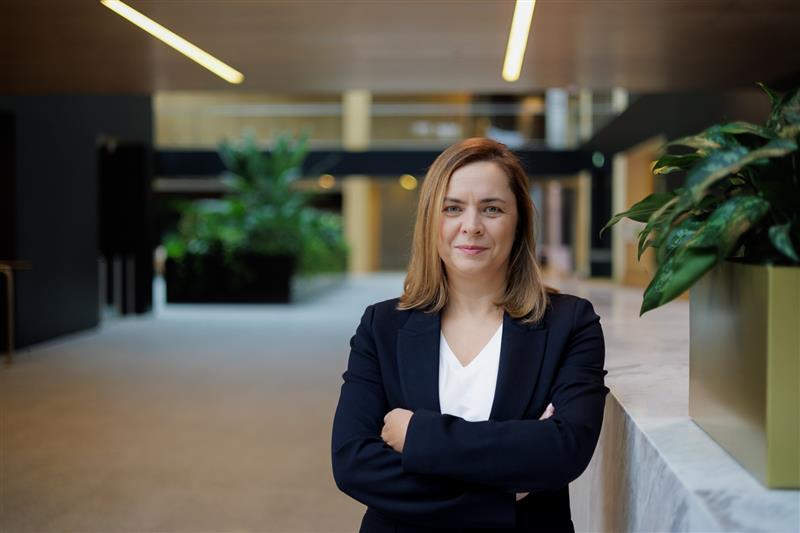
Technology will not replace a bank employee, but it will significantly improve its operations and allow it to offer customers services at a completely new level, argues Marta Mróz-Sipiora, responsible for the international development of the banking offer at Asseco Poland, in an interview with Bankier.pl. He also talks about how artificial intelligence can influence banking processes, from credit decisions, through customer service, to security, and what is the main obstacle to innovation in banking and payments today.
The modern banking sector is experiencing a dynamic technological transformation, and artificial intelligence plays one of the key roles. According to our interlocutor, it has the potential to radically speed up decision-making processes, especially regarding credit areas or the processes themselves.
– Artificial intelligence systems can analyze data from many sources, creating a loan proposal almost immediately – he says Marta Mróz-Sipiora, director of global development and innovation at Asseco Poland.
Faster decisions and better tailored offers
It describes how AI can support this process. – Artificial intelligence collects information about the customer available in banking systems and in external systems, where the bank customer has obviously consented to the processing of his data, analyzing his transaction history or card payments. Based on these behaviors, the system automatically prepares an offer proposal, he says. However, this will not result in automatic granting of a loan. – The bank cannot fully rely on the machine. EU regulations require full transparency: the bank must be able to explain to the customer where the credit decision came from. It is necessary to justify why, for example, PLN 50,000 was awarded. or 100 thousand PLN and why the interest rate was X and not Y – explains the manager of Asseco Poland.
He emphasizes that streamlining credit processes is of great importance, especially for entrepreneurs. – In the era of dynamic technological development, the credit decision-making process for the SME sector could be significantly more optimized, both in terms of time and the quality of risk assessment. For smaller companies, access to a credit limit can be a decisive factor in maintaining liquidity at critical times, and, consequently, even “to be or not to be” on the market – he emphasizes.
Another area where artificial intelligence will be more widely used is the personalization of offers in retail banking. As Mróz-Sipiora explains, today banks analyze the behavior of groups of customers, not a specific John Kowalski, which, although it ensures speed, does not provide an offer perfectly tailored to the individual.
According to the Asseco representative, however, we are on the threshold of change. – The immediate prospect for the sector is hyper-personalization, i.e. moving away from offers for the entire group of similar customers to offers addressed to one specific recipient. However, for this scenario to come true, financial institutions need to do their homework. The key to success is structuring the data held by banks. This is a priority task for banks, he emphasizes.
Digital Ranger
To understand the potential of hyper-personalization, you need to look at the numbers. Banking systems collect a lot of data points about one customer: from transaction history, through purchasing preferences, to metadata about the devices we use. This is a powerful set of data that, when properly processed, allows you to build an extremely precise consumer profile.
– Banks today have very extensive knowledge about their clients – emphasizes the expert. – This automatically means the need for equally high responsibility for the way in which this information is used. They remain public trust institutions, and customers can be sure that their funds and data are safe and professionally managed.
Today, this protection is increasingly due to algorithms. Artificial intelligence finds key applications in the “digital back office” of banks – in the fight against cyber threats and anti-money laundering (AML). This is an area of transformation that, although invisible to the client, is the foundation of trading security. – Artificial intelligence can help banks integrate appropriate models into their systems to support the fight against money laundering and cybercrime – emphasizes Mróz-Sipiora.
How to make a chatbot not frustrating
One of the first areas in which bank customers encountered AI en masse are chatbots – solutions that improve contact with the bank, provide quick answers and relieve the hotline.
According to Marta Mróz-Sipiora, the problems with chatbots do not lie in the technology itself, but in the approach to its maintenance: banks often implement chatbots with ready-made conversation scenarios, but do not always ensure their systematic, ongoing optimization. – When, after implementation, a more difficult question arises for which the bot has no answer and the client goes to a consultant, it is a clear signal for the bank to verify and update the scenario. This is the only way the chatbot really learns from interactions and improves the quality of service from month to month – emphasizes the expert.
Customers are forced to go through long paths of even several dozen questions instead of two specific ones, only to end up with a hotline employee anyway. This causes dissatisfaction, which in extreme cases may result in the customer leaving for the competition.
The expert suggests a solution – banks should constantly monitor interactions with customers and periodically implement corrected or completely new scenarios. The process of supplementing chatbots' knowledge should be radically accelerated so that customers have a good experience with them.
Embedded finances and the “wallet on wheels”
Looking at technological development in finance, the so-called embedded finance. Although the trend started with enriching banking applications with simple services – such as tickets or parking fees – over time it reached much further. Today, embedded finance involves integrating payments with external ecosystems so closely that they become almost transparent to the user.
Proof of this change are solutions already being tested that are intended to make payments completely maintenance-free. Marta Mróz-Sipiora points to systems that connect a bank account directly with a car license plate as an example. – You drive to the station, fill up and drive away, almost like in Formula 1 – explains the expert. The system works in the background – the green light at the dispenser means that the payment has been collected automatically, which completely eliminates the need to visit the cash register or even reach for your smartphone to pay with the app.
But the “wallet on wheels” applies not only to the gas station. – Let's imagine a situation in which, driving past a multiplex, children persuade their parents to watch a screening. This is already available in some car brands. You can order a cinema ticket here and now from the panel in the car, as well as make a payment – explains Marta Mróz-Sipiora.
These are examples of the fact that we will increasingly use banking without smartphones. The future belongs to an ecosystem in which payments will be made in the background by a network of connected devices. – We are talking about all devices that will be integrated directly with the central payment system and settlements – explains the expert.
A major obstacle to innovation
As he emphasizes, innovations must go hand in hand with legislative changes. In European Union countries, it is impossible to implement solutions such as in China, where you can already pay in stores using biometrics, e.g. face scanning. – We cannot offer banks an innovative solution that would be inconsistent with current regulations. The development of technology must always be supported by regulations and we pay special attention to this, emphasizes the manager. He adds that excessive and frequently changing regulations are a challenge for the banking sector.
Marta Mróz-Sipiora sees no reason to fear that the development of technology, including artificial intelligence, will negatively affect the labor market in banking. – Will AI replace a bank employee? NO. Will AI improve the work of a bank employee? Yes, and it is obvious to us. However, it is crucial that employees have appropriate competences and knowledge to make the best use of solutions based on technologies and artificial intelligence – emphasizes the Asseco Poland expert.
The Asseco Group is the leader in banking digitization in Poland, serving over half of the domestic market. It also dominates this sector in Southeastern Europe and is developing dynamically in Africa, building a strong position, among others. in Angola and Mozambique. It is the financial sector – including banking, insurance and payments – that remains an important driving force of Asseco's revenues today.