Russians test 'spy pigeons' controlled by brain chips. Putin's biodrones raise dark questions about ethics and militarization


In Vladimir Putin's Russia, dystopian fantasies are slowly becoming publicly funded research projects. A neurotech company close to the Kremlin claims it can turn ordinary pigeons into “biodrones” – birds controlled by chips implanted in their brains, controlled remotely like military drones.
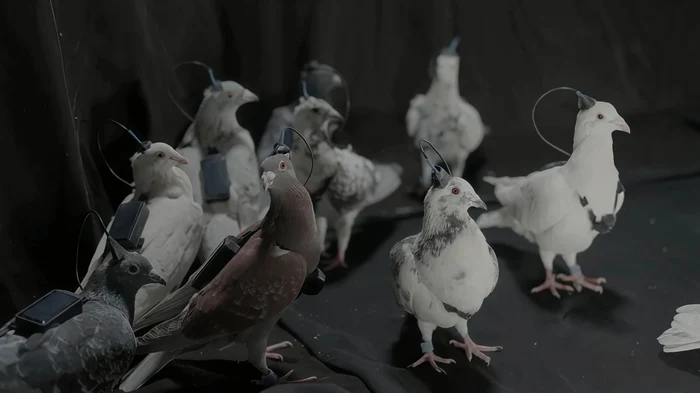
Pigeons with a brain chip/PHOTO: X
Neiry, the firm in the Moscow high-tech ecosystem, boasts that its operators can guide entire flocks “at will”. Behind the bombastic statements is PJN-1, the code name for some surgically modified pigeons: their brains contain electrodes inserted with “millimeter” precision, through which technicians send impulses that force the bird to turn left, right or continue on a certain trajectory.
According to the company, the birds “think they want to fly” in the prescribed direction. This while carrying a solar mini-backpack on his back, with GPS, command receiver and a neural stimulator connected directly to the implant, writes the daily Mail.
Pigeons with chips, seagulls for coasting, crows for heavier loads
The founder of the company, Aleksander Panov, does not hide his ambitions: if the pigeons behave well, other species will follow. Ravens for transport, seagulls for coastal monitoring, albatrosses for sea routes. All without training periods, the company claims. After the operation, the animal becomes “controllable”.
Neiry, however, avoids specifying how many birds died during the experiments. It just says it “aims for a 100% survival rate”.
From civilian monitoring to military use
Officially, biodrones could be used for environmental monitoring, industrial inspections or search and rescue operations. Unofficially, they can become ideal tools in intelligence: ordinary, anonymous birds that get lost in the urban landscape. Cameras mounted on them can collect images without arousing suspicion, including in conflict zones such as Ukraine.
The firm describes the PJN-1 as almost identical to a regular pigeon, “just with the neuro-interface wire coming out of the head and the electronic backpack.”
The risks are minimized: falls “do not exceed the natural probability of a bird falling from the sky”. The system works with GPS and altimetry, and neural stimulation adjusts the bird's “motivation” to turn in one direction or another.
A controversial company, but well anchored in the Kremlin structures
Neiry is not the first scandal. He has drawn criticism in the past for experiments on cows, trying to manipulate the animals' brain reactions to increase milk production.
But the firm's political influence remains solid. It benefits from NTI funds, from investments connected to the Russian Sovereign Fund (RDIF), led by Kirill Dmitriev – a close associate of Putin, involved in negotiations with the US regarding the conflict in Ukraine. Neiry is also part of the Skolkovo hub, dubbed the Russian Silicon Valley, a massive state-backed project.
Repeated history: from USSR military dolphins to chip birds
The program with neurally controlled pigeons is reminiscent of the old Soviet experiments with military dolphins. Back then, marine mammals were trained to patrol, detect diver-saboteurs and even carry underwater weapons. Today, “biotechnology” is only wearing new clothes.
Essentially, Russia is extending the same military logic: using animals for war or surveillance tasks, only moving from training to direct brain control.