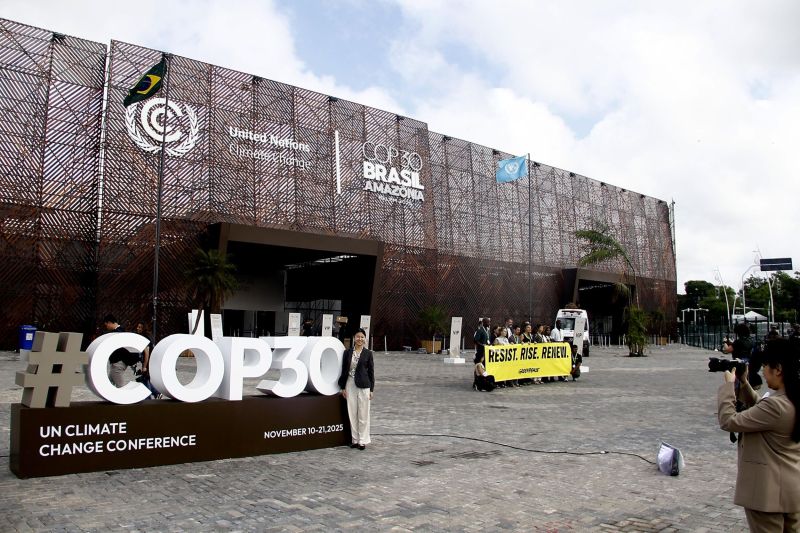
Pavilion at COP30, Belem, Brazil (source Igor Mota / Zuma Press / Profimedia)
The great COP30 climate summit in Brazil has ended, but the final plenary was prolonged for many hours, with tense interventions, repeated interruptions and procedural requests that delayed the adoption of decisions, an InfoClima.ro analysis says.
The final decision of COP30 does NOT include the formulation of a fundamental theme, that of “fossil fuel phasing out” as a negotiated commitment. But there remain a number of gains and clarifications on several topics.
A mechanism designed to annually track progress on national climate plans, adaptation and transparency reporting was also launched at COP 30.
The analysis on InfoClima.ro is signed by Elena-Alexandra Miron who was present at the last four COP summits. She has experience in climate governance, green transition and climate diplomacy.
Fossil fuel phase-out controversies
Even before Belém it was clear that a firm agreement on the phase-out of fossil fuels was unlikely. Global economic dependence on oil, gas and coal continues to block real consensus.
COP30 brought a rare moment of convergence because:
- more than 80 countries supported Brazil's proposal for a global roadmap
- Northern and Southern states spoke with one voice
- several Latin American, African and European governments have insisted on the need for global coordination to maintain the 1.5°C limit
However, the process did not progress. Major oil-producing states have rejected the idea of launching a global phase-out framework, citing the autonomy of national rhythms.
The only step forward remains the COP30 Presidency's announcement of a “roadmap” coordinated by Brazil, a science-based consultative process that will continue until COP32. This is, for now, a policy framework, NOT a requirement.
Romania at COP30
The Romanian delegation at COP30 was led by the Minister of Environment, Water and Forests, Diana Buzoianu. In Romania's official intervention in the high-level segment, Diana Buzoianu emphasized the direct impact of climate change on vulnerable communities in the country and the need to protect people. Romania still supports the objective of 1.5 degrees as the critical limit between a manageable future and irreversible losses.
The European Union entered COP30 with the objective of keeping the global trajectory within 1.5 degrees and maintaining pressure for the effective implementation of existing commitments. The EU's position was one of the most coherent and technical in the plenary.
Only partial clarifications for the international financing chapter
Funding was one of the most sensitive topics of the conference. Although COP29 had established a new collective global funding target, the NCQG, its structure remained incomplete.
COP30 only partially clarified the directions:
- the goal of tripling adaptation funding by 2035 was set.
- no reference year was defined
- no new sources of funding appeared
- Global South countries' applications for grants and equitable access remain open
COP30 did not change the global direction
The analysis predicted that COP30 will be a conference of clarifications, not major transformations.
COP30 did not change the global direction, but it provided the minimum necessary framework to evaluate what is working and where much firmer interventions are needed, the article on InfoClima.ro also says.
The recently concluded summit can be seen as a calibration stage, where the global climate process has become more transparent about its own limits and the directions in which it needs strengthening.
The COP31 summit will take place in Antalya, Turkey,